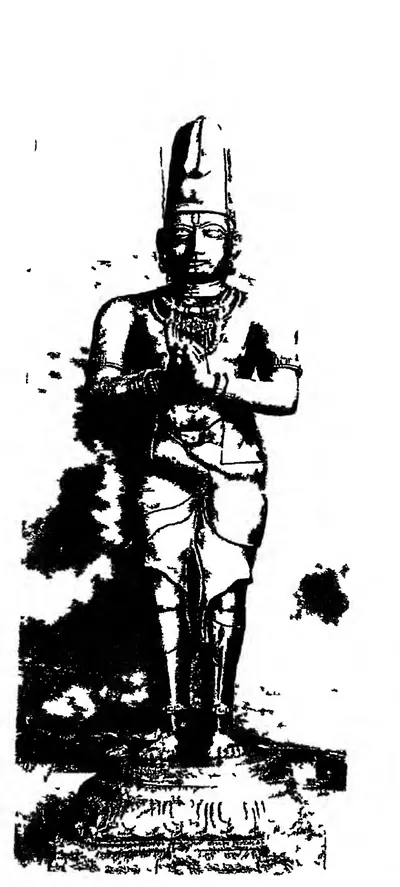
Sriranga II (Vijayanagara)
Sriranga II, called Chikka Raya, was a nephew of Venkatapati, who adopted him and on his deathbed in 1614 gave him the ring of state. He reigned only a few months. Jagga Raya, the father of one of the old king's queens, wanted the queen's supposed son on the throne, and seized the fort of Chandragiri with other nobles. Sriranga was imprisoned and, after failed rescue attempts, forced to kill himself and his family. One son, Rama, was smuggled out and saved by the loyal chief Yachama Nayaka, and a civil war followed.
Download
Sriranga II, called Chikka Raya, was king of Vijayanagara for a few months in 1614.12 His uncle, King Venkatapati, chose him as heir over the queen’s supposed son.32 A group of nobles led by Jagga Raya rose against him at Chandragiri. They killed him and nearly all his family.456 The civil war that followed broke the empire into two camps.6 See Vijayanagara and Venkatapati II.
Family
The Sanskrit commentary Srutiranjani says that Venkatapati’s brother Rama married Narasingama and had two sons, Tirumala and Sriranga.7 S. Krishnaswami Aiyangar wrote that Sriranga was the second son of Rama, and the younger brother of the viceroy of Srirangapatna (then Seringapatam).6
The Telugu Ramarajiyamu says that Venkatapati adopted Sriranga, also called Chikka Raya, and anointed him Yuvaraja (crown prince).8 It says that Chikka Raya married Obamma, the daughter of Jillella Narasimha, and that their son was Rama Deva Raya.8 Chikka Raya means “little king”, the name always given to the heir to the throne.3
The ring of state
The Jesuit Manuel Barradas wrote from Cochin in December 1616 about what had happened at Chandragiri.9 He says that Venkatapati’s queen Bayama, a daughter of Jagga Raya, had no son.3 So, Barradas says, she passed off a Brahman woman’s baby as her own.3 The king knew the truth, and never treated the boy as his son.3
Three days before his death, the old king called his nephew Chikka Raya before the nobles.32 He held out his right hand with the ring of state, so that the nephew should take it and rule after him.32 The nephew wept and twice begged to be excused, but at last he took the ring.2 The king also gave him his royal robe, the great diamond from his ear and his pearls, and Chikka Raya was proclaimed king.2
The rising of Jagga Raya
The old king died three days later, aged sixty-seven.2 Most of the captains came to swear loyalty to the new king, but three refused: Jagga Raya, Timma Nayaka and Maka Raya.2 They swore instead to crown the queen’s supposed son.2
The new king soon angered three more of his nobles.4 One was his commander-in-chief (dalavay), whom he asked to give up three forts for his own sons. Another was his minister, whom he accused of theft.4 These men plotted with Jagga Raya.4 The conspirators came to Chandragiri as if to do homage, brought thousands of their men inside the fort, and seized its gates.4 The king surrendered on a promise that he would not be harmed.410 Jagga Raya then crowned his grandson and took the palace treasure.10
Death
Only one captain, Yachama Nayaka, refused to join Jagga Raya.10 He bribed the washerman who took clean clothes to the imprisoned king.10 The washerman carried out the king’s second son, a boy of twelve, hidden under dirty clothes.10 Yachama Nayaka’s soldiers then dug a tunnel to the king’s room, but the guards found it just as the king was climbing into it.115 A second attempt, by a captain inside the fort, also failed.5
After this, Barradas says, Jagga Raya decided to kill the king and all his family.5 His brother told the king that he must kill himself, or be stabbed to death.5 The king killed his wife, his youngest son and a little daughter, and then threw himself on his sword.5 His eldest son killed his own wife and then himself.5 One remaining little daughter was killed by Jagga Raya’s brother.12
What followed
The boy who had escaped was Rama.68 Krishnaswami Aiyangar wrote that Yachama Nayaka was the founder of the Venkatagiri family.6 Barradas says that Yachama Nayaka defeated Jagga Raya’s much larger army, found the old king’s royal insignia in his tents, and proclaimed the boy king.12 The war went on, with the Nayaka of Madurai on Jagga Raya’s side and the Nayaka of Thanjavur (then Tanjore) on the young king’s.13
Krishnaswami Aiyangar wrote that Raghunatha Nayaka of Thanjavur defeated the rebels at Topur, near the Grand Anicut.6 Jagga Raya fell in the battle, and the young prince was raised to the throne as Rama II.6 See Raghunatha Nayaka and Chandragiri.
Where the sources disagree
- Jagga Raya’s relation to the old king. Barradas makes Queen Bayama a daughter of Jagga Raya.3 Krishnaswami Aiyangar wrote that Jagga Raya was either the brother-in-law or the father-in-law of Venkatapati.6
- The queen’s son. Barradas says that the boy was a Brahman woman’s child, passed off as the queen’s.3 Krishnaswami Aiyangar wrote that the queen “pretended to have a son”, and that Venkatapati was perhaps aware of the truth.6
- His number. Sewell (1900) thought that Chikka Raya might be the king he numbered Ranga III.93 Sewell’s later work calls him Sriranga II.1
- The date. Sewell’s later work marks the year of the murder as 1614 with a question mark.1 It relies on Barradas’s account for the events.14
Footnotes
-
Robert Sewell, ed. S. Krishnaswami Aiyangar, The Historical Inscriptions of Southern India (1932), p. 402, pedigree of the Aravidu dynasty (archive.org (opens in a new tab)). ↩ ↩2 ↩3
-
Barradas, in Sewell, A Forgotten Empire (1900), p. 224 (archive.org (opens in a new tab)). ↩ ↩2 ↩3 ↩4 ↩5 ↩6 ↩7 ↩8 ↩9
-
Barradas, in Sewell, A Forgotten Empire (1900), p. 223 and notes (archive.org (opens in a new tab)). ↩ ↩2 ↩3 ↩4 ↩5 ↩6 ↩7 ↩8 ↩9 ↩10
-
Barradas, in Sewell, A Forgotten Empire (1900), p. 225 (archive.org (opens in a new tab)). ↩ ↩2 ↩3 ↩4 ↩5 ↩6
-
Barradas, in Sewell, A Forgotten Empire (1900), p. 228 (archive.org (opens in a new tab)). ↩ ↩2 ↩3 ↩4 ↩5 ↩6 ↩7
-
S. Krishnaswami Aiyangar (ed.), Sources of Vijayanagar History (1919), introduction, p. 20 (archive.org (opens in a new tab)). ↩ ↩2 ↩3 ↩4 ↩5 ↩6 ↩7 ↩8 ↩9
-
Krishnaswami Aiyangar, Sources of Vijayanagar History (1919), p. 213, extract 64, the Srutiranjani (archive.org (opens in a new tab)). ↩
-
Krishnaswami Aiyangar, Sources of Vijayanagar History (1919), p. 244, the Ramarajiyamu (archive.org (opens in a new tab)). ↩ ↩2 ↩3
-
Robert Sewell, A Forgotten Empire (Vijayanagar) (1900), p. 222 and notes, the letter of Manuel Barradas (archive.org (opens in a new tab)). ↩ ↩2
-
Barradas, in Sewell, A Forgotten Empire (1900), p. 226 (archive.org (opens in a new tab)). ↩ ↩2 ↩3 ↩4 ↩5
-
Barradas, in Sewell, A Forgotten Empire (1900), p. 227 (archive.org (opens in a new tab)). ↩
-
Barradas, in Sewell, A Forgotten Empire (1900), p. 229 (archive.org (opens in a new tab)). ↩ ↩2
-
Barradas, in Sewell, A Forgotten Empire (1900), p. 230 (archive.org (opens in a new tab)). ↩
-
Sewell, Historical Inscriptions (1932), p. 404, notes to the pedigrees (archive.org (opens in a new tab)). ↩
Related
Dynasties
References
Notes (0)
Sources (3)
Spotted an error on this page? Tell us
Last updated: