Racha Vema Reddi
Racha Vema was the last king of the Reddis of Kondavidu, in the early 1420s. He was the son of Peda Komati Vema and his queen Suramba. No grant of his reign was known to the historians of the Reddis, and later chronicles remember him as a harsh ruler who reigned four years and was murdered. In his time Vijayanagara and the Gajapatis of Orissa pressed on the kingdom, and it came to an end.
Download
Racha Vema was the last king of the Reddis of Kondavidu. This Reddi family had its seat in the hill fort of Kondaveedu.1 Racha Vema followed his father Peda Komati Vema about 1420 and ruled for only about four years.23 By the end of his short reign the kingdom had fallen.4 Somasekhara Sarma counted about a hundred years for the whole dynasty.5
Family
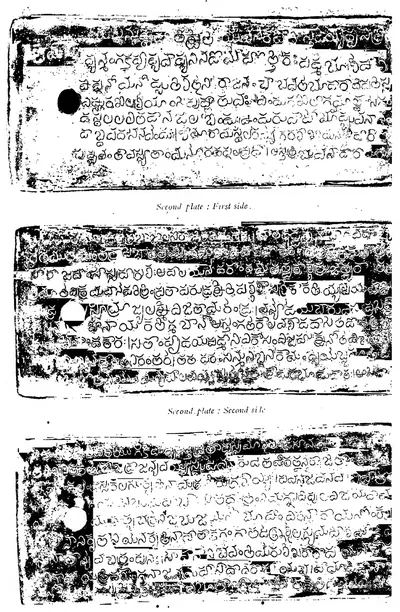
His father was Peda Komati Vema, and his mother was Suramba.63 In his edition of the Madras Museum plates of Vema, J. Ramayya showed that Racha Vema was Peda Komati Vema’s son, not his brother.7 His proof was a short Telugu verse inscription near Aminabad, which adjoins Phirangipuram.7 At its end are the words “Srinatha’s composition”.7
This inscription says that Racha Vema, son of Vema, dug a channel in Saka 1337 (1415) to feed the tank Santana-sagara.7 Saka is an Indian way of counting years. His mother Suramba had built the tank.7 A pillar inscription at Phirangipuram records the same tank, and says that Suramba was a daughter of King Ganna of Dhanyavati, that is Dharanikota.78 See Amaravati–Dharanikota.
A short and hard reign
The Dandakavili, a verse chronicle of the dynasty, gave Racha Vema the years Saka 1338 to 1341, as Ramayya reported it.7 Ramayya kept the same four years in his own list.7 N. Ramesan (1962) gave him the years 1420 to 1424.2
The chronicles and the village histories (kaifiyats) say that he ruled for four years and treated his people cruelly.63 Somasekhara Sarma adds that, in their account, he laid new taxes and collected them harshly.6 He found no records of Racha Vema’s own reign.6 He gave the Aminabad channel of 1415 to the reign of the father.6
Strong neighbours pressed on the weakened kingdom. The village histories say that a Langula Gajapati of Kalinga overran the coast in Saka 1342 (1420).6 Somasekhara Sarma found no inscription to confirm this.6 But he noted a record of the Vijayanagara king at Potturu, a village near Kondavidu, dated about 1420.65 Ramesan wrote that the oppressed people gave Racha Vema little help against these invasions, so he was probably overthrown.34
His death
The Kistna district manual (1883) says that Racha Vema, “after an evil reign of four years was assassinated by a peon named Choudari Yellappa in 1428”.1 Somasekhara Sarma knew the same story of a murder by one of his subjects. He found no evidence to support it.5
A Kondavidu chronicle summarised by Robert Sewell in 1884 makes a Langala Gajapati succeed Racha Vema.9 It says that this Gajapati ruled from 1420 to 1431.9 Sewell’s own list ends the dynasty with an overthrow “by the Muhammadans in A.D. 1427”.10
Where the sources disagree
- His father. The Kistna manual makes him a son of Komaragiri Reddi.1 The Dandakavili, as Ramayya reported it, made him Peda Komati Vema’s brother.7 Ramayya showed from the Aminabad inscription that he was Peda Komati Vema’s son.7
- His records. Somasekhara Sarma (1948) and Ramesan (1962) knew no record of his reign.63 The epigraphy report for 1932–33 described a damaged Telugu verse inscription at Vemavaram, in the Sattenapalle taluk, as belonging to Racha Vema.11 It names “Vemaya Racha-Vema” and his mother Suramba, but the last digit of its date is lost.11 The report placed it near the Aminabad inscription of Saka 133[7], which it also called the king’s own, and took both to be Srinatha’s work.11
- His dates. The Dandakavili gives Saka 1338 to 1341.7 Ramesan gives 1420 to 1424.2 The Kistna manual dates his accession to 1424 and his death to 1428.1 Sewell’s list of 1884 gives him 1423 to 1427.10
- Two men of the name. The 1932–33 report warned that this king was not the Racha Vema of a record of Saka 1320, a son of Pina-Komati.12
Footnotes
-
Gordon Mackenzie, A Manual of the Kistna District in the Presidency of Madras (1883), p. 10 (archive.org (opens in a new tab)). ↩ ↩2 ↩3 ↩4
-
N. Ramesan, Copper Plate Inscriptions of Andhra Pradesh Government Museum, Hyderabad, Vol. I (1962), p. 165, table of the Kondavidu kings (archive.org (opens in a new tab)). ↩ ↩2 ↩3
-
Ramesan, Copper Plate Inscriptions, Vol. I (1962), p. 170 (archive.org (opens in a new tab)). ↩ ↩2 ↩3 ↩4 ↩5
-
Ramesan, Copper Plate Inscriptions, Vol. I (1962), p. 171 (archive.org (opens in a new tab)). ↩ ↩2
-
Somasekhara Sarma, History of the Reddi Kingdoms (1948), p. 171 (archive.org (opens in a new tab)). Cite-only; paraphrased. ↩ ↩2 ↩3
-
M. Somasekhara Sarma, History of the Reddi Kingdoms (circa 1325 A.D. to circa 1448 A.D.) (1948), p. 170 (archive.org (opens in a new tab)). Cite-only; paraphrased. ↩ ↩2 ↩3 ↩4 ↩5 ↩6 ↩7 ↩8 ↩9
-
J. Ramayya, “Madras Museum Plates of Vema”, Epigraphia Indica VIII (1905–06), p. 13 and notes (archive.org (opens in a new tab)). ↩ ↩2 ↩3 ↩4 ↩5 ↩6 ↩7 ↩8 ↩9 ↩10 ↩11
-
J. Ramayya, “Three Inscriptions of the Reddis of Kondavidu”, Epigraphia Indica XI (1911–12), p. 315 (archive.org (opens in a new tab)). ↩
-
Sewell, Lists of Inscriptions (1884), p. 188 (archive.org (opens in a new tab)). ↩ ↩2
-
Robert Sewell, Lists of Inscriptions, and Sketch of the Dynasties of Southern India (Lists of Antiquarian Remains, Vol. II, 1884), p. 187 (archive.org (opens in a new tab)). ↩ ↩2
-
Annual Report on South-Indian Epigraphy for the Year ending 31st March 1933 (1936), Part II, para. 20, p. 63 (archive.org (opens in a new tab)). Paraphrased. ↩ ↩2 ↩3
-
Annual Report on South-Indian Epigraphy, 1932–33 (1936), Part II, para. 20, p. 64 (archive.org (opens in a new tab)). Paraphrased. ↩
Related
Dynasties
References
Notes (0)
Sources (7)
Spotted an error on this page? Tell us
Last updated: