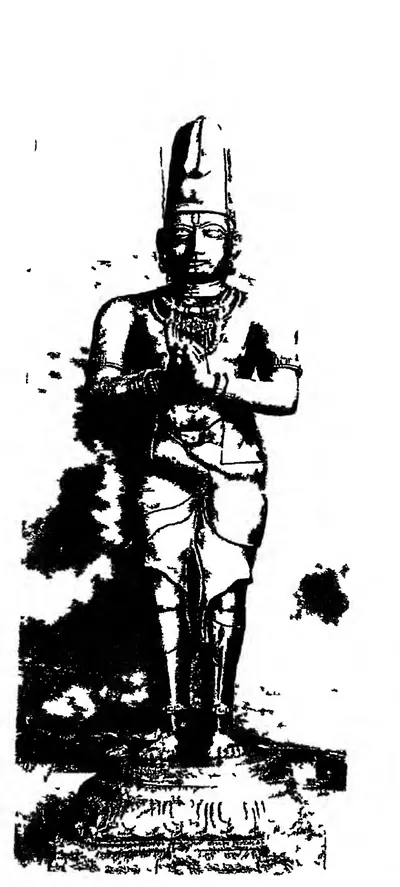
Rama Deva Raya
Rama Deva Raya, called Rama II by Sewell, was king of Vijayanagara from 1614 to 1630. He was the son of Sriranga II and the only one of his family to escape the massacre at Chandragiri, smuggled out as a boy by the loyal chief Yachama Nayaka. Raghunatha Nayaka of Thanjavur won the battle of Toppur for him. For most of his reign his great chiefs fought one another, while famine struck the coast. His records run from Mysore and Kurnool to Madurai until 1630, the year of his death.
Download
Rama Deva Raya was king of Vijayanagara from 1614 to 1630.12 Robert Sewell calls him Rama II.1 He was the only one of his family to survive the massacre of 1614 at Chandragiri, and he came to the throne in the middle of a civil war.34 For most of his reign the great chiefs fought over the empire, while famine struck the coast.56
Escape from Chandragiri
The Telugu poem Ramarajiyamu, as S. Krishnaswami Aiyangar summarised it, makes Rama Deva Raya the son of Chikka Raya, that is Sriranga II, and his wife Obamma.7 In 1614 a party of nobles led by Jagga Raya rose against Sriranga and held him prisoner at Chandragiri.1
The Jesuit Manuel Barradas tells how the boy escaped. Only one captain, Yachama Nayaka, stayed loyal to the king.3 He bribed the washerman who took clean clothes to the prisoner.3 The washerman carried out the king’s second son, a boy of twelve, hidden under dirty clothes.3
Soon after, Jagga Raya’s men forced Sriranga to kill his family and himself.8 Sewell worked out that the king died after 10 October and before 6 November 1614, when Rama II was already king.1 Krishnaswami Aiyangar wrote that Yachama Nayaka was the founder of the Venkatagiri family.4
The battle of Toppur
Barradas says that Yachama Nayaka defeated Jagga Raya’s much larger army.9 In Jagga Raya’s tents he found the royal insignia, and he proclaimed the boy king.9 But the war went on.10 The Nayaka of Madurai took Jagga Raya’s side, and the Nayaka of Thanjavur took the young king’s.10 In December 1616 Barradas wrote that vast armies faced each other on the plains of Tiruchirappalli (then Trichinopoly).11
Krishnaswami Aiyangar told how it ended. Yachama Nayaka retreated with the prince to the court of Thanjavur.4 Raghunatha Nayaka met the rebels at Toppur, not far from the Grand Anicut on the Kaveri, and defeated them completely.4 Jagga Raya fell in the battle, and the prince was raised to the throne as Rama II.4 In his History of Tirupati, Krishnaswami Aiyangar thought the new king was then about ten or twelve years old.12 See Raghunatha Nayaka.
A divided empire
Toppur did not end the war.13 Krishnaswami Aiyangar wrote that Jagga Raya’s followers still held most of the east coast, down to Pulicat.12 Their leader was his brother Yatiraja.5 Yachama Nayaka acted as the king’s guardian and fought to win back the empire’s lands.5 Krishnaswami Aiyangar placed these campaigns between 1618 and 1620.14 The sultans on the northern frontier also took advantage of the empire’s trouble.13
English and Dutch traders on the coast described the misery of these years.56 The traveller William Methwold wrote of civil war and a famine so severe that parents sold their children at the seaside for a little rice.5 In time Yatiraja became Rama’s father-in-law, the father of his second wife.6 Rama was then hardly seventeen or eighteen, in Krishnaswami Aiyangar’s estimate, and his position was uncertain.6 In 1622 he named two relatives as heirs in case anything happened to him.615 They were a grandson and a great-grandson of Aliya Rama Raya, the regent who fell in 1565.15
Where he was obeyed
Sewell’s year-by-year list of inscriptions shows where Rama was recognised as king:
- Mysore in 1617, where he is called Ramachandra11
- North Arcot in 162016
- Coimbatore and Kurnool in 162216
- Penukonda in 162316
- Kurnool again in 1624, and Chingleput in 162517
- Mysore and Anantapur in 1626 and 162817
- east Mysore and Madurai in 162917
A grant of 1620 from the Coimbatore district names “Vira Ramadeva, then ruling at Penukonda”, as the overlord of an agent of the Madurai Nayaka.18 The editor of the History of the Nayaks of Madura, Krishnaswami Aiyangar, saw this as a sign of the donor’s loyalty to the empire.18
Last years
A letter of the English traders in August 1629 reported that the king had at last won back nearly all his lands.15 Krishnaswami Aiyangar took this to mean that Rama had finally mastered his chiefs.19 But in 1630 a terrible famine struck the Deccan and the coast.19
Rama’s last record, from south-east Mysore, is dated April 1630.2 Sewell wrote that he seems to have died during that year, and that Pedda Venkata, a grandson of Aliya Rama Raya, succeeded him.2 Krishnaswami Aiyangar thought that the two heirs Rama had named then quarrelled over the throne.20
Where the sources disagree
- When he became king. Sewell has Rama II already king by 6 November 1614.1 In his History of Tirupati, Krishnaswami Aiyangar thought Rama could have succeeded only in name in 1616, after Toppur.14
- The date of Toppur. The battle report in the Raghunathabhyudayam is dated in the month Ashadha of the cyclic year Nala.21 Krishnaswami Aiyangar converted this to 1617–18 in 1919.21 In his notes of 1924 he gave August–September of 1616–17.22
- His age. Barradas makes him a boy of twelve at his escape in 1614.3 Krishnaswami Aiyangar thought he was about ten or twelve when he was put on the throne after Toppur.12
Footnotes
-
Robert Sewell, ed. S. Krishnaswami Aiyangar, The Historical Inscriptions of Southern India (1932), p. 271 (archive.org (opens in a new tab)). ↩ ↩2 ↩3 ↩4 ↩5
-
Sewell, Historical Inscriptions (1932), p. 275 (archive.org (opens in a new tab)). ↩ ↩2 ↩3
-
Barradas, in Robert Sewell, A Forgotten Empire (Vijayanagar) (1900), p. 226 (archive.org (opens in a new tab)). ↩ ↩2 ↩3 ↩4 ↩5
-
S. Krishnaswami Aiyangar (ed.), Sources of Vijayanagar History (1919), introduction, p. 20 (archive.org (opens in a new tab)). ↩ ↩2 ↩3 ↩4 ↩5
-
Krishnaswami Aiyangar, History of Tirupati, Vol. II (1941), p. 341 (archive.org (opens in a new tab)). Cite-only; paraphrased. ↩ ↩2 ↩3 ↩4 ↩5
-
Krishnaswami Aiyangar, History of Tirupati, Vol. II (1941), p. 346 (archive.org (opens in a new tab)). Cite-only; paraphrased. ↩ ↩2 ↩3 ↩4 ↩5
-
Krishnaswami Aiyangar, Sources of Vijayanagar History (1919), p. 244, the Ramarajiyamu (archive.org (opens in a new tab)). ↩
-
Barradas, in Sewell, A Forgotten Empire (1900), p. 228 (archive.org (opens in a new tab)). ↩
-
Barradas, in Sewell, A Forgotten Empire (1900), p. 229 (archive.org (opens in a new tab)). ↩ ↩2
-
Barradas, in Sewell, A Forgotten Empire (1900), p. 230 (archive.org (opens in a new tab)). ↩ ↩2
-
Sewell, Historical Inscriptions (1932), p. 272 (archive.org (opens in a new tab)). ↩ ↩2
-
S. Krishnaswami Aiyangar, A History of Tirupati, Vol. II (1941), p. 340 (archive.org (opens in a new tab)). Cite-only; paraphrased. ↩ ↩2 ↩3
-
Krishnaswami Aiyangar, Sources of Vijayanagar History (1919), introduction, p. 21 (archive.org (opens in a new tab)). ↩ ↩2
-
Krishnaswami Aiyangar, History of Tirupati, Vol. II (1941), p. 342 (archive.org (opens in a new tab)). Cite-only; paraphrased. ↩ ↩2
-
Krishnaswami Aiyangar, History of Tirupati, Vol. II (1941), p. 347 (archive.org (opens in a new tab)). Cite-only; paraphrased. ↩ ↩2 ↩3
-
Sewell, Historical Inscriptions (1932), p. 273 (archive.org (opens in a new tab)). ↩ ↩2 ↩3
-
Sewell, Historical Inscriptions (1932), p. 274 (archive.org (opens in a new tab)). ↩ ↩2 ↩3
-
R. Sathyanatha Aiyar, History of the Nayaks of Madura, ed. S. Krishnaswami Aiyangar (1924), p. 72 and editor’s note 5 (archive.org (opens in a new tab)). ↩ ↩2
-
Krishnaswami Aiyangar, History of Tirupati, Vol. II (1941), p. 348 (archive.org (opens in a new tab)). Cite-only; paraphrased. ↩ ↩2
-
Krishnaswami Aiyangar, History of Tirupati, Vol. II (1941), p. 349 (archive.org (opens in a new tab)). Cite-only; paraphrased. ↩
-
Krishnaswami Aiyangar, Sources of Vijayanagar History (1919), p. 259, extract 86 (archive.org (opens in a new tab)). ↩ ↩2
-
Sathyanatha Aiyar, History of the Nayaks of Madura (1924), p. 76, editor’s note (archive.org (opens in a new tab)). ↩
Related
Dynasties
References
Notes (0)
Sources (5)
Spotted an error on this page? Tell us
Last updated: