Tala II
Eastern Chalukya prince of the junior line, also called Vishnuvardhana, son of Yuddhamalla II and younger brother of Badapa. His only known grant, the Sripundi plates, made 'during the period of his rule', gives a small village in the Velanandu district to a minister whose father had died in his service. Its seal reads Tribhuvanasimha instead of the family's Tribhuvanankusa. This led both its editors to doubt that he ruled from the throne of Vengi.
Tala II, also called Vishnuvardhana, was a prince of the junior branch of the Eastern Chalukyas.12 He is known only from his own grant, the Sripundi plates.12 The plates were registered in 1908–09 and edited by K. V. Lakshmana Rao in 1928.12
Family
Tala II, also called Vishnuvardhana, was a son of Yuddhamalla II and the younger brother of Badapa.31 His grant lists the family as “Bhima’s younger brother Talabhupala; his son Sri Yuddhamalla; his son Maharajadhiraja Paramesvara Badapa; his younger brother Vishnuvardhana Talabhupala”.3 The 1921 epigraphy report also called Tala II the younger brother of Badapa.4 See Yuddhamalla II and Badapa.
He is numbered Tala II because his grandfather, the Tala or Tadapa who held the throne for one month in 925, is counted as Tala I.5 Lakshmana Rao noted a mistake in the Madras Museum catalogue of 1918.5 It had ascribed the Sripundi plates to that Tala I, although the plates name the grandson as donor.5
J. F. Fleet recorded that the family name appears in the grants as Taha, Tala, Talapa and Tadapa.6 Lakshmana Rao explained the different forms by the history of the old Dravidian letter la in Telugu and Kannada.7
The Sripundi plates make Tala I the younger brother of “Bhima”.16 The 1908–09 report took this Bhima to be Chalukya-Bhima I.16 Other grants make Tadapa a son of Yuddhamalla I, and so a cousin of Chalukya-Bhima I.16 Lakshmana Rao thought that the plates’ account of the years after 925 was rearranged on purpose, to show an unbroken succession of the junior line.5
Exile
V. Rangacharya wrote in 1960 about the fate of Yuddhamalla II’s sons.8 He thought that after Yuddhamalla II was overthrown in 933–34, his two sons fled to the Rashtrakuta court.8 They were Badapa and Talapa, that is, Tala II Vishnuvardhana.8
His grant
In the Sripundi plates Vishnuvardhana speaks “during the period of his rule” (svarajya).3 He addresses the chiefs of families headed by the Rashtrakutas of the Velanandu district.3 He gives the small village of Aduru, near Sripundi in the Repalle taluk, to Kuppanayya of the Pallavamalla family, a great feudatory and minister.593 Kuppanayya’s father Makariyaraja “has suffered and died in our cause”.593
The 1921 report noted that Tala II, like Badapa, made his gift in the Velanandu district.4 The 1908–09 report saw in the donee and his father evidence that “they were troublous times” when Tala II was continuing his rule in the Velanandu district.10 In such times, it said, “faithful ministers were perhaps rare”.10
Did he rule?
The grant is not dated. Lakshmana Rao placed it after the reign of Amma II and before the restoration of the senior line.9 Two arguments about Tala’s position were made from it:
- The 1908–09 report pointed to the legend Tribhuvanasimha, “the lion of the three worlds”, on the seal.10 It held that this showed that “Tala II. was not ruling from the Eastern Chalukya throne”.10 If he had been, he would have used the family legend Tribhuvanankusa.10
- K. V. Lakshmana Rao (1928) thought it probable that Tala did not rule independently of his elder brother.911 He pointed to the seal and to the titles in the grant.911 Only Badapa is called Maharajadhiraja Paramesvara, while Tala is once Talabhupala and once Maharajadhiraja, but never Paramesvara.911 He concluded that Badapa was the supreme ruler and Tala his lieutenant.911 In his view svarajya meant the time when the junior line held the kingdom it regarded as its own.911
Footnotes
-
H. Krishna Sastri, Annual Report on Epigraphy, Southern Circle, for 1908–09 (1909), Part II, para. 61, p. 108 (archive.org (opens in a new tab)). ↩ ↩2 ↩3 ↩4 ↩5 ↩6 ↩7
-
Lakshmana Rao, “Two Copper-plate Inscriptions” (1928), p. 148 (archive.org (opens in a new tab)). ↩ ↩2 ↩3
-
Lakshmana Rao, “Two Copper-plate Inscriptions” (1928), p. 154, translation (archive.org (opens in a new tab)). ↩ ↩2 ↩3 ↩4 ↩5 ↩6
-
Annual Report on Epigraphy, Madras, for 1920–21 (1921), Part II, para. 14, p. 91 (archive.org (opens in a new tab)). ↩ ↩2
-
Lakshmana Rao, “Two Copper-plate Inscriptions” (1928), p. 149 and note 1 (archive.org (opens in a new tab)). ↩ ↩2 ↩3 ↩4 ↩5 ↩6
-
J. F. Fleet, “The Chronology of the Eastern Chalukya Kings”, Indian Antiquary XX (1891), p. 268 (archive.org (opens in a new tab)). ↩ ↩2 ↩3 ↩4
-
K. V. Lakshmana Rao, “Two Copper-plate Inscriptions of Eastern Chalukya Princes”, Epigraphia Indica XIX (1927–28), p. 139 (archive.org (opens in a new tab)). ↩
-
V. Rangacharya, “Mangallu Grant of Amma II”, Epigraphia Indica XXXI (1955–56, publ. 1960), p. 39 (archive.org (opens in a new tab)). ↩ ↩2 ↩3
-
Lakshmana Rao, “Two Copper-plate Inscriptions” (1928), p. 151 (archive.org (opens in a new tab)). ↩ ↩2 ↩3 ↩4 ↩5 ↩6 ↩7 ↩8
-
Krishna Sastri, Annual Report on Epigraphy for 1908–09 (1909), Part II, para. 61, p. 109 (archive.org (opens in a new tab)). ↩ ↩2 ↩3 ↩4 ↩5
-
Lakshmana Rao, “Two Copper-plate Inscriptions” (1928), p. 152 (archive.org (opens in a new tab)). ↩ ↩2 ↩3 ↩4 ↩5
Photos
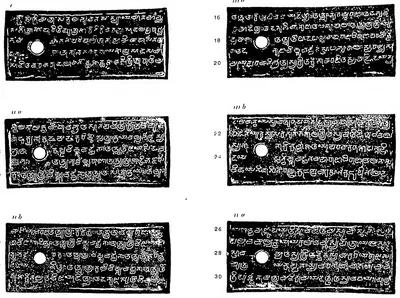 "Sripundi Plates of Tala II", plates i, ii a, ii b, iii a, iii b and iv a (Epigraphia Indica XIX, plate between pp. 152 and 153 (PDF p. 214))Inscription rubbing · 1928
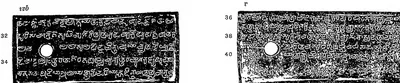 "Sripundi Plates of Tala II", plates iv b and v (Epigraphia Indica XIX, plate between pp. 152 and 153 (PDF p. 215))Inscription rubbing · 1928
Related
Dynasties

References
Notes (0)
Sources (5)
Spotted an error on this page? Tell us
Last updated: