Arumbaka
Village in the former Repalle taluk of Guntur district. The Eastern Chalukya prince Badapa gave it to the archer Gandanarayana in his Arumbaka plates. Its neighbours named in the grant were found round it within four miles. Among them are Sripundi (Sripudi), the village of Tala II's grant, and Kavuru.
Arumbaka is the village granted in the Arumbaka plates of Badapa, a prince of the junior line of the Eastern Chalukyas. The grant places it in the Velanandu district (vishaya).1 Badapa gave it, free of all taxes, to Gandanarayana, who passed it on to his cousin Chandena.2 The plates themselves were found not here but at Polamuru in the Tanuku taluk.12
Identification
The epigraphy report for 1920–21 identified the village with “the modern village Arumbaka in the Repalle taluk of the Guntur district”.3 K. V. Lakshmana Rao, who edited the grant in 1928, agreed.1 He found the boundary villages of the grant all round it, within a radius of four miles:1
- Sripundi, the southern boundary, as Sripudi1
- Cherakumballi, the eastern, as Cherukumilli1
- Kavuru, the western, under its old name1
He was told that Gomaduvu, the northern boundary, was Govada, three miles to the north in the Tenali taluk.1
Sripundi
Sripundi, on Arumbaka’s southern side, is the village of the Sripundi plates of Tala II, Badapa’s younger brother.1 A copy of those plates is kept in Colin Mackenzie’s collection.12 According to it, the village accountants had found the plates buried in the village some fifteen years before about 1800.12
Lakshmana Rao noted that Sripundi still lay south of Arumbaka in the Repalle taluk.4 From the boundaries in the two grants, he argued that Tala’s gift was a new hamlet carved out of Sripundi or its neighbour Aduru, not the whole village.4
Footnotes
-
K. V. Lakshmana Rao, “Two Copper-plate Inscriptions of Eastern Chalukya Princes”, Epigraphia Indica XIX (1927–28), p. 140 (archive.org (opens in a new tab)). ↩ ↩2 ↩3 ↩4 ↩5 ↩6 ↩7 ↩8 ↩9 ↩10 ↩11
-
Lakshmana Rao, “Two Copper-plate Inscriptions” (1928), p. 148 (archive.org (opens in a new tab)). ↩ ↩2 ↩3 ↩4
-
Annual Report on Epigraphy, Madras, for 1920–21 (1921), Part II, para. 14, p. 91 (archive.org (opens in a new tab)). ↩
-
Lakshmana Rao, “Two Copper-plate Inscriptions” (1928), p. 151 (archive.org (opens in a new tab)). ↩ ↩2
Photos
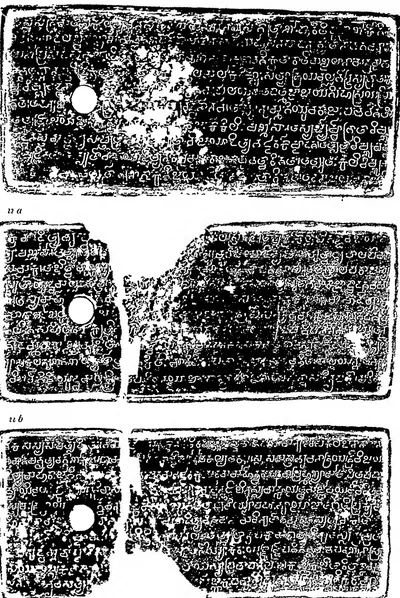 "Arumbaka Plates of Badapa", plates i, ii a and ii b (Epigraphia Indica XIX, plate between pp. 142 and 143 (PDF p. 200))Inscription rubbing · 1928
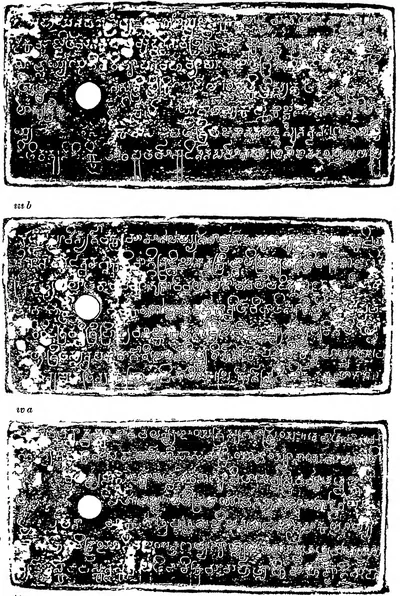 "Arumbaka Plates of Badapa", plates iii a, iii b and iv a (Epigraphia Indica XIX, plate between pp. 142 and 143 (PDF p. 201))Inscription rubbing · 1928
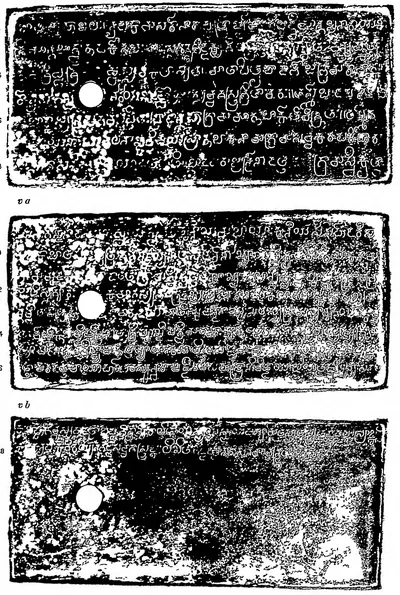 "Arumbaka Plates of Badapa", plates iv b, v a and v b (Epigraphia Indica XIX, plate between pp. 144 and 145 (PDF p. 204))Inscription rubbing · 1928
References
Notes (0)
Sources (2)
Spotted an error on this page? Tell us
Last updated: