Badapa
Eastern Chalukya prince of the junior line, son of Yuddhamalla II and elder brother of Tala II. In his Arumbaka plates he claimed to have driven Amma II out of Vengi with the help of the Rashtrakuta king Krishna III, and he took the imperial titles. Scholars disagree whether he ruled for a short time about 956 in the Velanandu district, or for the 27 years that the later grants call an interregnum (a gap in rule).
Badapa was a prince of the junior branch of the Eastern Chalukyas, the line descended from Yuddhamalla I, a younger brother of Gunaga Vijayaditya III. J. F. Fleet placed Yuddhamalla I as a younger brother of Gunaga Vijayaditya III and of the crown prince Vikramaditya I.1
Badapa is known from his own grant, the Arumbaka plates, and from the Sripundi plates of his younger brother Tala II.23 K. V. Lakshmana Rao, who edited both in 1928, read the name with a dental d. The 1908–09 epigraphy report spelt it Badaba.24
Family
Badapa was a son of Yuddhamalla II.53 The Arumbaka plates call him “son of king Yuddhamalla, lord of Vengi”.5 The Sripundi plates name his grandfather as Talabhupala, and his younger brother as Vishnuvardhana Talabhupala.6
Lakshmana Rao identified the grandfather with Tala I, the Tadapa who reigned for a month in 925.7 Tala II was Badapa’s younger brother.64 See Yuddhamalla II and Tala II.
Exile
Yuddhamalla II held the throne for seven years until Chalukya-Bhima II overthrew him in 933–34.8 Rangacharya numbers this king Bhima III.8
V. Rangacharya, writing in 1960, thought that Yuddhamalla probably died fighting.89 In his view the two sons, Badapa and Tala, had to flee to the Rashtrakuta court. He accepted the suggestion that they were refugees there, seeking the Rashtrakuta king’s help against Amma II.89 He thought that, urged on by them, Krishna III invaded Vengi in or a little before 956.89
The claim to Vengi
In Lakshmana Rao’s translation of the Arumbaka plates, “Badapa with the help of the Vallabha (king) called Karnaraja drove away from the country the prosperous (king) called Ammaraja”.5 Lakshmana Rao and the 1921 epigraphy report both identified Karnaraja-Vallabha with the Rashtrakuta Krishna III.1011 The plates go on to say that Badapa defeated his agnates (relatives on the father’s side) and crushed his enemies.5
The plates give him the titles Samastabhuvanasraya, Vijayaditya, Maharajadhiraja, Paramesvara and Paramamahesvara, and call him Adhiraja.125 His seal bears the family legend Sri-Tribhuvanankusa.3
The Sripundi plates also call him Maharajadhiraja Paramesvara, the only king in their list to receive royal titles.1314 Lakshmana Rao took this to show that Badapa was then the living supreme ruler, and Tala II his subordinate.1314
Badapa’s grant is addressed to the chiefs of families of the Velanandu district.155 It gives the village of Arumbaka to the archer Gandanarayana, whom Lakshmana Rao identified as the brother-in-law of Amma II.155
Lakshmana Rao suggested that Gandanarayana may have helped Badapa to overthrow Amma II.15 B. V. Krishna Rao, in 1930, described him as a traitor who left the king for Badapa.1617
How long did he rule?
The sources used here disagree:
- The 1921 epigraphy report dated the Arumbaka grant to the years immediately after 956. It concluded that Badapa held sway “(perhaps temporarily)” over the Velanandu district in the east.311 Danarnava, it said, held the Natavadi district in the west in the name of the absent Amma II.311
- K. V. Lakshmana Rao (1928) argued that Badapa reigned immediately after Amma II, so after 970. The later grants call the twenty-seven years 973–999 a time without a ruler.10 He held that these years were really the rule of the junior line, which the exiled senior line did not recognise.10
- H. Krishna Sastri, in an editorial note to the same article, called this “very doubtful”. In his view the plates could not show that Badapa ousted Amma II for good, and Badapa might have displaced him only for a time.10
- B. V. Krishna Rao (1930) thought that Badapa seized the throne about 970 with Rashtrakuta help, and that Danarnava fought him in 970–973.17 In his view Badapa’s rule, probably lasting twenty-seven years, was the period later called the interregnum.17
- B. V. Krishna Rao (1936) edited the Tandikonda grant.18 He described Badapa as Krishna III’s protégé, whom Krishna wished to put on the throne.18 He thought that Amma II defeated the coalition.18
Badapa’s grant gives no date.10
Footnotes
-
J. F. Fleet, “The Chronology of the Eastern Chalukya Kings”, Indian Antiquary XX (1891), p. 103 (archive.org (opens in a new tab)). ↩
-
K. V. Lakshmana Rao, “Two Copper-plate Inscriptions of Eastern Chalukya Princes”, Epigraphia Indica XIX (1927–28), p. 137 and note 1 (archive.org (opens in a new tab)). ↩ ↩2
-
Annual Report on Epigraphy, Madras, for 1920–21 (1921), Part II, paras. 13–14, p. 90 (archive.org (opens in a new tab)). ↩ ↩2 ↩3 ↩4 ↩5
-
H. Krishna Sastri, Annual Report on Epigraphy, Southern Circle, for 1908–09 (1909), Part II, para. 61, p. 108 (archive.org (opens in a new tab)). ↩ ↩2
-
Lakshmana Rao, “Two Copper-plate Inscriptions” (1928), p. 146, translation (archive.org (opens in a new tab)). ↩ ↩2 ↩3 ↩4 ↩5 ↩6 ↩7
-
Lakshmana Rao, “Two Copper-plate Inscriptions” (1928), p. 154, translation (archive.org (opens in a new tab)). ↩ ↩2
-
Lakshmana Rao, “Two Copper-plate Inscriptions” (1928), p. 149, note 1 (archive.org (opens in a new tab)). ↩
-
V. Rangacharya, “Mangallu Grant of Amma II”, Epigraphia Indica XXXI (1955–56, publ. 1960), p. 39 (archive.org (opens in a new tab)). ↩ ↩2 ↩3 ↩4 ↩5
-
Rangacharya, “Mangallu Grant of Amma II” (1960), p. 40 (archive.org (opens in a new tab)). ↩ ↩2 ↩3
-
Lakshmana Rao, “Two Copper-plate Inscriptions” (1928), p. 140, with note 1 by H. Krishna Sastri (archive.org (opens in a new tab)). ↩ ↩2 ↩3 ↩4 ↩5
-
Annual Report on Epigraphy, Madras, for 1920–21 (1921), Part II, para. 14, p. 91 (archive.org (opens in a new tab)). ↩ ↩2 ↩3
-
Lakshmana Rao, “Two Copper-plate Inscriptions” (1928), p. 139 (archive.org (opens in a new tab)). ↩
-
Lakshmana Rao, “Two Copper-plate Inscriptions” (1928), p. 151 (archive.org (opens in a new tab)). ↩ ↩2
-
Lakshmana Rao, “Two Copper-plate Inscriptions” (1928), p. 152 (archive.org (opens in a new tab)). ↩ ↩2
-
Lakshmana Rao, “Two Copper-plate Inscriptions” (1928), p. 141 (archive.org (opens in a new tab)). ↩ ↩2 ↩3
-
B. V. Krishna Rao, “Telugu Academy Plates of Saktivarman II”, Journal of the Andhra Historical Research Society V, pt. 1 (1930), p. 35 (archive.org (opens in a new tab)). ↩
-
Krishna Rao, “Telugu Academy Plates of Saktivarman II” (1930), p. 36 (archive.org (opens in a new tab)). ↩ ↩2 ↩3
-
B. V. Krishna Rao, “Tandikonda Grant of Ammaraja II”, Epigraphia Indica XXIII (1935–36), p. 162 (archive.org (opens in a new tab)). ↩ ↩2 ↩3
Photos
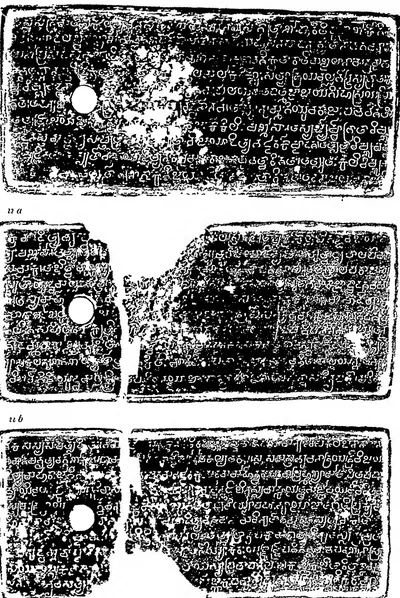 "Arumbaka Plates of Badapa", plates i, ii a and ii b (Epigraphia Indica XIX, plate between pp. 142 and 143 (PDF p. 200))Inscription rubbing · 1928
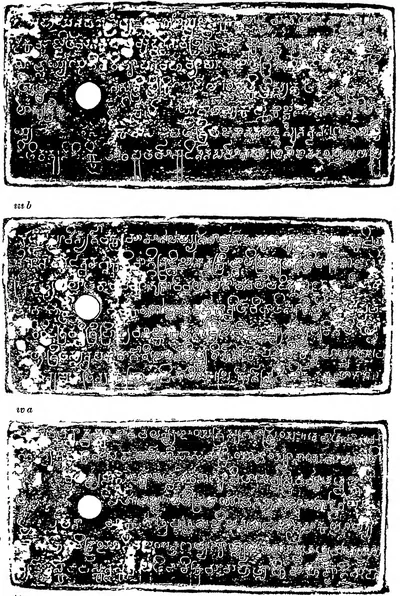 "Arumbaka Plates of Badapa", plates iii a, iii b and iv a (Epigraphia Indica XIX, plate between pp. 142 and 143 (PDF p. 201))Inscription rubbing · 1928
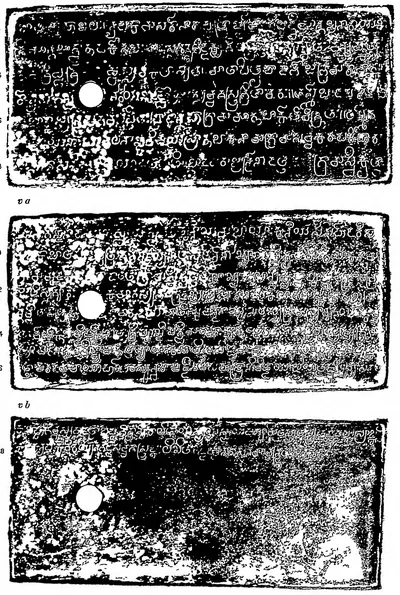 "Arumbaka Plates of Badapa", plates iv b, v a and v b (Epigraphia Indica XIX, plate between pp. 144 and 145 (PDF p. 204))Inscription rubbing · 1928
Related
Dynasties

References
Notes (0)
Sources (7)
Spotted an error on this page? Tell us
Last updated: