Sripundi plates of Tala II
Five undated Sanskrit copper plates of Tala II, also called Vishnuvardhana, a younger brother of Badapa and son of Yuddhamalla II. They were found buried at Sripundi (Sripudi, Repalle taluk) in the late 18th century and copied for the Mackenzie collection about 1800, and they reached the Madras epigraphist in 1908. Made 'during the period of his rule', they give a small village near Sripundi to Kuppanayya of the Pallavamalla family, whose father had died in Tala's service. Their family tree leaves out the reign lengths and rearranges the kings of 925–934.
These plates are the only known grant of Tala II, also called Vishnuvardhana.12 He was a younger brother of Badapa and a son of Yuddhamalla II, of the junior line of the Eastern Chalukyas.12
K. V. Lakshmana Rao edited the plates in 1928, together with the Arumbaka plates of Badapa. The village they concern lay just south of Arumbaka, the village Badapa granted.34
Discovery and description
The plates were registered as No. 5 of Appendix A in the Madras epigraphy report for 1908–09.52 They had been received from the Collector of Guntur in 1908, and were noticed in the same report.52
Lakshmana Rao pointed out that they had already been examined and copied about 1800 for Colin Mackenzie’s collection of manuscripts.5 One of the copies says that the village accountants of Sripundi had found the plates buried in the ground some fifteen years earlier.5 It also records a village tradition that a king called Vishnuvardhana had given them to some Kshatriyas (Kshatrajus).5
V. Rangacharya’s Topographical List, Lakshmana Rao noted, entered two of the Mackenzie copies and the plates themselves as three separate grants.5 Yet all are copies of the same record.5
There are five plates with raised rims, and the first and last are inscribed on the inner side only.56 They hang on a copper ring about 4 inches across.56 Its ends are soldered into a round seal resting on a flower of several petals.56
The seal shows an expanded lotus and the legend Sri-Tribhuvanasimha.56 It also shows a standing boar facing left, an elephant-goad laid horizontally, and a crescent with a dot, perhaps for the sun.56
The ring had been cut before the plates reached the epigraphist’s office.6 Lakshmana Rao found the plates perfectly preserved and “most carefully” engraved.6 They were then in the Madras Museum.6
Language
The language is Sanskrit prose, “very carelessly written”.7 The boundaries are given in Telugu words, some of them out of use in the spoken language and missing from the dictionaries.7 Lakshmana Rao discussed them at length.7 Among them are koda-maduvu, which he took for a sluice of a tank with a masonry top sill, and gogurevu, a plot where hemp was grown.7
The letter la of Tamil, which he also found in the Arumbaka plates, appears here in the name Tala.8
The genealogy
The grant lists the kings from Kubja-Vishnuvardhana, brother of Satyasraya-Vallabhendra (Pulakesin II), down to the donor.6 Unlike other Chalukya grants, it gives no lengths of reign.6
Lakshmana Rao found its family tree very different from that of the Arumbaka plates and other published grants.6 Between Jayasimha-Vallabha and Mangi-yuvaraja it puts five generations instead of the usual two.6 From Vijayaditya-Bhattaraka to Amma I it is correct.6
In his translation, the list goes on from Amma I: “after him, Vikramaditya; after him, Bhima’s younger brother Talabhupala”.1 Then come “his son Sri Yuddhamalla” and “his son Maharajadhiraja Paramesvara Badapa”.1 Last is “his younger brother Vishnuvardhana Talabhupala”.1
The record therefore leaves out the short reigns of Beta-Vijayaditya V and Bhima III, the two sons of Amma I.6 It also puts Vikramaditya II before Tala I (Tadapa), the reverse of the usual order.6
Lakshmana Rao thought the author meant to show an unbroken succession of the junior line from Tala I to Tala II, after Vikramaditya II.6 This was “quite contrary to what is stated elsewhere”.6 He suggested that this was why the reign lengths were left out.6
The 1908–09 report had already noticed that Tala is called here the younger brother of Bhima, that is Chalukya-Bhima I.2 It had also noticed that Tala is made the successor of Vikramaditya II.2 (Kings are numbered here as by J. F. Fleet and E. Hultzsch; the “Tala I” of the edition is the Tadapa who reigned for a month in 925.)
The grant
Tala II, “during the period of his rule” (svarajya), addresses the chiefs of families headed by the Rashtrakutas of the Velanandu district.1
The donee is Kuppanayya of the Pallavamalla family, grandson of Kalivarma.61 He was the son of Makariyaraja, “who has suffered and died in our cause”.61 He held the rank of a great feudatory and minister (mahasamant-amatya).61 He had passed the four tests of loyalty, disinterestedness, continence and courage.61
The boundaries are listed by trees, tanks, embankments and the boundary of a village called Aduru.1 The grant ends: “Within this boundary I have given you as manya the small village called Aduru exempted from all taxes”.1 Ravivarmacharya wrote the grant.1
Lakshmana Rao noted that the text first calls the gift the small village of Sripundi, and later the hamlet of Aduru.4 He thought the writer had made a mistake.4 In his view a new hamlet had been carved out of Sripundi or Aduru for the grant, since its boundaries touched only Aduru, on the south.4
He identified Sripundi with the village of that name, still south of Arumbaka in the Repalle taluk of Guntur district.4 Aduru could not be found and had perhaps merged with the parent village.4 The plates place the land between two streams, which he took to mean a small delta.4 See Arumbaka.
The donee’s family name puzzled both editors. The 1908–09 report found it “strange” that it was the surname of the Pallava king Nandivarman, “the last great Pallava sovereign of Kanchi”.29 It compared the Kuppanayya, or Kuppanamatya, who was the donee of Amma II’s Vandram plates.29
Lakshmana Rao thought that some members of the Pallava family had settled in the Telugu country after the Pallavas fell.6 He did not identify the two Kuppanayyas, because the grandfathers’ names differ.6
Tala’s position and the date
The grant is not dated.4 Lakshmana Rao placed it after the reign of Amma II, the last king it mentions who is known from other records.4 He placed it before the restoration of the senior line.4 Two readings of Tala’s position were offered:
- The 1908–09 report inferred from the seal that “Tala II. was not ruling from the Eastern Chalukya throne”.9 If he had been, it argued, he would have used the family legend Tribhuvanankusa and not Tribhuvanasimha, “the lion of the three worlds”.9 It thought the times were “troublous” and faithful ministers rare.9
- K. V. Lakshmana Rao (1928) thought it probable that Tala did not rule independently of his elder brother.410 He pointed to the seal and to the titles.410 Only Badapa is called Maharajadhiraja Paramesvara, while Tala is once Talabhupala and once Maharajadhiraja but never Paramesvara.410 He concluded that Badapa was the supreme ruler and Tala his subordinate.410 In his view, svarajya meant the time in which the junior line held the kingdom, which in its own view was rightly theirs.410
The 1921 report noted only that Tala II, like Badapa, made his gift in the Velanandu district.11 V. Rangacharya, who edited the Mangallu grant of Amma II in Epigraphia Indica XXXI (published in 1960), thought that both brothers had fled to the Rashtrakuta court after their father’s fall in 933–34.12
The Madras Museum catalogue of 1918, Lakshmana Rao noted, had attributed the grant to Tala I, who reigned for a month in 925.6 He rejected this, since the plates themselves name Tala II as the donor.6
Footnotes
-
Lakshmana Rao, “Two Copper-plate Inscriptions” (1928), p. 154, translation (archive.org (opens in a new tab)). ↩ ↩2 ↩3 ↩4 ↩5 ↩6 ↩7 ↩8 ↩9 ↩10 ↩11 ↩12 ↩13
-
H. Krishna Sastri, Annual Report on Epigraphy, Southern Circle, for 1908–09 (1909), Part II, para. 61, p. 108 (archive.org (opens in a new tab)). ↩ ↩2 ↩3 ↩4 ↩5 ↩6 ↩7 ↩8
-
Lakshmana Rao, “Two Copper-plate Inscriptions” (1928), p. 140 (archive.org (opens in a new tab)). ↩
-
Lakshmana Rao, “Two Copper-plate Inscriptions” (1928), p. 151 (archive.org (opens in a new tab)). ↩ ↩2 ↩3 ↩4 ↩5 ↩6 ↩7 ↩8 ↩9 ↩10 ↩11 ↩12 ↩13 ↩14 ↩15
-
Lakshmana Rao, “Two Copper-plate Inscriptions” (1928), p. 148 and note 2 (archive.org (opens in a new tab)). ↩ ↩2 ↩3 ↩4 ↩5 ↩6 ↩7 ↩8 ↩9 ↩10 ↩11 ↩12
-
Lakshmana Rao, “Two Copper-plate Inscriptions” (1928), p. 149 and note 1 (archive.org (opens in a new tab)). ↩ ↩2 ↩3 ↩4 ↩5 ↩6 ↩7 ↩8 ↩9 ↩10 ↩11 ↩12 ↩13 ↩14 ↩15 ↩16 ↩17 ↩18 ↩19 ↩20 ↩21 ↩22 ↩23 ↩24 ↩25 ↩26
-
Lakshmana Rao, “Two Copper-plate Inscriptions” (1928), p. 150 (archive.org (opens in a new tab)). ↩ ↩2 ↩3 ↩4
-
K. V. Lakshmana Rao, “Two Copper-plate Inscriptions of Eastern Chalukya Princes”, Epigraphia Indica XIX (1927–28), p. 139 (archive.org (opens in a new tab)). ↩
-
Krishna Sastri, Annual Report on Epigraphy for 1908–09 (1909), Part II, para. 61, p. 109 (archive.org (opens in a new tab)). ↩ ↩2 ↩3 ↩4 ↩5
-
Lakshmana Rao, “Two Copper-plate Inscriptions” (1928), p. 152 (archive.org (opens in a new tab)). ↩ ↩2 ↩3 ↩4 ↩5
-
Annual Report on Epigraphy, Madras, for 1920–21 (1921), Part II, para. 14, p. 91 (archive.org (opens in a new tab)). ↩
-
V. Rangacharya, “Mangallu Grant of Amma II”, Epigraphia Indica XXXI (1955–56, publ. 1960), p. 39 (archive.org (opens in a new tab)). ↩
Photos
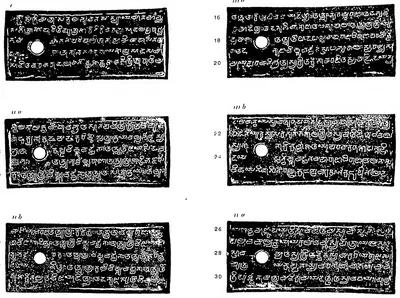 "Sripundi Plates of Tala II", plates i, ii a, ii b, iii a, iii b and iv a (Epigraphia Indica XIX, plate between pp. 152 and 153 (PDF p. 214))Inscription rubbing · 1928
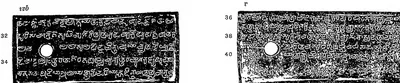 "Sripundi Plates of Tala II", plates iv b and v (Epigraphia Indica XIX, plate between pp. 152 and 153 (PDF p. 215))Inscription rubbing · 1928
References
Notes (0)
Sources (4)
Spotted an error on this page? Tell us
Last updated: