Tammusiddhi
Telugu Choda king of the Pottapi and Nellore family, and a vassal of the Chola king Kulottunga III. He was anointed at Nellore in 1205–06 and made grants at Kanchipuram, Tiruvalangadu, Tiruppasur, Tiruvorriyur, Nellore and Kavali. His inscriptions give the fullest early family tree of the family, but they disagree about who his brother or uncle Nallasiddhi was.
Sewell lists Tammusiddhi as a vassal of the Chola king Kulottunga III.1 An inscription of Saka 1127 (1205–06; Saka is an Indian way of counting years) says that he had been anointed in the town of Nellore.2 His inscriptions trace his family far back, but they disagree about who the king Nallasiddhi was.34 See the Telugu Chodas of Pottapi and Nellore.
Family
Tammusiddhi was a son of Erasiddhi and his queen Sridevi.5 His Sanskrit inscriptions trace the family from the solar race through the Chola king Karikala.56 They then name an ancestor called Madhurantaka Pottapi-Chola.56 He is said to have conquered Madura and founded the town of Pottapi “in (the country of) the Andhras”.56 After him came a king Tilungavidya, who set up a pillar of victory at Ujyapuri.56
In Tilungavidya’s family came king Siddhi and his younger brother Betta I.5 Betta’s eldest son was Dayabhima, and Dayabhima’s younger brother was Erasiddhi.5 Another inscription of Tammusiddhi, at Kanchipuram, gives his father the surname Ganda-Gopala.2
The Tiruvalangadu inscription names three sons of Erasiddhi and Sridevi: Manmasiddhi, Betta II and Tammusiddhi. H. Lüders edited it in 1903.5 He noted that only Manmasiddhi among them is described as actually reigning.5 Of Betta II, he wrote, it is “expressly stated” that he was “given to the practice of austerities” (strict religious discipline).5 So after the death of Manmasiddhi, Betta II handed the government to his younger brother Tammusiddhi.5
The Tiruppasur inscription says the same “in a more explicit way”.3 After Manmasiddhi’s death, it says, the kingdom passed to Tammusiddhi “without any disturbances”.3
Anointment at Nellore
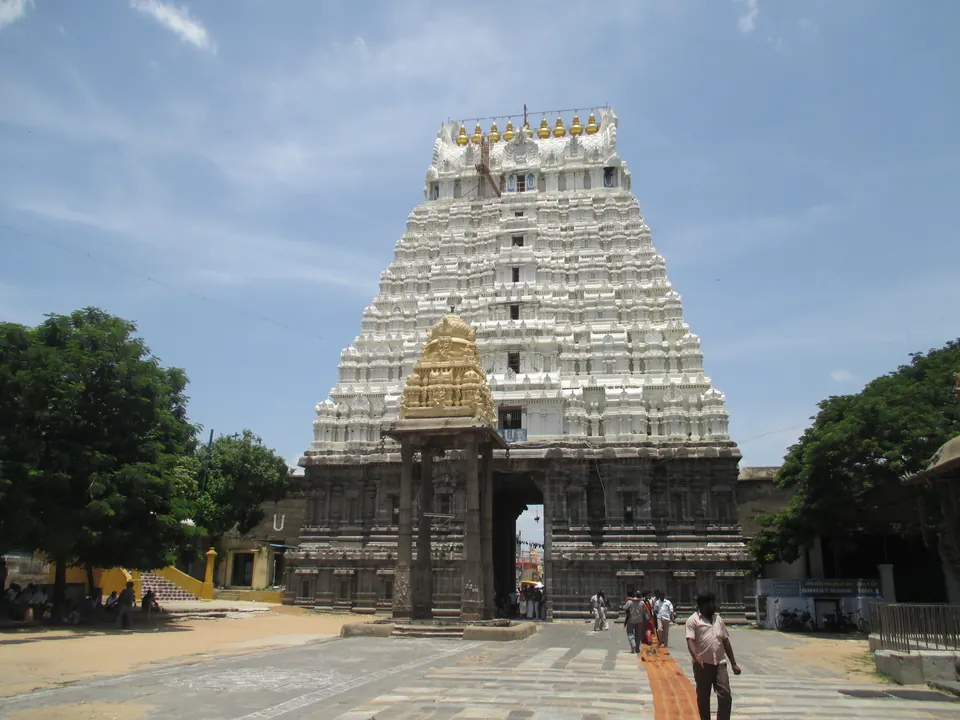
An inscription stands on the platform of the Arulala-Perumal temple at Kanchipuram.2 It records that in Saka 1127 (1205–06) Tammusiddhi, “having performed his anointment in the town of Nellûr”, gave a village to the god of the temple.2 The village was Muttiyampakka, the headquarters of Pantarashtra.2 See the Arulala-Perumal inscription.
In Saka 1129 (1207–08) he gave the king’s revenues from the temple villages to the gods of Tiruvalangadu, Tiruppasur and Tiruvorriyur.574 In the same year, at Kavali in the Nellore country, he founded an agrahara (a village given to Brahmins) named Sripura after his mother.574
A Tamil record at Nellore is dated in the 26th year of the Chola Kulottunga.8 It names Madurantakapottapichōla alias Tammusiddharasa as the donor of a tax-free village.8 The village went to the god Pallikondaperumal at Tiruppalkadal in Nellore, which the record calls Vikramasingapura.8 Sewell lists his Tiruvalangadu grants as those of a vassal of Kulottunga III.1
Who was Nallasiddhi?
A king Nallasiddhi appears in the family, and his place in it has been read four ways.
- A brother of Erasiddhi. The Tiruppasur inscription puts a king Nallasiddhi in Siddhi’s family and calls Erasiddhi his younger brother.37 This might have made Nallasiddhi another name for Dayabhima.37 Lüders, using a third inscription at Tiruvorriyur, showed that Nallasiddhi and Dayabhima were two different persons.37 He drew Nallasiddhi as Erasiddhi’s brother, that is, Tammusiddhi’s uncle.37 E. Hultzsch, in the same volume, called him “an uncle of Tammusiddhi” who was “stated to have occupied Kâñchi”.9
- The eldest son. The Kavali inscription of 1207–08 calls Nalla Siddha the eldest son of Erasiddhi and Sridevi.4 It says: “Of them the eldest, king Nalla Siddha, was anointed; by his favour (his younger brother) Ṣrí Tammu Siddha, lord of men, rules the whole kingdom as supreme lord.”4 Its editors, Alan Butterworth and V. Venugopaul Chetty (1905), concluded that “the donor Tammu Siddha was regent while his elder brother Nalla Siddha was the anointed king”.10
- Betta II. Robert Sewell identified Nallasiddhi with Betta II, and he treated Nalla, “black”, as a nickname.1112 From the Kavali record he argued that Nalla had been anointed and then retired, leaving the kingdom to Tammusiddhi.1112
- Manmasiddhi I. Sewell’s editor, S. Krishnaswami Aiyangar, read the same evidence in another way.1 To him Nallasiddhi was another name of the eldest brother, Manmasiddhi, who chose Tammusiddhi as his successor.1 He held that Betta, the religious middle brother, died before Tammusiddhi succeeded.1
Parabrahma Sastry, a modern historian, gave a political account.13 In his view, the Chola Kulottunga III had removed Manmasiddhi I and set up his younger brother Nallasiddhi.13 Nallasiddhi and Tammusiddhi then ruled Nellore under the Chola king until 1207–08.13
The end of his rule
Tammusiddhi’s last dates are of 1207–08.54 Parabrahma Sastry held that Manmasiddhi I’s son Tikka claimed to be the rightful heir.13 In his account, Tikka won the help of the Kakatiya Ganapatideva.13 Ganapatideva, he says, marched on Nellore, put Tammusiddhi to flight and gave the kingdom back to Tikka.13 See Tikka I and the Telugu Chodas of Pottapi and Nellore.
Footnotes
-
Sewell, Historical Inscriptions (1932), p. 130 and editor’s note (archive.org (opens in a new tab)). Paraphrased. ↩ ↩2 ↩3 ↩4 ↩5
-
Lüders, “Two Further Inscriptions of Tammusiddhi” (1903), p. 152 (archive.org (opens in a new tab)). ↩ ↩2 ↩3 ↩4 ↩5
-
Lüders, “Two Inscriptions of Tammusiddhi” (1903), p. 122 (archive.org (opens in a new tab)). ↩ ↩2 ↩3 ↩4 ↩5 ↩6 ↩7
-
Alan Butterworth and V. Venugopaul Chetty, A Collection of the Inscriptions on Copper-Plates and Stones in the Nellore District, Part II (1905), Kavali No. 39, pp. 735–736 (archive.org (opens in a new tab)). ↩ ↩2 ↩3 ↩4 ↩5 ↩6
-
H. Lüders, “Two Inscriptions of Tammusiddhi, Saka-Samvat 1129”, Epigraphia Indica VII (1903), pp. 120–121 (archive.org (opens in a new tab)). ↩ ↩2 ↩3 ↩4 ↩5 ↩6 ↩7 ↩8 ↩9 ↩10 ↩11 ↩12 ↩13 ↩14
-
Lüders, “Two Inscriptions of Tammusiddhi” (1903), p. 125, translation (archive.org (opens in a new tab)). ↩ ↩2 ↩3 ↩4
-
H. Lüders, “Two Further Inscriptions of Tammusiddhi”, Epigraphia Indica VII (1903), pp. 148–149 (archive.org (opens in a new tab)). ↩ ↩2 ↩3 ↩4 ↩5 ↩6
-
Butterworth and Venugopaul Chetty, Nellore Inscriptions II (1905), p. 843 (archive.org (opens in a new tab)). ↩ ↩2 ↩3
-
E. Hultzsch, “Arulala-Perumal Inscription of Prataparudra; Saka-Samvat 1238”, Epigraphia Indica VII (1903), p. 129 (archive.org (opens in a new tab)). ↩
-
Butterworth and Venugopaul Chetty, Nellore Inscriptions II (1905), note to Kavali No. 39, pp. 739–740 (archive.org (opens in a new tab)). ↩
-
Sewell, Historical Inscriptions (1932), p. 395 (archive.org (opens in a new tab)). Paraphrased. ↩ ↩2
-
Robert Sewell, The Historical Inscriptions of Southern India (1932), p. 129 and note (archive.org (opens in a new tab)). Paraphrased. ↩ ↩2
-
P. V. Parabrahma Sastry, The Kakatiyas of Warangal (1978), p. 109. Cite-only; paraphrased. ↩ ↩2 ↩3 ↩4 ↩5 ↩6
Photos
References
Notes (0)
Sources (4)
Spotted an error on this page? Tell us
Last updated: