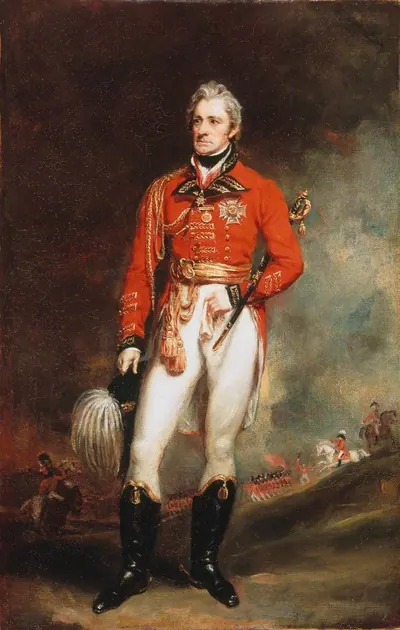
Sir Thomas Munro
Sir Thomas Munro (1761–1827) was a Scottish soldier and administrator. As the first Principal Collector of the Ceded Districts of Rayalaseema, from 1800 to 1807, he put down the poligars (local military chiefs) and made the ryotwari settlement with each cultivator. He became Governor of Madras in 1820. He died in office at Pattikonda, then in the Bellary district, on 6 July 1827. In the Ceded Districts he was remembered with ballads and as a 'father'.
Thomas Munro was the Company’s first and best-remembered administrator in Rayalaseema. G. R. Gleig’s Life (1830) says that he “was born at Glasgow, on the 27th of May, 1761”.1 He was the son of a merchant of that city.1 See East India Company.
His biographer John Bradshaw divides his career in India into these periods:2
- from 1792 to 1799 in the Baramahal, ceded by Tipu Sultan2
- in 1799–1800 in Kanara2
- from 1800 to 1807 in the Ceded Districts2
- from 1814 to 1818, after six years in Europe, civil and military service2
- his governorship of Madras “from June 8, 1820, until his death on July 6, 1827”2
The Ceded Districts
Munro wrote that in November 1800 he “proceeded to the Ceded Districts, to the civil administration of which I had been appointed in the preceding month”.3 He stayed in charge until he sailed for England on 23 October 1807.3
The Bellary gazetteer calls him the districts’ “first (and their most famous) ‘Principal Collector’”.45 He lived at Anantapur.45 His Sub-Collectors, among them William Thackeray, were posted at Adoni and elsewhere.45
Bradshaw says that there were then some 30,000 armed peons in the districts under eighty poligars (local military chiefs).6 Munro wrote that the poligars “were almost constantly in rebellion, and their reduction and rebellion were equally disastrous to the country”.7
He assessed each poligar at the highest tribute he had paid to the Nizam or to Haidar Ali.7 With General Dugald Campbell’s troops and his own companies of armed peons, he reduced or drove out those who refused.7 Within a year, the gazetteer says, no force remained able to “make any formidable opposition to Government”.7
In 1804 the Directors wanted “more gentle measures”.8 In February 1805 Munro answered that the poligars’ “feudal habits and principles” were crimes and oppressions.8 See Gooty, Bellary, Kadapa and Forts and warfare.
In 1801–02 he introduced the ryotwari settlement, a direct agreement with each cultivator (ryot).9 Under it “every ryot held his land immediately from the Government under a patta from the Collector” (a patta is a written title to land).9 Between 1802 and 1805 he had the whole country surveyed.9
When he left, the Madras government reported on the people of the districts.10 It said they had once been “disunited hordes of lawless plunderers and freebooters”.10 Now, it said, they were “as far advanced in civilization, submission to the laws, and obedience to the Magistrates, as any of the subjects under this Government”.10 See Governance.
Governor of Madras
In a minute (an official note) of 1822, Governor Munro wrote about the unrest in the zamindari districts of the north, the estates held by landholders called zamindars.11 He blamed it on the government’s duty to enforce moneylenders’ decrees against zamindars.11 He urged that “no zamindari once forfeited for rebellion should ever be restored”.11
He died in office.12 Maclean’s list of the Governors says he “died at Putticondah in the Bellary District on the 6th July 1827”.12
Memory
The Bellary gazetteer says that the people of the Ceded Districts regarded him with the utmost affection.10 They “called him their ‘father’” and still sang ballads in his honour.10
Bradshaw, writing in 1894, says that “in the Ceded Districts boys are still named after him, ‘Munrolappa’”.13 In the Kadapa (then Cuddapah) district, wandering mendicants sang his praise.13 A Brahman schoolmaster at Gooty told Bradshaw that Munro was “styled Mandava Rishi,—Mandava Rishi being no other than Munro deified”.13 See Folk traditions.
Footnotes
-
G. R. Gleig, The Life of Major-General Sir Thomas Munro, Vol. I (1830), p. 1 (archive.org (opens in a new tab)). ↩ ↩2
-
John Bradshaw, Sir Thomas Munro and the British Settlement of the Madras Presidency (1894), p. 17 (archive.org (opens in a new tab)). ↩ ↩2 ↩3 ↩4 ↩5 ↩6
-
Gleig, Life of Munro, Vol. I (1830), p. xix (archive.org (opens in a new tab)). ↩ ↩2
-
W. Francis, Madras District Gazetteers: Bellary (1904), p. 46 (archive.org (opens in a new tab)). ↩ ↩2 ↩3
-
Francis, Bellary (1904), p. 47 (archive.org (opens in a new tab)). ↩ ↩2 ↩3
-
Bradshaw, Sir Thomas Munro (1894), p. 112 (archive.org (opens in a new tab)). ↩
-
Francis, Bellary (1904), p. 48 (archive.org (opens in a new tab)). ↩ ↩2 ↩3 ↩4
-
Francis, Bellary (1904), p. 49 (archive.org (opens in a new tab)). ↩ ↩2
-
Francis, Bellary (1904), p. 155 (archive.org (opens in a new tab)). ↩ ↩2 ↩3
-
Francis, Bellary (1904), p. 161 (archive.org (opens in a new tab)). ↩ ↩2 ↩3 ↩4 ↩5
-
F. R. Hemingway, Madras District Gazetteers: Godavari, Vol. I (1907), p. 166 (archive.org (opens in a new tab)). ↩ ↩2 ↩3
-
C. D. Maclean (ed.), Manual of the Administration of the Madras Presidency, Vol. II (1885), p. 269 (archive.org (opens in a new tab)). ↩ ↩2
-
Bradshaw, Sir Thomas Munro (1894), p. 7 (archive.org (opens in a new tab)). ↩ ↩2 ↩3
Photos
References
Notes (0)
Sources (5)
Spotted an error on this page? Tell us
Last updated: