Vemana
Telugu poet of short moral, religious and satirical verses, each ending with the refrain 'Viswad abhi rama vinara Vema'. His verses were the moral schoolbook of the Telugu country. Nothing certain is known of his life: C. P. Brown, who collected and translated the verses from 1824, heard that he lived about 1600, while Chenchiah and Bhujanga Rao preferred the early 15th century.
Vemana was a Telugu poet of short verses on right conduct, religion and the follies of society.12 For centuries his verses were the first moral lessons of Telugu schoolchildren.2 Almost nothing is known of his life, not even the century in which he lived.32 What we have is the verses themselves, gathered from many copies by the English scholar Charles Philip Brown from 1824 onward.1
The verses
Most of the verses are in the ataveladi metre, Brown noted, and end with the same refrain: “Viswad abhi rama vinara Vema”.34 He called the meaning of the refrain “obscure”, though each verse makes sense without it.4 “Some believe”, he added, that the Vema spoken to was the poet’s elder brother.4
The verses form a satakam (a set of about a hundred verses with one refrain), though far more than a hundred survive.32 P. Chenchiah and Raja M. Bhujanga Rao, in their history of Telugu literature (1928), called Vemana “the prince of sataka writers”.2 In their view each verse holds one moral truth.2 The first two lines give a picture, and the last two state the lesson.2
They called him “the greatest moral teacher of the Andhras”.2 For about five centuries, they wrote, his verses had been “the text-book of morals for Telugu boys”.2 With the Sumati Satakam, they gave Telugu youth its moral training.56 C. R. Reddy, in his foreword, called Vemana “a star of the first magnitude” among the reformer-poets.7
Chenchiah and Bhujanga Rao pointed out one verse that is “a fairly literal translation” of the saying in the Gospels, “Love your enemies”.2 Another, in their reading, matches St Paul’s words, “If thine enemy hunger, feed him”.2
Brown’s collection, 1824–1829
Brown was an officer of the Madras Civil Service.8 In 1824, while learning Telugu at Machilipatnam (then Masulipatam), he asked for popular books in an easy style.1 He was given manuscripts of Vemana.1 He found them “full of errors of every kind, in orthography, metre, and meaning”.1 No two copies were in the same order, and they held from two to eight hundred verses each.1
He collected more copies from Visakhapatnam (then Vizagapatam), Nellore, Guntur, Kadapa (then Cuddapah) and Madras.1 He had an index made, comparing nine manuscripts.1 He counted about 2,500 verses, but found that the true total, without repeats, was little more than 2,000.1
Brown sorted the verses into five groups: religious, moral, satirical, mystic and miscellaneous.1 The last two groups made up more than half.1 He left them out of his book as “devoid of interest and utility”.1 He also left out some satirical verses, and verses that he thought belonged to other collections.1
His book, The Verses of Vemana, came out in 1829 with an English translation.910 In 1852 Brown wrote that it held “about one-third” of the verses.9 By 1857 several more editions had been printed, without the translation.10
Brown thought Vemana a good first book for learners.3 He compared him to the Greek writer Lucian: “a familiar writer, useful to a beginner, though neither poetical nor classical”.3 In his Telugu grammar of 1857, he told students to read Vemana after his own easier readers.11
The manuscripts
The old College at Madras held many copies of the verses.12 William Taylor described them in his catalogue of 1860.12 One copy had 878 verses, “ascribed to Vema reddi”.12 Taylor noted that many had been “collated, and translated into English”, and that “a complete copy is rare”.12 Another had 785 verses, which he called “a sort of omnium gatherum” (a mixed collection).12
What Brown heard about his life
Brown wrote that “it is not easy to ascertain any thing regarding the history of Vemana”.3 He believed that Vemana was the poet’s personal name.3 He recorded these traditions:3
- Vemana was “by birth a capu or farmer”
- some said he belonged to the family of Ana Vema Reddi, a chief in the Kurnool (then Curnool) country
- his brother was said to have commanded the fort of Gandikota
- different people named his birthplace as a village in Kurnool, Inaconda in Guntur, or Chitvel in Kadapa3
Brown asked at all these places but “gained no information whatever”.3 Vemana never gives his family name.3 From this, Brown guessed that he had joined the Jangams, the Virashaiva priests, who give up their family names.3 He noticed that their creed was the only one that Vemana did not mock.3 From the dialect of a few verses, he thought Vemana came from the south-west of the Telugu country.3
The traditions that link Vemana with the Reddi chiefs are discussed on the page Reddis of Kondavidu.
Where the sources disagree
The sources disagree on Vemana’s date and birthplace.
- Date. Brown wrote that “it is believed that he lived about the beginning of the seventeenth century”.3 Chenchiah and Bhujanga Rao thought it “probable that he lived in the beginning of the fifteenth century”.2 But they admitted that his date could not be fixed “even approximately”.2
- Birthplace. Brown heard of villages in Kurnool, Guntur and Kadapa, but could confirm none.3 Chenchiah and Bhujanga Rao reported claims for Kondavidu and for Katuru, “a village where his tomb exists”.2 They called his birthplace uncertain.2
- Religion. Brown guessed that Vemana was a Jangam, a Virashaiva.3 Chenchiah and Bhujanga Rao called him an Advaita mystic and a sannyasi (one who has given up the world).2
Footnotes
-
Charles Philip Brown (tr.), The Verses of Vemana (1911 reprint of the 1829 edition), preface, PDF p. 5 (archive.org (opens in a new tab)). ↩ ↩2 ↩3 ↩4 ↩5 ↩6 ↩7 ↩8 ↩9 ↩10 ↩11 ↩12 ↩13
-
Chenchiah and Bhujanga Rao, A History of Telugu Literature (1928), p. 99 (archive.org (opens in a new tab)). ↩ ↩2 ↩3 ↩4 ↩5 ↩6 ↩7 ↩8 ↩9 ↩10 ↩11 ↩12 ↩13 ↩14 ↩15 ↩16
-
Brown, The Verses of Vemana (1911 reprint of the 1829 edition), preface, PDF p. 6 (archive.org (opens in a new tab)). ↩ ↩2 ↩3 ↩4 ↩5 ↩6 ↩7 ↩8 ↩9 ↩10 ↩11 ↩12 ↩13 ↩14 ↩15 ↩16 ↩17
-
Brown, The Verses of Vemana (1911 reprint of the 1829 edition), preface, note, PDF p. 7 (archive.org (opens in a new tab)). ↩ ↩2 ↩3
-
Chenchiah and Bhujanga Rao, A History of Telugu Literature (1928), p. 56 (archive.org (opens in a new tab)). ↩
-
Chenchiah and Bhujanga Rao, A History of Telugu Literature (1928), p. 57 (archive.org (opens in a new tab)). ↩
-
C. R. Reddy, foreword to P. Chenchiah and Raja M. Bhujanga Rao, A History of Telugu Literature (1928), p. 7 (archive.org (opens in a new tab)). ↩
-
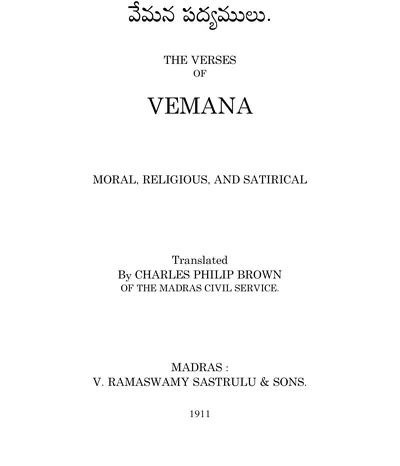
Charles Philip Brown (tr.), The Verses of Vemana (1911 reprint of the 1829 edition), title page, PDF p. 2 (archive.org (opens in a new tab)). ↩
-
Charles Philip Brown, A Dictionary, Telugu and English (1852), p. xiv (archive.org (opens in a new tab)). ↩ ↩2
-
William Taylor, A Catalogue Raisonnée of Oriental Manuscripts in the Library of the (late) College, Fort Saint George, Vol. I (1857), p. xxiv, list of Brown’s works (archive.org (opens in a new tab)). ↩ ↩2
-
Charles Philip Brown, A Grammar of the Telugu Language (2nd ed., 1857), preface, p. iv (archive.org (opens in a new tab)). ↩
-
Taylor, Catalogue Raisonnée, Vol. II (1860), p. 513, Nos. 360–367 (archive.org (opens in a new tab)). ↩ ↩2 ↩3 ↩4 ↩5
Photos
References
Notes (0)
Sources (6)
Spotted an error on this page? Tell us
Last updated: