Vemulavada Bhimakavi
Telugu poet known mostly from legend, linked by tradition with Vemulavada in Karimnagar district and with Draksharama. Chenchiah and Bhujanga Rao called him 'a poet of mystery': he has been placed in every century from the 12th to the 16th, and no work can be given to him with certainty. Later poets remembered him for 'words of power', and one tradition makes him the first to write verse with two meanings.
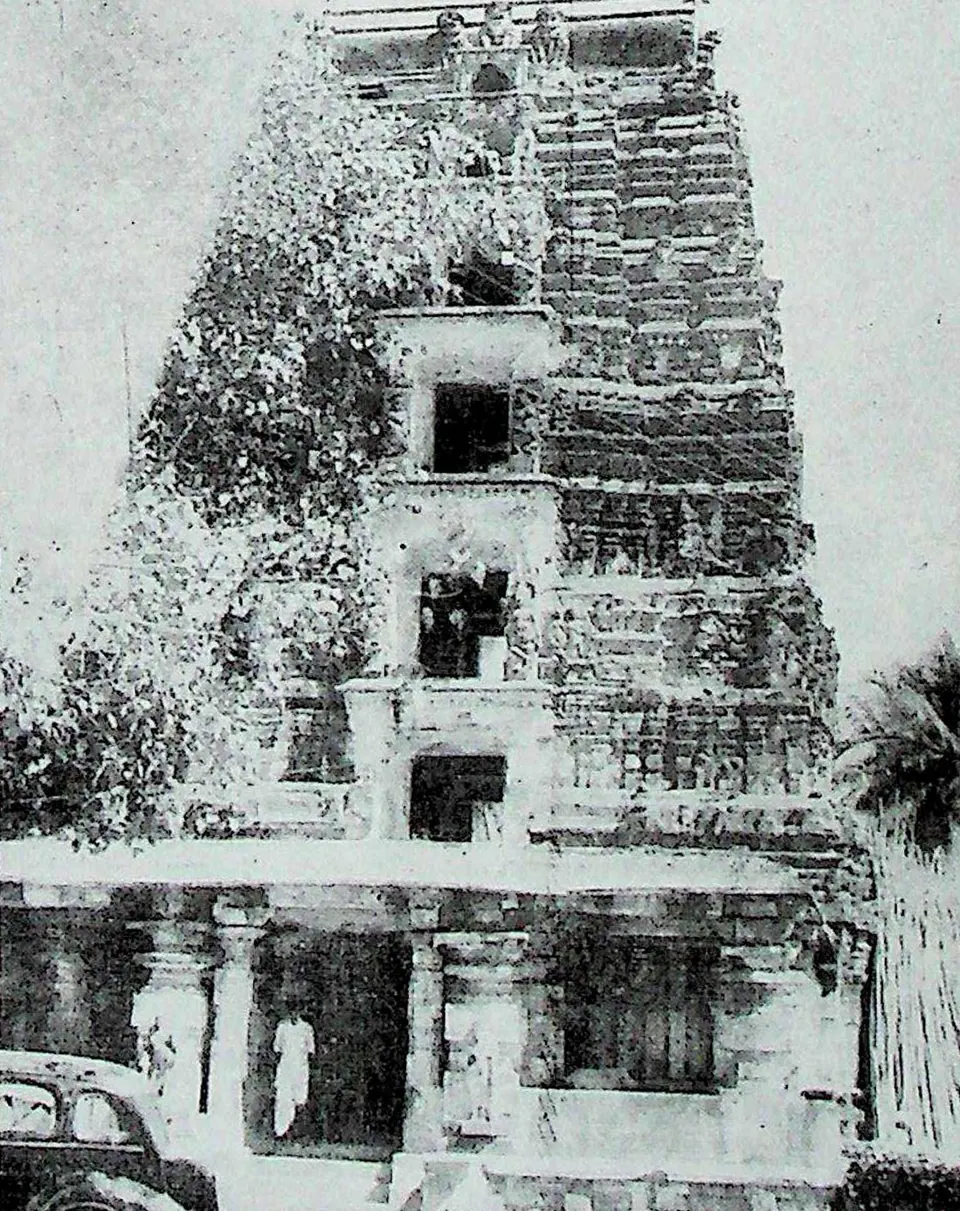
Vemulavada Bhimakavi is a Telugu poet known almost only through stories.1 His name links him with Vemulavada, in Karimnagar district.2 P. Chenchiah and Raja M. Bhujanga Rao called him “a poet of mystery in Telugu literature”.1 His date, his life and even his works are uncertain.13
A poet of legend
Chenchiah and Bhujanga Rao, in their history of Telugu literature (1928), wrote that tradition had woven so many stories round his name that his date could not be fixed.1 Scholars had placed him in the 12th, 13th, 14th, 15th and 16th centuries.1 In the stories he is an inspired prophet whose words come true.1 They thought such legends usually gather round a poet from the very beginnings of a literature.1 Srinatha, they noted, placed him before the three poets of the Telugu Mahabharata.1
Apart from his being “a staunch Saivite”, they wrote, “nothing is known of him”.1 In their words, he “flits across the stage like a strange shadow”, and never becomes “a concrete figure of history”.4 P. T. Raju, in 1944, quoted the same words.3 He added that none of the poet’s works survives except quotations in anthologies.3
Places linked with him
P. Sreenivasachar, Director of Archaeology in Hyderabad, wrote a preface in 1953 to N. Venkataramanayya’s book on the Chalukyas of Vemulavada.2 He noted that tradition links Vemulavada with the famous Telugu poet Bhima Kavi.2 But he added that there is clearer proof that the Kannada poet Pampa lived there.2
M. Rama Rao, writing on the Eastern Chalukya temples of Andhra in 1964, gives another tradition.5 In it Bhimakavi was the son of a Brahmin widow of Draksharama.5 He said that the god Bhimesvara of that temple was his father.5
Works given to him
Chenchiah and Bhujanga Rao list five or six works given to him, but they doubted every one:1
- the Raghava Pandaviyamu, telling the stories of Rama and Krishna in verses with double meanings, already lost by the time of Pingali Surana
- the Kavijanasrayamu, then recently printed, but said to be by a Jain merchant named Rachanna
- the Satakantha Ramayanamu and the Nrisimha Puranamu, known only from verses quoted in anthologies
- a Telugu Basava Puranamu, which they thought very doubtful16
K. Sitaramaiya, in 1943, also wrote that “one Bhimakavi is said to be the originator” of verse that tells two stories at once.7 But no work of his survives.7 So Pingali Surana’s Raghavapandaviyamu is the first such poem we have.7
In Sreenivasachar’s 1942 list of Telugu writers of the Kakatiya age, one entry asks a question.8 Beside “Kavi-Rakshasudu”, author of the Kavi-Rakshasiyamu, he wrote: “Is this writer identical with Vemulavada Bhimakavi?”8 He did not answer it.8
How later poets remembered him
A verse of praise addressed to Srinatha, quoted by Chenchiah and Bhujanga Rao, names the great poets before him.9 It says Srinatha could write “now like Bhima Kavi in words of power”.9 The same verse names Nannaya and Tikkana.9
Where the sources disagree
- His date. Chenchiah and Bhujanga Rao listed dates from the 12th to the 16th century, and leaned to an early date because of the legends.1 Raju wrote only that “there is much controversy about his date”.3
- His home. The name and a tradition reported in 1953 link him with Vemulavada.2 A tradition reported in 1964 makes him a son of Draksharama.5
- His works. Chenchiah and Bhujanga Rao doubted all the works given to him.1 Sreenivasachar wondered whether he might be the author of the Kavi-Rakshasiyamu.8
Footnotes
-
Chenchiah and Bhujanga Rao, A History of Telugu Literature (1928), p. 58 (archive.org (opens in a new tab)). ↩ ↩2 ↩3 ↩4 ↩5 ↩6 ↩7 ↩8 ↩9 ↩10 ↩11 ↩12 ↩13
-
P. Sreenivasachar, preface to N. Venkataramanayya, The Chalukyas of L(V)emulavada (1953), PDF p. 2 (archive.org (opens in a new tab)). Paraphrased. ↩ ↩2 ↩3 ↩4 ↩5
-
P. T. Raju, Telugu Literature (1944), p. 24 (archive.org (opens in a new tab)). Cite-only; paraphrased. ↩ ↩2 ↩3 ↩4
-
Chenchiah and Bhujanga Rao, A History of Telugu Literature (1928), p. 59 (archive.org (opens in a new tab)). ↩
-
M. Rama Rao, Eastern Chalukyan Temples of Andhra Desa (1964), p. 15 (archive.org (opens in a new tab)). Paraphrased. ↩ ↩2 ↩3 ↩4
-
P. Chenchiah and Raja M. Bhujanga Rao, A History of Telugu Literature (1928), p. 54 (archive.org (opens in a new tab)). ↩
-
K. Sitaramaiya, A Hand Book of Telugu Literature (1943), p. 43 (archive.org (opens in a new tab)). Cite-only; paraphrased. ↩ ↩2 ↩3
-
P. Sreenivasachar (ed.), A Corpus of Inscriptions in the Telingana Districts, Part I (1942), p. 14, note 2 (archive.org (opens in a new tab)). ↩ ↩2 ↩3 ↩4
-
Chenchiah and Bhujanga Rao, A History of Telugu Literature (1928), p. 112 (archive.org (opens in a new tab)). ↩ ↩2 ↩3
Photos
References
Notes (0)
Sources (6)
Spotted an error on this page? Tell us
Last updated: