Vikramaditya II (Bana)
Vikramaditya II was a Bana king of the early 10th century, the son of Vijayaditya Prabhumeru. With his father's consent he issued the Gudimallam plates, which confirmed an old grant of the village of Viprapitha, the Sanskrit name of Gudimallam, to its Brahmins. E. Hultzsch called him the heir-apparent when the plates were made. V. Venkayya thought that either he or his successor lost the Bana kingdom to the Chola king Parantaka I, in or before 921–22.
Download
Vikramaditya II was a king of the Banas in the early 10th century.12 He was the son of Vijayaditya Prabhumeru.1 He is known from a set of copper plates found at Gudimallam, near Kalahasti.3 By them he confirmed an old gift of that village to its Brahmins.1
Family
The Gudimallam plates trace his line back to King Nandivarman.1 His grandfather was Jayameru, also called Vikramaditya, so the donor of the plates is counted as Vikramaditya II.14 See Vikramaditya I. The older Udayendiram plates name a Vikramaditya, son of Prabhumeru, and then two later kings.4 E. Hultzsch (1924) listed them as Vijayaditya III, called Pugalvippavarganda, and Vikramaditya III, called Vijayabahu.4
The Gudimallam plates
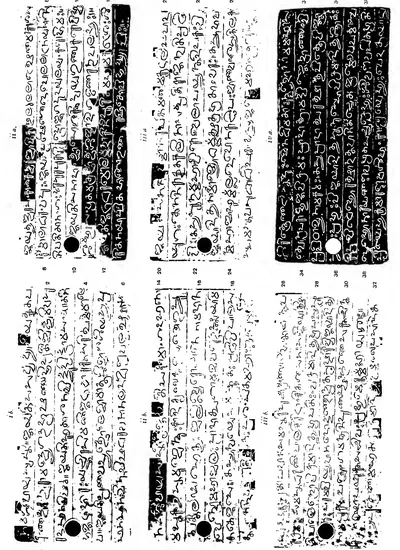
The plates were found at Gudimallam, in the Kalahasti zamindari.3 There are five plates, strung on a ring with a seal showing a bull lying down.3 Most of the text is in Sanskrit, in the Grantha script, with a short note in Tamil at the end.3 See the Gudimallam plates.
The plates say that an earlier king had granted the village of Viprapitha to Brahmins.1 Hultzsch showed that Viprapitha was the Sanskrit form of Tiruvippirambedu, the old name of Gudimallam.1 Vikramaditya had received a boon from the god of the Parasuramesvara temple there.1 So, with his father’s consent, he gave the Brahmins of the village “protection”, that is, he confirmed the old grant.1 The Tamil note says that the village’s revenue was 500 measures of paddy and 10 kalanju (a gold weight) of gold.1
The end of the Bana kingdom
V. Venkayya (1912) wrote that Vijayaditya Prabhumeru ruled until at least 909.2 So he thought Vikramaditya II became the leader of the Banas after that date.2 Either he or his successor, Venkayya wrote, was conquered by the Chola king Parantaka I, in or before 921–22.5 Parantaka gave the Bana kingdom to his Ganga vassal Prithivipati II.5 Hultzsch saw Prithivipati II as the Chola king’s candidate for the Bana throne and a temporary usurper.4
Where the sources disagree
- His rank when the plates were made. In his table of the Bana kings, Hultzsch marked him as heir-apparent.4 The plates say that he made the grant with his father’s consent.1 Venkayya placed his rule after 909.2
- The friend of King Krishna. Venkayya took the Udayendiram plates to make Vikramaditya II a friend of the Rashtrakuta king Krishna II.62 Hultzsch showed that the friend was the later Vikramaditya-Vijayabahu, and the king Krishna III.4
Footnotes
-
Hultzsch, “Gudimallam Plates” (1924), p. 2 (archive.org (opens in a new tab)). ↩ ↩2 ↩3 ↩4 ↩5 ↩6 ↩7 ↩8 ↩9 ↩10 ↩11
-
Venkayya, “Five Bana Inscriptions” (1912), p. 237 (archive.org (opens in a new tab)). ↩ ↩2 ↩3 ↩4 ↩5
-
E. Hultzsch, “Gudimallam Plates of the Bana King Vikramaditya II”, Epigraphia Indica XVII (1923–24), p. 1 (archive.org (opens in a new tab)). ↩ ↩2 ↩3 ↩4
-
Hultzsch, “Gudimallam Plates” (1924), p. 3 (archive.org (opens in a new tab)). ↩ ↩2 ↩3 ↩4 ↩5 ↩6
-
Venkayya, “Five Bana Inscriptions” (1912), p. 238 (archive.org (opens in a new tab)). ↩ ↩2
-
V. Venkayya, “Five Bana Inscriptions from Gudimallam”, Epigraphia Indica XI (1911–12), p. 236 (archive.org (opens in a new tab)). ↩
Photos
References
Notes (0)
Sources (2)
Spotted an error on this page? Tell us
Last updated: