Vikramendravarman II (Vishnukundin)
Vishnukundin king, eldest son of Indravarman, who issued the Chikkulla plates from Lendulura (Denduluru near Vengi) in his 10th year, giving a village on the Krishna to a Shiva temple. The plates say he took up the government as a child. Some scholars identify him with the Vikramahendra of the Polamuru plates, the grandfather of the last known Vishnukundin king; D. C. Sircar did not. Sircar dated him about 655–670, and the scheme printed by Sewell in 1932 about 496–521.
The donor of the Chikkulla plates
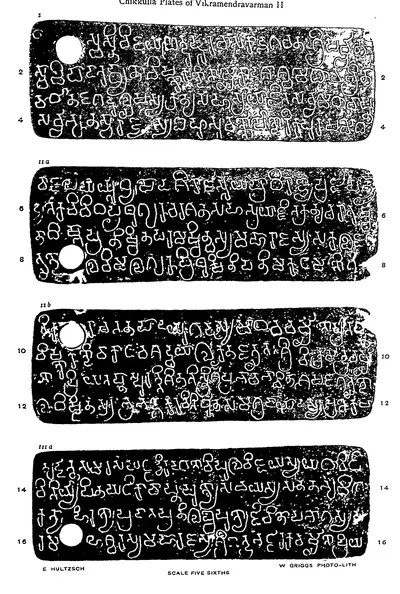
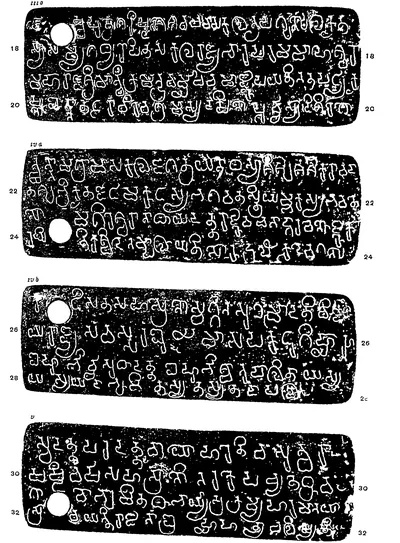
Vikramendravarman II is known from one grant, the Chikkulla plates, the first Vishnukundin record to be published (by F. Kielhorn in 1897).12 They were issued “from his residence, the victorious Lendulura”.34 J. Ramayya identified Lendulura with Dendaluru (Denduluru), a village on the ruins of the city of Vengi about five miles north-east of Eluru (then Ellore).34
In the plates he calls himself a devout worshipper of Maheshvara (Shiva) and one who meditates on the feet of the holy lord of Sriparvata.45
Family
Vikramendravarman II was the eldest son of Indravarman, the Indrabhattarakavarman of the Chikkulla plates.24 Through his father he was the grandson of Vikramendravarman I and the great-grandson of the Maharaja Madhavavarman, the performer of eleven horse sacrifices.2 See Indravarman and Madhavavarman.
A child king
In Kielhorn’s translation the plates describe him as the Maharaja Vikramendravarman, “who, in childhood already embellished with all the virtues of a king, has duly taken upon himself the whole burden of government”.5 R. S. Panchamukhi took this to mean that he came to the throne as a child because his father died young.6 On that ground Panchamukhi limited his reign to no more than about 27 years.6
The grant
In the 10th year of his reign, on the 5th day of the 8th fortnight of summer, Vikramendravarman II gave the village of Regonram to the temple of Somagirishvaranatha.25 Somagirishvaranatha was a form of Tryambaka (Shiva).25 Regonram lay south-east of the village of Ravireva, on the bank of the Krishnabenna (the Krishna), in a district whose name Kielhorn read as Nat[ri?]pati.25
Robert Sewell identified Ravireva with Ravirela, as reported by Jouveau-Dubreuil in 1920 and by Sewell and Aiyangar in 1932.78 Dubreuil took the grant as proof that the king reigned on the banks of the Krishna.7 D. C. Sircar thought Somagirishvaranatha was probably the name of a linga (stone emblem of Shiva) in a temple at Lendulura.9
Was he the Vikramahendra of the Polamuru plates?
The Polamuru plates of the Vishnukundin Madhavavarman Janashraya trace that king’s descent from a Vikramahendra through his son Govindavarman.10 In the epigraphical report for 1913–14 H. Krishna Sastri considered whether this Vikramahendra was a corrupt form of Vikramendra, that is, Vikramendravarman II.10 That would add two generations to the line, but he thought the later style of the letters made this doubtful.10
The report for 1919–20 did place the Polamuru kings after Vikramendravarman II, because of their script and the title Janashraya.11 Several scholars identified Vikramahendra with Vikramendravarman II outright.127131415 They were Jouveau-Dubreuil, K. V. Lakshman Rao (whose scheme Sewell and Aiyangar printed), M. Somasekhara Sarma and Panchamukhi.127131415
Sircar disagreed.1617 In his view the Madhavavarman of the Polamuru plates was the great sacrificer Madhavavarman I.1617 So Vikramahendra was his grandfather and the earliest known king of the family, not the last.1617
K. R. Subramanian also kept them apart.1819 He made the Polamuru Govindavarman a son of Vikramendravarman II, but would not identify him with the Govindavarman of the first set of Ipur plates.1819 See the Vishnukundins page for the competing family trees.
Date
The plates carry only a year of reign.5 Kielhorn wrote before any other Vishnukundin record was known.3 He thought the plates not later than about the end of the 8th century, and probably not much earlier.3 Later reconstructions put the king much earlier:
| Source | Date proposed |
|---|---|
| K. V. Lakshman Rao, in Sewell (1932)13 | About 496–521 |
| Somasekhara Sarma (JAHRS, 1930–31)14 | Vikramendravarman about 496–521, following Lakshman Rao |
| Sircar (1939)20 | About 655–670 |
Sewell and Aiyangar also entered his grant of land near Ravireva among the records of about the 6th century.8 The reign chart on the Vishnukundins page follows Sircar.
Footnotes
-
F. Kielhorn, “Chikkulla Plates of Vikramendravarman II”, Epigraphia Indica IV (1897), p. 193 (archive.org (opens in a new tab)). ↩
-
Kielhorn, “Chikkulla Plates” (1897), p. 194 (archive.org (opens in a new tab)). ↩ ↩2 ↩3 ↩4 ↩5 ↩6
-
Kielhorn, “Chikkulla Plates” (1897), p. 195 (archive.org (opens in a new tab)). ↩ ↩2 ↩3 ↩4
-
Kielhorn, “Chikkulla Plates” (1897), p. 197, translation (archive.org (opens in a new tab)). ↩ ↩2 ↩3 ↩4
-
Kielhorn, “Chikkulla Plates” (1897), p. 198, translation (archive.org (opens in a new tab)). ↩ ↩2 ↩3 ↩4 ↩5 ↩6
-
R. S. Panchamukhi, “Tandivada Grant of Prithivi-Maharaja: 46th Year”, Epigraphia Indica XXIII (1936), p. 93 (archive.org (opens in a new tab)). ↩ ↩2
-
Jouveau-Dubreuil, Ancient History of the Deccan (1920), p. 92 (archive.org (opens in a new tab)). ↩ ↩2 ↩3 ↩4
-
Robert Sewell and S. Krishnaswami Aiyangar, The Historical Inscriptions of Southern India (1932), p. 21 (archive.org (opens in a new tab)). ↩ ↩2
-
Sircar, Successors of the Satavahanas (1939), p. 139 (archive.org (opens in a new tab)). ↩
-
Annual Report on Epigraphy, Madras, for 1913–14 (1914), Part II, para. 35, p. 102 (archive.org (opens in a new tab)). ↩ ↩2 ↩3
-
Annual Report on Epigraphy, Madras, for 1919–20 (1920), Part II, para. 10, p. 99 (archive.org (opens in a new tab)). ↩
-
G. Jouveau-Dubreuil, Ancient History of the Deccan (1920), p. 90 (archive.org (opens in a new tab)). ↩ ↩2
-
Sewell and Aiyangar, Historical Inscriptions of Southern India (1932), p. 404 (archive.org (opens in a new tab)). ↩ ↩2 ↩3
-
M. Somasekhara Sarma, “Indrabhattaraka and the Ganga Era”, Journal of the Andhra Historical Research Society V, pt. 3 (1930–31), pp. 184–185 (archive.org (opens in a new tab)). ↩ ↩2 ↩3
-
Panchamukhi, “Tandivada Grant” (1936), p. 95, genealogical table (archive.org (opens in a new tab)). ↩ ↩2
-
D. C. Sircar, The Successors of the Satavahanas in Lower Deccan (1939), p. 103 (archive.org (opens in a new tab)). ↩ ↩2 ↩3
-
Sircar, Successors of the Satavahanas (1939), p. 107 (archive.org (opens in a new tab)). ↩ ↩2 ↩3
-
K. R. Subramanian, Buddhist Remains in Andhra and the History of Andhra between 225 and 610 A.D. (1932), p. 114 (archive.org (opens in a new tab)). ↩ ↩2
-
Subramanian, Buddhist Remains in Andhra (1932), p. 117 and note 3 (archive.org (opens in a new tab)). ↩ ↩2
-
Sircar, Successors of the Satavahanas (1939), p. 112, chronological table (archive.org (opens in a new tab)). ↩
Photos
Related
Dynasties
References
Notes (0)
Sources (9)
Spotted an error on this page? Tell us
Last updated: