Aurangabad
City in the Marathi-speaking north-west of the former Hyderabad State (now in Maharashtra), founded as Fatehnagar by Malik Ambar in 1610 and renamed by Aurangzeb. Asaf Jah came here as viceroy of the Deccan, and according to the Imperial Gazetteer he later made Hyderabad his capital. Salabat Jang's court and Bussy's French troops were at Aurangabad in the 1750s. Under the Nizams it was the head-quarters of a Division and a cantonment of the Hyderabad Contingent. Asaf Jah is buried at Khuldabad nearby.
Aurangabad lies in the Marathi-speaking north-west of the former dominions of the Asaf Jahi Nizams, outside the Telugu country. The Imperial Gazetteer of 1909 calls it the second city of the state “in point of historical interest and size”, with 36,837 people in 1901. It says that the Ahmadnagar minister Malik Ambar founded it in 1610 near the village of Kharki, and called it Fatehnagar.1 Aurangzeb, as viceroy of the Deccan, renamed it Aurangabad.1
Under the Nizams
The Imperial Gazetteer says that after Aurangzeb’s death “Asaf Jah, the first Nizam, came to Aurangabad, and, having declared his independence, subsequently made Hyderabad his capital”.1
Mudiraj’s Pictorial Hyderabad (1929) says that Asaf Jah returned to Aurangabad after his first campaigns against the Marathas in 1714.23 He married his principal wife, Syed-un-Nissa Begum, there.23 Near Aurangabad he defeated his rebellious son Nasir Jang in 1741.23
Gribble’s History of the Deccan describes Salabat Jang’s entry into Aurangabad in June 1751.4 Bussy’s French troops were quartered in its fort and acted as the town’s police.5 In 1753 the Nizam moved there from Hyderabad.6
Briggs describes the treaty with the Marathas after the battle of Udgir in 1760.7 He says that by it the Nizam gave up the province of Aurangabad except the city and two of its parganas.7
Decline
Campbell (1898) says that Aurangabad remained a great trading centre “down to the time of the first of the Nizams”.8 But “with the removal of the capital to Hyderabad, however, the fate of Aurangabad was practically sealed”.8 Elsewhere he dates its eclipse to 1720, “when the Hyderabad dynasty was founded, with Hyderabad as the capital”.9
In 1909 Aurangabad was the head-quarters of the Aurangabad Division, District and taluk.110 Its cantonment of the Hyderabad Contingent saw a mutiny in 1857, which a force from Poona put down.110 The gazetteer lists among its monuments “the ancient palace of the Nizam near Borapal”.10 Fourteen miles away, at Khuldabad (Rauza), are the tombs of Aurangzeb and of Asaf Jah.11
Footnotes
-
Imperial Gazetteer of India: Hyderabad State (1909), p. 208 (archive.org (opens in a new tab)). ↩ ↩2 ↩3 ↩4 ↩5
-
K. Krishnaswamy Mudiraj, Pictorial Hyderabad, Vol. I (1929), p. 51 (archive.org (opens in a new tab)). ↩ ↩2 ↩3
-
Mudiraj, Pictorial Hyderabad (1929), p. 55 (archive.org (opens in a new tab)). ↩ ↩2 ↩3
-
J. D. B. Gribble (ed. M. Pendlebury), A History of the Deccan, Vol. II (1924), p. 30 (archive.org (opens in a new tab)). ↩
-
Gribble, History of the Deccan, Vol. II (1924), p. 31 (archive.org (opens in a new tab)). ↩
-
Gribble, History of the Deccan, Vol. II (1924), pp. 36–37 (archive.org (opens in a new tab)). ↩
-
Henry George Briggs, The Nizam, Vol. I (1861), p. 62 (archive.org (opens in a new tab)). ↩ ↩2
-
Campbell, Glimpses of the Nizam’s Dominions (1898), p. 378 (archive.org (opens in a new tab)). ↩ ↩2
-
A. Claude Campbell, Glimpses of the Nizam’s Dominions (1898), p. 374 (archive.org (opens in a new tab)). ↩
-
Imperial Gazetteer: Hyderabad (1909), p. 209 (archive.org (opens in a new tab)). ↩ ↩2 ↩3
-
Imperial Gazetteer: Hyderabad (1909), p. 213 (archive.org (opens in a new tab)). ↩
Photos
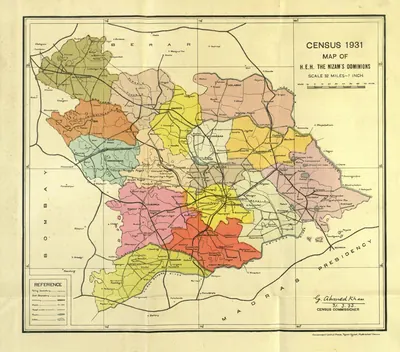 "Census 1931 Map of H.E.H. the Nizam's Dominions" (coloured) (Census of India 1931, Hyderabad, folding map, PDF p. 3)Map · 1933
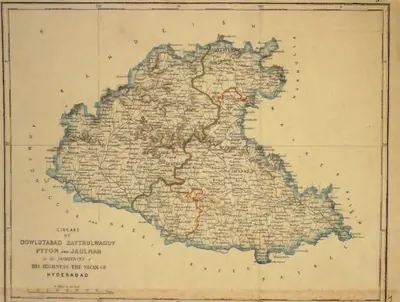 "Circars of Dowlutabad, Baythulwaddy, Pyton and Jaulnah, in the Dominions of His Highness the Nizam of Hyderabad" (map No. 12, atlas presented to the Nizam, 1865), with Aurangabad markedMap · 1865
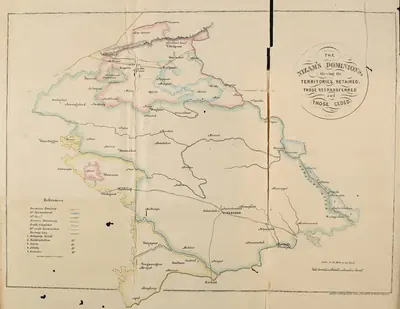 "The Nizam's Dominions, shewing the territories retained, those retransferred and those ceded" (coloured map) (Briggs 1861, folding map, PDF p. 26)Map · 1861
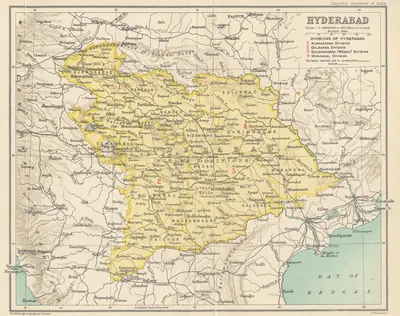 Hyderabad State (Imperial Gazetteer, 1909)Map · 1909
Related
Dynasties
People
Charles de Bussy
1718 CE
French general, born in 1718, who commanded the French troops at the court of the Nizams Muzaffar Jang and Salabat Jang from 1751 to 1758. He raised Salabat Jang to the throne and obtained from him the four Northern Circars for the French Company in 1753. He governed them through the Raja of Vizianagaram and the zamindars. In 1757 he destroyed the fort of Bobbili and took the English factories on the coast. Lally recalled him to the Carnatic in 1758, and he left the Circars to be lost to Colonel Forde.
Nizam-ul-Mulk Asaf Jah I (Mir Qamar-ud-din)
1724–1748 CE
Founder of the Asaf Jahi dynasty and first Nizam of Hyderabad. A Mughal noble of Turani descent, born at Delhi in 1671, he was made viceroy of the Deccan in 1713 with the title Nizam-ul-Mulk. He defeated and killed the governor Mubariz Khan at Shakar Kheda in Berar in 1724, received the title Asaf Jah, and ruled the Deccan as an independent sovereign until his death at Burhanpur in 1748. He is buried at Khuldabad near Aurangabad.
Nasir Jang (Mir Ahmad Khan)
1748–1750 CE
Second son of Nizam-ul-Mulk Asaf Jah I. He seized the treasury and the throne of the Deccan when his father died in 1748. The English backed him against his nephew Muzaffar Jang and the French. He took Muzaffar Jang prisoner in 1750. In December 1750 the Nawab of Cuddapah shot him dead on his elephant, in a plot encouraged by Dupleix.
Salabat Jang
1751–1761 CE
Third son of Nizam-ul-Mulk Asaf Jah I, raised to the throne of the Deccan by the French commander Bussy in 1751. Under Bussy's protection he defeated the Marathas and his elder brother Ghazi-ud-din, and in 1753 assigned the Northern Circars to the French. After Colonel Forde drove the French from the coast, he ceded Masulipatam to the English (1759). His brother Nizam Ali took power as his minister, deposed him in 1761 or 1762 and had him killed in prison about 1763.
Madhavrao I
1761–1772 CE
Peshwa (chief minister) of the Marathas from 1761 to his death in November 1772, and the son of Balaji Baji Rao. As a young man he fought beside his uncle Raghunath Rao against Nizam Ali at Rakshasbhuvan on the Godavari in 1763. In his wars with Haidar Ali of Mysore he took Sira in 1767, and the Mysore commander Mir Sahib then received Gurramkonda from the Marathas. His uncle Trimbak Rao took Gurramkonda by siege in 1771. The treaty of June 1772 left it with the Marathas until Tipu took it back in 1773–74.
Nizam Ali Khan (Asaf Jah II)
1761–1803 CE
Fourth son of Nizam-ul-Mulk Asaf Jah I. He pushed aside his brother Salabat Jang in 1761–62 and ruled the Deccan until his death at Hyderabad in 1803. In his reign the Northern Circars passed to the East India Company (1766, Guntur in 1788). The Nizam joined the British against Tipu Sultan, was defeated by the Marathas at Kharda (1795) and accepted a permanent subsidiary force (1798). To pay for it he gave up his Mysore gains, the later Ceded Districts of Rayalaseema (1800). He is the first Nizam buried at the Mecca Masjid.
References
Notes (0)
Sources (5)
Spotted an error on this page? Tell us
Last updated: