Arumbaka plates of Badapa
Five undated Sanskrit copper plates of Badapa, son of Yuddhamalla II, found buried in a pot at Polamuru in the Tanuku taluk in 1921. Badapa claims that, with the help of the Rashtrakuta king called Karnaraja-Vallabha, he drove Amma II out of Vengi. He gives the village of Arumbaka, in the Velanandu district (now in Repalle taluk), to the archer Gandanarayana, a brother-in-law of Amma II, who passes it to his cousin. Editors disagree over whether Badapa really ruled, and for how long.
These plates are the grant of Badapa, a prince of the junior line of the Eastern Chalukyas and a son of Yuddhamalla II.1 K. V. Lakshmana Rao edited them in 1928, together with the Sripundi plates of Badapa’s younger brother Tala II.1 He wrote that both princes had not been known before.1
Their importance lies in one claim.23 The grant claims that Badapa, with Rashtrakuta help, drove the reigning king Amma II out of the country.23
Discovery and description
According to Lakshmana Rao, the plates were found in 1921 buried underground in a pot at Polamuru.14 Polamuru is in the Tanuku taluk of what was then the Krishna (then Kistna) district.14 He got the plates from a gentleman of the village and sent them to the Assistant Archaeological Superintendent for Epigraphy at Madras.14 They were registered as No. 16 of Appendix A in the epigraphy report for 1920–21.14
There are five plates, 4½ inches high and 9 inches broad.14 They hang on a ring 5 inches across, which had not been cut when the plates were first sent to the editor.14 A massive seal is fixed to the ring.14
The 1921 report describes the seal.14 It has a crescent at the top, with an elephant-goad (ankusa) laid horizontally below it.14 Then comes the legend Sri-Tribhuvanankusa in two lines.14 Below that is the boar standing on a lotus, with the sun near the boar’s head.14
Language and the name
The language is Sanskrit.2 Lakshmana Rao noted a Dravidian letter, the la of Tamil.2 The Bezwada pillar inscription of Yuddhamalla had first shown this letter to exist in early Telugu.2
The same letter is used in the name Tala, which the family’s grants spell in several ways.2 He took the variation as a sign that the sound gave way to da in the Telugu country and to la in the Kannada country.2 He read the donor’s name with a dental d, Badapa, where the epigraphy reports had a lingual d.1
Content
After the usual praise of the Chalukya family, the grant lists the kings from Kubja-Vishnuvardhana to Chalukya-Bhima II with their reigns.2 Lakshmana Rao noted that these agree with those in other grants of the family.2
In his translation, the list runs from Kubja-Vishnuvardhana (18 years) through Gunaga-Vijayaditya (44 years) and Chalukya-Bhima I (30 years).5 It goes on to Kollabiganda-Vijayaditya (6 months) and Amma I (7 years).5 Then come:5
- Talapa, who dethroned Amma I’s son Vijayaditya, “who was a boy”, and reigned for one month5
- Vikramaditya, the son of Chalukya-Bhima, for eleven months5
- Talaparaja’s son Yuddhamalla, for seven years5
- Bhimaraja, the son of Kollabiganda-Vijayaditya, who conquered him, for twelve years5
The grant then praises Amma II, Bhima’s son by Lokamahadevi, who “ruled well the Vengi country with Trikalinga”.25 It does not give the length of his reign.25
The next verse, in Lakshmana Rao’s translation, says: “Badapa with the help of the Vallabha (king) called Karnaraja drove away from the country the prosperous (king) called Ammaraja”.5 Badapa, “son of king Yuddhamalla, lord of Vengi”, is said to have defeated his agnates (dayadas, kinsmen).5 He is said to rule the earth according to the laws of Manu.5 He takes the titles Samastabhuvanasraya, Vijayaditya, Maharajadhiraja, Paramesvara and Paramamahesvara, and is also called Adhiraja.25
Badapa addresses “all the chiefs of families headed by the Rashtrakutas” of the Velanandu district (vishaya).5 He gives the village of Arumbaka in Velanandu, free of all taxes, to Gandanarayana, whose name was Bhaskara.67 Gandanarayana in turn gives it to Chandena, the son of Samakamba, his mother’s younger sister.67
The boundaries are Cherakumballi to the east, Sripundi to the south, Kavuru to the west and Gomaduvu to the north.87 The executor (ajnapti) was Kataka-nripa, the poet Ayyana-bhatta and the writer Bhattadeva.87
Lakshmana Rao identified Arumbaka with the village of the same name in the Repalle taluk of Guntur district.8 He found the other villages within four miles of it.8 He took Sripundi to be Sripudi and Cherakumballi to be Cherukumilli, and he found Kavuru under its old name.8
He was told that Gomaduvu was Govada, three miles to the north in the Tenali taluk.8 Sripundi, the southern boundary, is the village granted by Badapa’s brother in the Sripundi plates.8 The 1921 report made the same identification of Arumbaka.3 See Arumbaka.
The family of the man who received the grant
More than thirty lines praise the donee and his ancestors.8 His grandfather is named in the plates as an expert archer.29 The grandfather had a son Nripakama, called Karmuk-arjuna (“an Arjuna with the bow”), Satya-Ballata and Saronatha, “lord of the lake”.29 Nripakama’s wife was Nayamamba, and their son was Gandanarayana.29
Lakshmana Rao took Nripakama for a petty chief, perhaps of the region of the Kolleru lake.6 The 1921 report read the grandfather’s name as Choladitya.3 It suggested that “lord of the lake” meant lord of Kolanu.3 It linked the family with the later Kolanu chiefs and, through Kielhorn’s list, with a Chola family.3
Lakshmana Rao identified Nripakama and Nayamamba with the father-in-law and mother-in-law of Amma II named in the Gundugolanu plates.6 That made Gandanarayana a brother-in-law of the king whom Badapa claimed to have expelled.6 He found it “very strange” that Badapa should patronise him.6 He suggested that political adventurers often changed sides, and that Gandanarayana may have helped to overthrow Amma II.6
B. V. Krishna Rao, writing in 1930, also held that Amma II’s father-in-law, mother-in-law and brother-in-law turned against the king.10 In his view Bhaskara deserted to Badapa.10
Who was Karnaraja-Vallabha?
Lakshmana Rao took Karnaraja-Vallabha to be a Rashtrakuta king, “as the epithet Vallabha clearly indicated”.8 He identified him with Kanna or Krishna III, a contemporary of Amma II whom he dated 939–968.8 He thought the poet had mistaken the name Kanna for a form of Karna, though it was a Prakrit form of Krishna.8
The 1921 report read the name as “the Vallabha (i.e., Rashtrakuta) Krishnaraja”.3 It also identified the ally with Krishna III.3
Date, and the years without a ruler
The plates are not dated, and the editors drew different conclusions from Badapa’s claim:
- The 1921 epigraphy report assigned the grant to the years immediately after 956.43 It relied on the Mangallu grant, which says that Amma II left for the north after eleven years.43 It concluded that Danarnava ruled the Natavadi district in the west in Amma’s name.43 It held that the pretender Badapa meanwhile held the Velanandu district in the east, “perhaps temporarily”.43
- K. V. Lakshmana Rao (1928) argued that Badapa conquered Amma II and reigned immediately after him.8 So, in his view, Badapa issued the grant after Amma’s twenty-five years ended in 970.8 The later grants place twenty-seven years without a ruler after Danarnava, 973–999.8 In Lakshmana Rao’s view this was no interregnum: the junior line had then ruled the country, and the senior line, in exile, did not recognise it.8 He promised a separate article on this period, but died before writing it.8
- H. Krishna Sastri, editing the volume, added a note that this was “very doubtful”.8 In his view the wording could not show that Badapa had ousted Amma II “once for all”, and Badapa might have displaced him for a time.8 He cited the Mangallu plates, by which Amma II went in his eleventh year to fight Krishna III.8 By the Arumbaka plates, this was the king who befriended Badapa.8
- B. V. Krishna Rao (1930) held that Badapa seized the throne about 970 with the help of the Rashtrakutas and the “traitor” Bhaskara.11 He thought that the civil war of 970–973 was Danarnava’s struggle against Badapa.11 In his view Badapa’s rule, perhaps twenty-seven years long, was the period the later kings called the interregnum.11
- B. V. Krishna Rao (1936), editing the Tandikonda grant, described Amma II’s expedition to Kalinga as a war against a coalition led by Krishna III.12 Krishna III, he wrote, wished to put his protégé Badapa on the throne.12 He cited the Arumbaka plates for this.12
- V. Rangacharya (1960) thought that Yuddhamalla II’s two sons had fled to the Rashtrakuta court after their father’s fall in 933–34.1314 In his view, Krishna III, incited by them, invaded Vengi in or a little before 956.1314
Footnotes
-
K. V. Lakshmana Rao, “Two Copper-plate Inscriptions of Eastern Chalukya Princes”, Epigraphia Indica XIX (1927–28), p. 137 (archive.org (opens in a new tab)). ↩ ↩2 ↩3 ↩4 ↩5 ↩6 ↩7 ↩8 ↩9 ↩10 ↩11 ↩12 ↩13 ↩14 ↩15
-
Lakshmana Rao, “Two Copper-plate Inscriptions” (1928), p. 139 (archive.org (opens in a new tab)). ↩ ↩2 ↩3 ↩4 ↩5 ↩6 ↩7 ↩8 ↩9 ↩10 ↩11 ↩12 ↩13 ↩14 ↩15
-
Annual Report on Epigraphy, Madras, for 1920–21 (1921), Part II, para. 14, p. 91 (archive.org (opens in a new tab)). ↩ ↩2 ↩3 ↩4 ↩5 ↩6 ↩7 ↩8 ↩9 ↩10 ↩11 ↩12
-
Annual Report on Epigraphy, Madras, for 1920–21 (1921), Part II, paras. 13–14, p. 90 (archive.org (opens in a new tab)). ↩ ↩2 ↩3 ↩4 ↩5 ↩6 ↩7 ↩8 ↩9 ↩10 ↩11 ↩12 ↩13 ↩14 ↩15
-
Lakshmana Rao, “Two Copper-plate Inscriptions” (1928), p. 146, translation (archive.org (opens in a new tab)). ↩ ↩2 ↩3 ↩4 ↩5 ↩6 ↩7 ↩8 ↩9 ↩10 ↩11 ↩12 ↩13 ↩14
-
Lakshmana Rao, “Two Copper-plate Inscriptions” (1928), p. 141 (archive.org (opens in a new tab)). ↩ ↩2 ↩3 ↩4 ↩5 ↩6 ↩7
-
Lakshmana Rao, “Two Copper-plate Inscriptions” (1928), p. 148, translation (archive.org (opens in a new tab)). ↩ ↩2 ↩3 ↩4
-
Lakshmana Rao, “Two Copper-plate Inscriptions” (1928), p. 140, with notes 1 and 2 by H. Krishna Sastri and the editor (archive.org (opens in a new tab)). ↩ ↩2 ↩3 ↩4 ↩5 ↩6 ↩7 ↩8 ↩9 ↩10 ↩11 ↩12 ↩13 ↩14 ↩15 ↩16 ↩17 ↩18 ↩19 ↩20
-
Lakshmana Rao, “Two Copper-plate Inscriptions” (1928), p. 147, translation (archive.org (opens in a new tab)). ↩ ↩2 ↩3
-
B. V. Krishna Rao, “Telugu Academy Plates of Saktivarman II”, Journal of the Andhra Historical Research Society V, pt. 1 (1930), p. 35 (archive.org (opens in a new tab)). ↩ ↩2
-
Krishna Rao, “Telugu Academy Plates of Saktivarman II” (1930), p. 36 (archive.org (opens in a new tab)). ↩ ↩2 ↩3
-
B. V. Krishna Rao, “Tandikonda Grant of Ammaraja II”, Epigraphia Indica XXIII (1935–36), p. 162 (archive.org (opens in a new tab)). ↩ ↩2 ↩3
-
V. Rangacharya, “Mangallu Grant of Amma II”, Epigraphia Indica XXXI (1955–56, publ. 1960), p. 39 (archive.org (opens in a new tab)). ↩ ↩2
-
Rangacharya, “Mangallu Grant of Amma II” (1960), p. 40 (archive.org (opens in a new tab)). ↩ ↩2
Photos
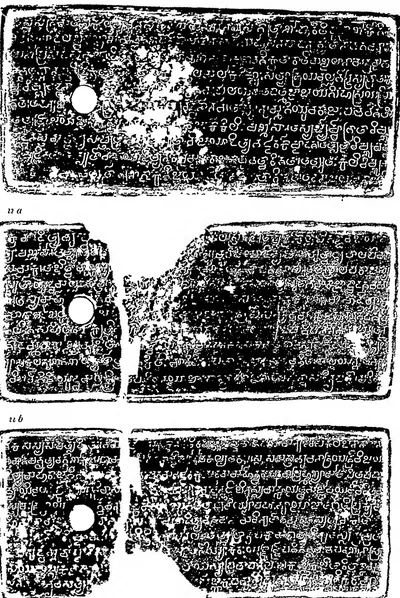 "Arumbaka Plates of Badapa", plates i, ii a and ii b (Epigraphia Indica XIX, plate between pp. 142 and 143 (PDF p. 200))Inscription rubbing · 1928
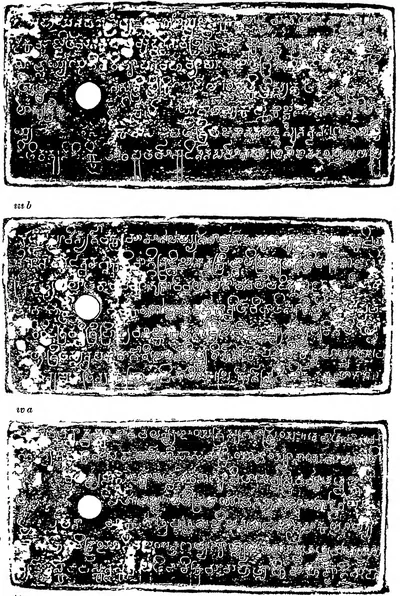 "Arumbaka Plates of Badapa", plates iii a, iii b and iv a (Epigraphia Indica XIX, plate between pp. 142 and 143 (PDF p. 201))Inscription rubbing · 1928
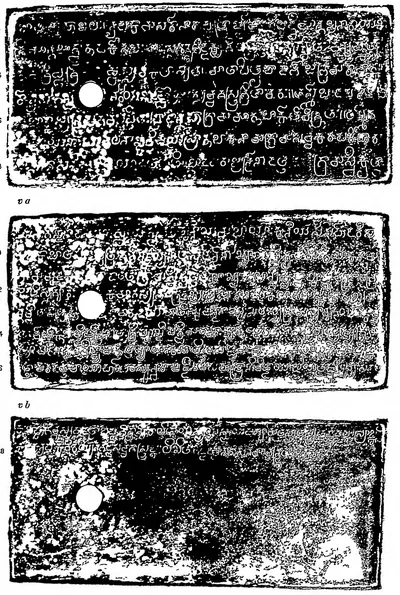 "Arumbaka Plates of Badapa", plates iv b, v a and v b (Epigraphia Indica XIX, plate between pp. 144 and 145 (PDF p. 204))Inscription rubbing · 1928
References
Notes (0)
Sources (5)
Spotted an error on this page? Tell us
Last updated: