Dantidurga
Rashtrakuta king (about 753–756) who overthrew the Chalukyas of Badami and founded the Rashtrakuta supremacy of the Deccan. His Samangad grant of January 754 says that he won the sovereignty by conquering the Chalukya 'Vallabha'. An inscription at Ellora lists among the rulers he subdued those of Kalinga, Kosala and the Srisaila country, which J. F. Fleet took to be the Kurnool country.
Dantidurga was the first king of the Rashtrakuta dynasty of Malkhed.12 In J. F. Fleet’s words he was “the real founder of it”.12 He ended the rule of the Chalukyas of Badami, whose lands included the Alampur and Kurnool country of the Telugu country.12
Family
Dantidurga was a son of the Rashtrakuta Indra II and of a Chalukya princess.34 Fleet noted that the wife of Indra II, whose name is not given, was the daughter of a Chalukya father and of a mother of the Lunar race.13 He inferred that until then the Rashtrakutas had not come into conflict with the Chalukyas.13 Robert Sewell went further and named the Chalukya king Vijayaditya as the one who gave the princess in marriage.13
Fleet’s genealogical table makes Karka I the father of both Indra II and Krishna I.4 Krishna I, who succeeded Dantidurga, was his paternal uncle.5
The conquest of the Chalukyas
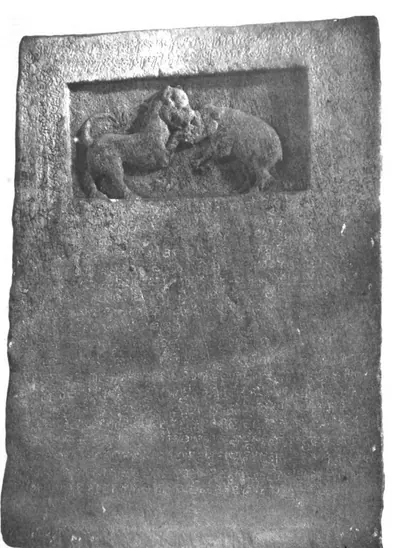
Dantidurga’s only record is a copper-plate grant from Samangad in the Kolhapur State.15 It is dated on a day that Fleet equated with 5 January 754.15 In it he has the title Khadgavaloka and the full imperial titles.15
The grant says that his elephants broke down the banks of the Mahi, the Mahanadi and the Reva (Narmada).15 It says that he won the supreme sovereignty by conquering “Vallabha”.15 Fleet wrote that this was the Chalukya king Kirtivarman II.15 The grant adds that “with but a small force, he quickly overcame the boundless Karnataka army”.15
Fleet concluded that by 754 Dantidurga and his kinsmen had taken all but the southern provinces of the Chalukya kingdom.16 Krishna I completed the conquest.16 Sewell dated the collapse of the Chalukyas to 753.7 He wrote that Dantidurga seized their capital and then went on to conquer the Pallavas, occupying Kanchi some time after 754.7
The Ellora list and the Telugu country
There is an unfinished inscription in the Dasavatara cave at Ellora, which carries the family line as far as Amoghavarsha I.18 It says that Dantidurga completed his conquest by subduing a series of rulers.18 Fleet read among them the lord of Kanchi, the rulers of Kalinga and Kosala, and “the lord of the Srisaila country, i.e. the Karnul territory”.18
The Pandit Bhagwanlal Indraji first published the inscription.18 He read eight names: Sandhubhupa, Kanchi, Kalinga, Kosala, Srisaila, Malava, Lata and Tanka.18 Fleet gives no further detail of these campaigns, and none of the claims is dated.1
Succession
Dantidurga’s successor was his uncle Krishna I.56 A later record says that Dantidurga died without children.56 An earlier one, the Baroda grant of 812, says that Krishna “uprooted his relative” who “had resorted to evil ways”.56 Fleet thought this the more probable account.56
D. R. Bhandarkar disagreed when he edited the Alas plates of 770 in 1901.9 He pointed to a verse saying that Krishna became king after Dantidurga had gone to heaven.9 This verse occurs in the Alas plates themselves, issued in Krishna’s own reign, and in the Paithan grant of 794.9 He thought the Baroda grant merely passed over Dantidurga because he belonged to a side branch of the reigning prince’s family.9
Footnotes
-
J. F. Fleet, “Dynasties of the Kanarese Districts”, Gazetteer of the Bombay Presidency I, pt. II (1896), p. 389 (archive.org (opens in a new tab)). ↩ ↩2 ↩3 ↩4 ↩5 ↩6 ↩7 ↩8 ↩9 ↩10 ↩11 ↩12 ↩13 ↩14 ↩15 ↩16 ↩17 ↩18 ↩19 ↩20 ↩21
-
Imperial Gazetteer of India, Provincial Series: Hyderabad State (1909), p. 10 (archive.org (opens in a new tab)). ↩ ↩2 ↩3
-
Robert Sewell, The Historical Inscriptions of Southern India (1932), p. 27 (archive.org (opens in a new tab)). Paraphrased. ↩ ↩2 ↩3 ↩4
-
Fleet, “Dynasties of the Kanarese Districts” (1896), genealogical table “The Rashtrakutas of Malkhed”, facing p. 386 (archive.org (opens in a new tab)). ↩ ↩2
-
Fleet, “Dynasties of the Kanarese Districts” (1896), p. 390 (archive.org (opens in a new tab)). ↩ ↩2 ↩3 ↩4 ↩5 ↩6 ↩7 ↩8 ↩9 ↩10 ↩11 ↩12
-
Fleet, “Dynasties of the Kanarese Districts” (1896), p. 391 (archive.org (opens in a new tab)). ↩ ↩2 ↩3 ↩4 ↩5 ↩6
-
Sewell, Historical Inscriptions (1932), p. 29 (archive.org (opens in a new tab)). Paraphrased. ↩ ↩2
-
Fleet, “Dynasties of the Kanarese Districts” (1896), p. 403, note 3 (archive.org (opens in a new tab)). ↩ ↩2 ↩3 ↩4 ↩5
-
D. R. Bhandarkar, “Alas Plates of the Yuvaraja Govinda II; Saka-Samvat 692”, Epigraphia Indica VI (1901), p. 209 (archive.org (opens in a new tab)). ↩ ↩2 ↩3 ↩4
Related
Dynasties
References
Notes (0)
Sources (4)
Spotted an error on this page? Tell us
Last updated: