Kakinada
Port on the Godavari coast, known to the English as Cocanada, which grew as Coringa silted up. Its southern suburb, Jagannathapuram, was a Dutch factory (trading post) with a mint from the seventeenth century until 1825. A French party that landed there in 1759 was forced to surrender in the Dutch fort. Cocanada was one of the first Collectorates of the Northern Circars in 1794.
Kakinada, the Cocanada of the Company’s records, is the chief port of the Godavari coast.1 The Godavari gazetteer (1907) says that the town first grew when Coringa bay silted up.1 It grew again during the American Civil War, when it shipped the cotton pressed at Guntur.1 The gazetteer adds that the name Kakinada “is supposed to have some connection with the phenomenal number of crows which live in it”.1 See Dutch East India Company.
Jagannathapuram
The gazetteer says that the part of the town with a history is Jagannathapuram, south of the harbour, “the site of a Dutch Factory”.2 Morris’s Godavari manual says that the original name of the place was “Daatijeroon”.34 The factory, with two villages used for bleaching cloth, belonged to the Dutch Company, and it was “defended by rude ramparts of earth”.34
The gazetteer quotes the report of W. Hodgson.2 According to it, the factory was held under farmans (royal orders) dated from 1628 to 1713, like Bheemunipatnam (then Bimlipatam) and Palakollu.2 Its mint struck the coins issued from Bheemunipatnam.2
The English Committee of Circuit reported on the factory in 1787.56 It found that the Dutch imported about a lakh of Madras pagodas a year at Jagannathapuram.56 They held the villages of Jagannathapuram, Gollapalem and Gundavaram in the Pithapuram zamindari (landholder’s estate), and paid a quit-rent (fixed rent) for them to the English Company.56 They also levied duties in the Cocanada river.56
The English took the factory in 1781.2 Then “the factory house, fortified I believe, and all the public buildings were demolished”.7 The English took it again in the 1790s.289 It was restored to the Dutch in 1785 and 1818, and it passed to the English for good in 1825.289 In 1794 the Dutch there told the Chief and Council at Machilipatnam (then Masulipatam) that their Company had given up its trade on the coast two years before.10
1759
The Dutch factory had a part in the French war. The gazetteer says that French officers wounded at Condore in December 1758 were allowed to go to Jagannathapuram on parole.2 In November 1759 Moracin landed at Kakinada with French troops.11 In December another small French party landed there.12 Captain Fischer drove them into the Dutch fort, and they were made to surrender, though the Dutch protested.122 See French East India Company and Chandurti.
Under the Company
In 1794 the Chiefs and Councils of the Northern Circars were abolished.13 Kakinada then became one of the three first Collectorates of the Godavari country, with Rajahmundry and Mogalturru.13 In the Jagannathapuram cemetery the oldest monument is to a Dutch family buried between 1775 and 1778.1 See East India Company.
Footnotes
-
F. R. Hemingway, Madras District Gazetteers: Godavari, Vol. I (1907), p. 210, s.v. Cocanada (archive.org (opens in a new tab)). ↩ ↩2 ↩3 ↩4 ↩5
-
Hemingway, Godavari (1907), p. 209 (archive.org (opens in a new tab)). ↩ ↩2 ↩3 ↩4 ↩5 ↩6 ↩7 ↩8 ↩9
-
Henry Morris, A Descriptive and Historical Account of the Godavery District (1878), p. 197 (archive.org (opens in a new tab)). ↩ ↩2
-
Morris, Godavery District (1878), p. 198 (archive.org (opens in a new tab)). ↩ ↩2
-
Morris, Godavery District (1878), p. 203 (archive.org (opens in a new tab)). ↩ ↩2 ↩3 ↩4
-
Morris, Godavery District (1878), p. 204 (archive.org (opens in a new tab)). ↩ ↩2 ↩3 ↩4
-
Alexander Rea, Monumental Remains of the Dutch East India Company in the Presidency of Madras (1897), p. 47 (archive.org (opens in a new tab)). ↩
-
“Acquisitions of Territory by the British in the Presidency of Fort St. George”, in W. K. Firminger (ed.), The Fifth Report from the Select Committee … on the Affairs of the East India Company, Vol. III (1918), p. xxv, No. XXXVI (archive.org (opens in a new tab)). ↩ ↩2
-
“Acquisitions of Territory”, in Firminger, Fifth Report, Vol. III (1918), p. xxvi (archive.org (opens in a new tab)). ↩ ↩2
-
Morris, Godavery District (1878), p. 205 (archive.org (opens in a new tab)). ↩
-
Hemingway, Godavari (1907), p. 32 (archive.org (opens in a new tab)). ↩
-
Hemingway, Godavari (1907), p. 33 (archive.org (opens in a new tab)). ↩ ↩2
-
Hemingway, Godavari (1907), p. 163 (archive.org (opens in a new tab)). ↩ ↩2
Photos
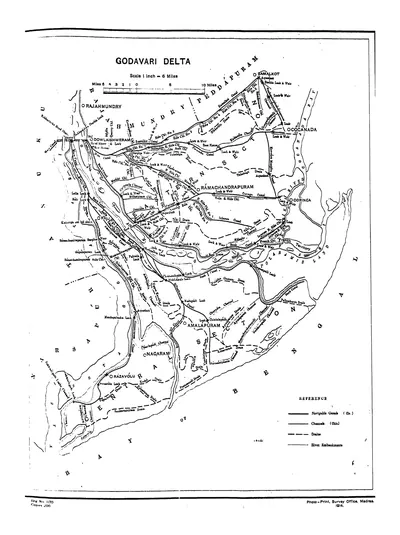 "Godavari Delta" map, with navigable canals, channels, drains and river embankments (Hemingway 1907, PDF p. 97)Map · 1907
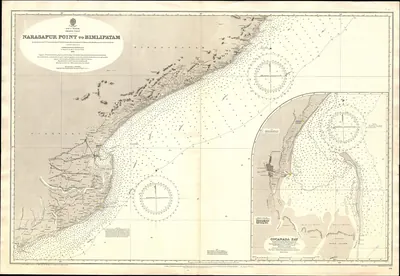 Chart No 1711 Narasapur Point to Bimlipatam, Published 1893, New Edition 1914Map · 1896
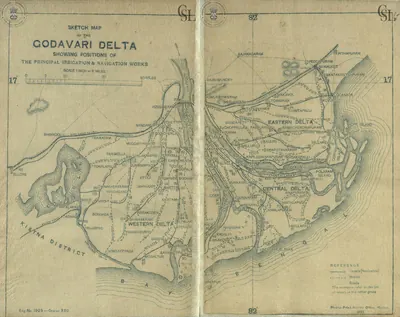 Godavari delta: "Sketch Map of the Godavari Delta showing positions of the principal irrigation & navigation works" (two halves joined) (Walch 1896, PDF pp. 17-18)Map · 1896
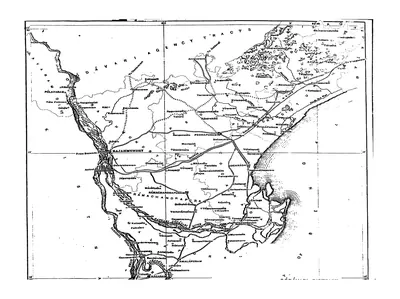 Map of the Godavari District (plains), folding map (Hemingway 1907, PDF p. 3)Map · 1907
References
Notes (0)
Sources (4)
Spotted an error on this page? Tell us
Last updated: