Morari Rao Ghorpade
A Maratha soldier who fought for pay, of the Ghorpade family. He was lord of Gooty from the 1740s until Haidar Ali took the fortress in 1776. The Marathas left him as governor of Trichinopoly in 1741. He gave it up to the first Nizam in the mid-1740s and was accepted as chief of Gooty under the subahdar of the Deccan. His horsemen, whom Orme thought the best Indian soldiers of the day, fought in the Carnatic wars for Muhammad Ali and the English, for Mysore and for the French. Later they fought with the English against Haidar. He held Penukonda and Madakasira and took tribute from the Anantapur poligars. After a long siege of Gooty he surrendered to Haidar and died a prisoner at Kabbaldurga.
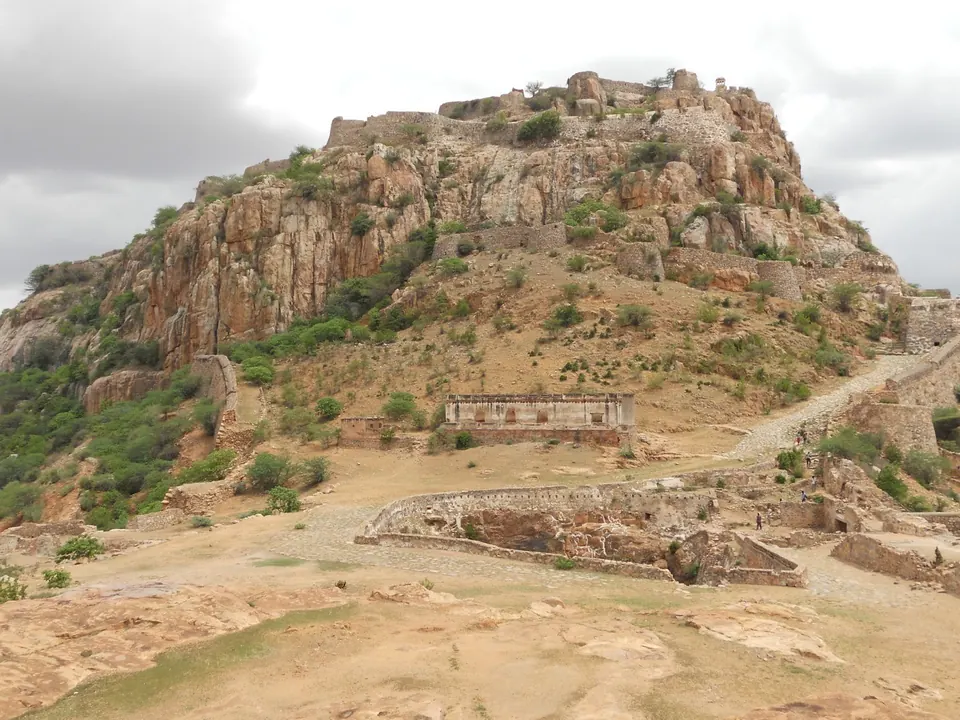
Morari Rao was, in the Anantapur gazetteer’s words, “the famous Maratha free-lance, whose exploits in the wars in the Tamil country figure so prominently in Orme’s history”.1 For thirty years he made his fortress of Gooty the seat of a small Maratha state, in name dependent on the Nizam, from which his horsemen hired themselves to the warring powers of the south. Grant Duff, the historian of the Marathas, wrote about his family.2 They “would rather have joined the Mahrattas, but superior advantages, and the chance of plunder, would induce them to fight on the side of Moghuls or Europeans”.2 See Morari Rao of Gooty and the Marathas.
Family
The sources give his family in different ways. Aitchison’s collection of treaties (1892) makes Morari Rao the third son of Siddoji.3 Siddoji was the grandson of Malloji Rao Ghorpade, an officer in the service of the Sultan of Bijapur.3
Lethbridge’s Golden Book of India (1893) names Siddoji’s father as Biraji, a son of Malloji Rao who entered the service of Shivaji.4 It says that Siddoji took Sandur and died in 1715.4 His second son, Gopal Rao, followed him there.4 The Anantapur gazetteer adds that his father, Siddoji Rao, “often known by his title of Hindu Rao, is said to be buried” in a tomb at Madakasira.5
Grant Duff tells it another way.61 He makes Morari Rao the grand-nephew of the Maratha general Santaji Ghorpade.61 He also makes him the adopted son and heir of an older Morari Rao of Gooty.61 The Anantapur gazetteer mentions accounts that Gooty had been taken by a trick “by his uncle, another Morari Rao”.61
Wilks wrote about the “Santajee Gorepora” of the Madras records of the 1690s.7 He thought that if this was the general of that name, the record “shews him to have been the ancestor of the celebrated Morari Row of Gooti”.7
Aitchison says that Morari Rao’s nephew and adopted son, Shiva Rao Bapa, fell in battle.3 He left a two-year-old son, Siddoji.3 In 1790 Siddoji and his uncle Venkat Rao took the fort of Sandur from Tipu’s governor.3 Aitchison names Daulat Rao as Morari Rao’s half-brother.3
Lethbridge calls this Shiva Rao the son of Gopal Rao.4 He says Shiva Rao was killed in 1785 “in a battle with the Mysore forces”.4 Wilks writes about Balaji, who was killed in a cavalry charge against the English near Tiruchirappalli (then Trichinopoly) in 1753.8 He calls Balaji “the adopted son of Morari Row, a man of distinguished courage”.8
Trichinopoly, 1741–1744
Morari Rao came south with the Maratha army of Raghoji Bhonsle in 1740.6 Grant Duff says that he joined it “for the first time” since the death of his kinsman Santaji.6 He demanded his family’s rank of senapati, or commander-in-chief.6 He gave up that claim “on obtaining a promise of three districts near the Toongbuddra”.6
Chanda Sahib surrendered Tiruchirappalli on 26 March 1741.910 Orme writes that the Marathas then “appointed Morari-row, one of their generals, viceroy of the kingdom”.910 They left “14,000 of their best troops under his command” and “returned to their own country”.910
The first Nizam marched into the Carnatic and called on the Maratha governor to surrender the city.11 Orme says that “presents and promises supplied the place of hostilities”.11 Morari Rao left Tiruchirappalli in August and left the Carnatic.11
Wilks says that while arranging the handover he “obtained his recognition of the state of Gooti as a dependency of the Soubadars of the Deckan”.12 So when Poona later asked him for tribute, he could plead that he depended on Hyderabad.12 See Raghoji Bhonsle I, Nizam-ul-Mulk Asaf Jah I and Srirangam.
The Carnatic wars
In 1750 Nasir Jang hired three bodies of 10,000 Maratha horse, and Morari Rao led one of them.1314 Orme tells how the French battalion was routed.1314 Morari Rao “attacked and broke into” its hollow square with only fifteen men, “imagining that the rest of his party followed him”.1314 He cut his way out on the far side.1314
In 1751 the king of Mysore hired him for Muhammad Ali.15 His 6,000 horse lay idle in the hills thirty miles from Arcot, until Clive’s defence of the fort moved him.15
He wrote to Clive that he “would not delay a moment to send a detachment of his troops to the assistance of such brave men as the defenders of Arcot”.15 He added that their “behaviour had now first convinced him that the English could fight”.15 A thousand of his horse under his nephew Basin Rao stayed to serve with Clive.16 See Muhammad Ali Walajah and Arcot.
Wilks describes his troops as “the most select, the most faithful, and the best organized of any in the south”.17 They were “composed of a judicious mixture of Mohammedans, Mahrattas, and Rajpoots, with an ample accompaniment of Beder Peons”.17 Wilks calls Morari Rao himself, “although expert in the national tactics of plunder”, “a genuine soldier where the occasion demanded”.17 He joined the defence of Tiruchirappalli “from the hope of being able, in the course of events, to seize the place for himself”.17
In 1752 Mysore broke with Muhammad Ali over Tiruchirappalli.81819 Morari Rao then served with the Mysoreans and the French.81819 In 1754 he took three lakhs of rupees from the Raja of Tanjore, paid in parts as he marched home, and left the Carnatic in July.81819
Orme knew his men from the English side of the war.20 He wrote that “there was not a commander of 100 horse who was not fit to command the whole”, and that “the whole army seemed as one family”.20 He judged that “this body of troops were without exception the best soldiers of native Indians at this time in Indostan”.20 This was because they had “surmounted in a great degree the terror of fire-arms”.20
Savanur and the Peshwa
In 1756 Morari Rao joined the Pathan Nawab inside Savanur against the joined armies of Salabat Jang and the Peshwa.12212223 Wilks says that Dupleix had given him a bond for his troops’ pay.12212223 Morari Rao used it to buy the help of Bussy, who arranged a settlement.12212223
Grant Duff says instead that the Peshwa’s officer Balwant Rao Mendle first drew him away from the alliance.12212223 Then “Ghorepuray, with his own and the Sondoor Mahrattas, returned to Gootee in the month of May”.12212223 See Balwant Rao Mendle and Salabat Jang.
Grant Duff says that the Peshwa Madhavrao later “formally restored Moorar Rao to his rank of Senaputtee, as the representative of the family of Ghorepuray”.24 The Peshwa called it “but an act of justice to the descendant of the gallant Suntajee”.24
In the war between Raghunath Rao and the ministers’ general Trimbak Rao, he took no part in the fighting.25 He went back “towards his principality at Gootee, and never more recrossed the Kistna”.25 See Madhavrao I.
Against Haidar Ali
In 1767–68 the Madras government hired him for the war against Haidar Ali.26 His force, “a nominal 3000 horse” with about 2,000 irregular foot soldiers, joined Colonel Smith at Hoskote on 4 August 1768.26
Haidar sent 6,000 horse with elephants against his camp by night.2728 Their orders were “to penetrate direct to the tent of Morari Row, whose head was the great object of the enterprize”.2728 Morari Rao ordered that “not a man should mount”, and his men cut down every rider in the camp.2728
Haidar lost nearly 300 killed and wounded.2728 Morari Rao lost 18 men and 30 horses.2728 He himself was “slightly” wounded in two places, and his nephew was badly wounded.2728
The fall of Gooty and his death
In 1776 Haidar besieged Gooty.2930 The citadel was crowded with followers and cattle, and it ran out of water.2930 Then Morari Rao, “accompanied by his son, and followed by his unarmed garrison, descended and threw himself on Hyder’s clemency”.2930 His family was sent first to Srirangapatna (then Seringapatam) and then to “Cabal Droog; where Morari Row soon afterwards died”.2930
Grant Duff wrote that he “was shamefully immured in the noxious atmosphere of an unhealthy hill fort, where he perished”.31 The Anantapur gazetteer dates the fall of Gooty to 1775.3233 It says that Haidar sent him “into an imprisonment from which he never emerged”.3233 See Gooty fort.
Footnotes
-
W. Francis, Madras District Gazetteers: Anantapur (1905), p. 157 (archive.org (opens in a new tab)). ↩ ↩2 ↩3 ↩4 ↩5
-
James Grant Duff, A History of the Mahrattas, Vol. II (1826), p. 22 (archive.org (opens in a new tab)). ↩ ↩2
-
C. U. Aitchison, A Collection of Treaties, Engagements and Sanads, Vol. VIII (1892), Part I, p. 101, “Sandur” (archive.org (opens in a new tab)). ↩ ↩2 ↩3 ↩4 ↩5 ↩6
-
Roper Lethbridge, The Golden Book of India (1893), p. 476, “Sandur” (archive.org (opens in a new tab)). ↩ ↩2 ↩3 ↩4 ↩5
-
Francis, Anantapur Gazetteer (1905), p. 183 (archive.org (opens in a new tab)). ↩
-
Grant Duff, History of the Mahrattas, Vol. II (1826), p. 2 and note (archive.org (opens in a new tab)). ↩ ↩2 ↩3 ↩4 ↩5 ↩6 ↩7 ↩8
-
Mark Wilks, Historical Sketches of the South of India, Vol. I (1810), p. 85 note (archive.org (opens in a new tab)). ↩ ↩2
-
Wilks, Historical Sketches, Vol. I (1810), p. 304 (archive.org (opens in a new tab)). ↩ ↩2 ↩3 ↩4 ↩5
-
Robert Orme, A History of the Military Transactions of the British Nation in Indostan, Vol. I (Madras reprint, 1861), p. 44 (archive.org (opens in a new tab)). ↩ ↩2 ↩3
-
Wilks, Historical Sketches, Vol. I (1810), p. 253 (archive.org (opens in a new tab)). ↩ ↩2 ↩3
-
Orme, Military Transactions, Vol. I (1861), p. 51 (archive.org (opens in a new tab)). ↩ ↩2 ↩3
-
Wilks, Historical Sketches, Vol. I (1810), p. 381 (archive.org (opens in a new tab)). ↩ ↩2 ↩3 ↩4 ↩5 ↩6 ↩7
-
Orme, Military Transactions, Vol. I (1861), p. 137 (archive.org (opens in a new tab)). ↩ ↩2 ↩3 ↩4
-
Orme, Military Transactions, Vol. I (1861), p. 142 (archive.org (opens in a new tab)). ↩ ↩2 ↩3 ↩4
-
Orme, Military Transactions, Vol. I (1861), p. 192 (archive.org (opens in a new tab)). ↩ ↩2 ↩3 ↩4
-
Orme, Military Transactions, Vol. I (1861), p. 196 (archive.org (opens in a new tab)). ↩
-
Wilks, Historical Sketches, Vol. I (1810), p. 278 (archive.org (opens in a new tab)). ↩ ↩2 ↩3 ↩4
-
Wilks, Historical Sketches, Vol. I (1810), p. 332 (archive.org (opens in a new tab)). ↩ ↩2 ↩3
-
Orme, Military Transactions, Vol. I (1861), p. 363 (archive.org (opens in a new tab)). ↩ ↩2 ↩3
-
Orme, Military Transactions, Vol. I (1861), p. 364 (archive.org (opens in a new tab)). ↩ ↩2 ↩3 ↩4
-
Wilks, Historical Sketches, Vol. I (1810), p. 382 (archive.org (opens in a new tab)). ↩ ↩2 ↩3 ↩4 ↩5
-
Grant Duff, History of the Mahrattas, Vol. II (1826), p. 93 and notes (archive.org (opens in a new tab)). ↩ ↩2 ↩3 ↩4 ↩5
-
Grant Duff, History of the Mahrattas, Vol. II (1826), p. 94 (archive.org (opens in a new tab)). ↩ ↩2 ↩3 ↩4 ↩5
-
Grant Duff, History of the Mahrattas, Vol. II (1826), p. 180 (archive.org (opens in a new tab)). ↩ ↩2
-
Grant Duff, History of the Mahrattas, Vol. II (1826), p. 263 (archive.org (opens in a new tab)). ↩ ↩2
-
Mark Wilks, Historical Sketches of the South of India, Vol. II (1817), p. 73 (archive.org (opens in a new tab)). ↩ ↩2
-
Wilks, Historical Sketches, Vol. II (1817), p. 76 (archive.org (opens in a new tab)). ↩ ↩2 ↩3 ↩4 ↩5 ↩6
-
Wilks, Historical Sketches, Vol. II (1817), p. 77 (archive.org (opens in a new tab)). ↩ ↩2 ↩3 ↩4 ↩5 ↩6
-
Wilks, Historical Sketches, Vol. II (1817), p. 170 (archive.org (opens in a new tab)). ↩ ↩2 ↩3 ↩4
-
Wilks, Historical Sketches, Vol. II (1817), p. 171 (archive.org (opens in a new tab)). ↩ ↩2 ↩3 ↩4
-
Grant Duff, History of the Mahrattas, Vol. II (1826), p. 335 (archive.org (opens in a new tab)). ↩
-
Francis, Anantapur Gazetteer (1905), p. 22 (archive.org (opens in a new tab)). ↩ ↩2
-
Francis, Anantapur Gazetteer (1905), p. 23 (archive.org (opens in a new tab)). ↩ ↩2
Photos
Related
Dynasties
References
Notes (0)
Sources (7)
Spotted an error on this page? Tell us
Last updated: