Nizampatnam
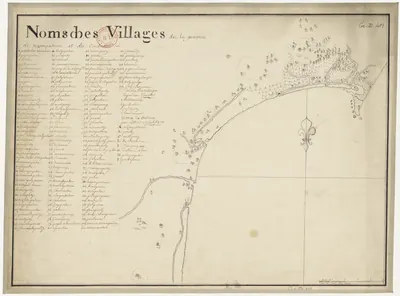
Old port on the Guntur coast south of the Krishna mouths. The Fifth Report's tables identify it with the Pettipolee or Pettapoli of the English records. Here the Globe landed English merchants on 20 August 1611, the first English trade on the eastern coast of India. It was a minor factory (trading post) of the Company in the seventeenth century. It gave its name to the Nizampatam Circar, granted to the French in 1751 and to the English by Salabat Jang's treaty of 1759.
Nizampatnam lies on the coast of the old Guntur country, south of the mouths of the Krishna. The Fifth Report has a table of the Company’s acquisitions of land.1 It identifies the “Pettipolee” of the early English records as “Now Nizampatam, a seaport in the district of Kistna”.1 Morris’s Godavari manual thought the Pettapollee of the first English letters was “probably Peddapalli” or Nizampatnam (then Nizampatam).2
The Kistna manual says that the Tungabhadra channel carried Krishna water across the delta.3 It entered the sea near Nizampatnam.3 See East India Company.
The first English trade
The Fifth Report’s table calls Pettipolee “the first place at which the English commenced to trade on the Eastern Coast of the continent of India”.1 The Globe, under Captain Antony Hippon, landed merchants and goods there on 20 August 1611.1 It picked them up again on its way back from Machilipatnam (then Masulipatam).1
Morris says that the earliest English letters from the coast were written by Lucas Antheuniss at “Pettapollee”.2 He wrote them in December 1611 and January 1612.2
The table records that the factory (trading post) was dissolved in 1653–54 and again later, and was re-settled.14 In the 1670s an establishment was proposed for Machilipatnam.5 Under it one servant was to be kept at Pettapollee “to keepe possession”.5 In 1679 the Company ordered its investments at Pettapollee and at Madapollam to be made independent of Machilipatnam.67
In October 1687 a ship came to Madras from “Pettapollee”.8 It told the Madras council of “a very great contagion in those parts, which has depopulated many towns, and wholly ruin’d trade there”.8 See Machilipatnam.
The Nizampatam Circar
Malleson says that in 1751 Salabat Jang gave the French “the lands attached to the villages of Nizampatnam”.9 By the treaty of 1759 the English received “the Circar of Nizampatam” with Machilipatnam.10 The Fifth Report describes it as a circar (district) of thirty-six mehals (revenue units) on the coast south of the Krishna.11 It stretched sixty miles south from Point Divi.11 See French East India Company.
Footnotes
-
“Acquisitions of Territory by the British in the Presidency of Fort St. George”, in W. K. Firminger (ed.), The Fifth Report from the Select Committee … on the Affairs of the East India Company, Vol. III (1918), p. x, No. III, Pettipolee (archive.org (opens in a new tab)). ↩ ↩2 ↩3 ↩4 ↩5 ↩6
-
Henry Morris, A Descriptive and Historical Account of the Godavery District (1878), p. 177 (archive.org (opens in a new tab)). ↩ ↩2 ↩3
-
Gordon Mackenzie, A Manual of the Kistna District (1883), p. 253 (archive.org (opens in a new tab)). ↩ ↩2
-
Morris, Godavery District (1878), p. 181 (archive.org (opens in a new tab)). ↩
-
Morris, Godavery District (1878), p. 184 (archive.org (opens in a new tab)). ↩ ↩2
-
Morris, Godavery District (1878), p. 188 (archive.org (opens in a new tab)). ↩
-
Morris, Godavery District (1878), p. 189 (archive.org (opens in a new tab)). ↩
-
Mackenzie, Kistna District (1883), p. 39 (archive.org (opens in a new tab)). ↩ ↩2
-
G. B. Malleson, History of the French in India (1868), p. 275 (archive.org (opens in a new tab)). ↩
-
C. U. Aitchison, A Collection of Treaties, Engagements and Sanads, Vol. VIII (1892), p. 278 (archive.org (opens in a new tab)). ↩
-
“Acquisitions of Territory”, in Firminger, Fifth Report, Vol. III (1918), p. xxii, No. XXXI (archive.org (opens in a new tab)). ↩ ↩2
Photos
References
Notes (0)
Sources (5)
Spotted an error on this page? Tell us
Last updated: