Polamuru
Village near Anaparti in the former Ramachandrapuram taluk of Godavari district. D. C. Sircar identified it with Puloburu, the village granted by the Vishnukundin king Madhavavarman Janashraya. The Eastern Chalukya Jayasimha I granted it again to the donee's son. Another scholar placed the village at a Polamuru in Bhimavaram taluk.
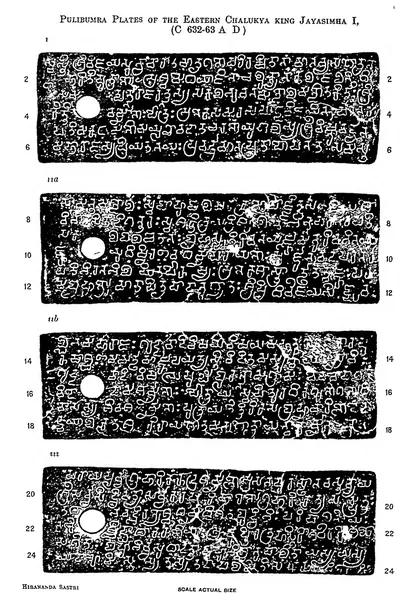
Polamuru is the modern form of the village named in two early copper-plate grants.12 They are the Polamuru plates of the Vishnukundin king Madhavavarman Janashraya, and a grant of the Eastern Chalukya king Jayasimha I.12 M. Somasekhara Sarma explained the old spelling Pulomburu as an early Telugu way of writing Polamuru.3 In it the nasal sound is written over the following letter.3
One village, two kings
The Vishnukundin grant gave the village, in the Guddavadi district, to a Brahmin named Shivasharman.41 Jayasimha I later gave the same village to Shivasharman’s son Rudrasharman, who is described as its former holder.52 D. C. Sircar thought the change of hands reflected fighting between the Chalukyas and the Vishnukundins in the district.6 R. S. Panchamukhi thought the son had lost the village, or had his title disputed, when power passed to the Chalukyas.7
The interval between the two grants is one of the main props of every Vishnukundin chronology; see the Vishnukundins page.18
Which Polamuru?
The sources disagree about which Polamuru is meant:
- Robert Sewell and S. Krishnaswami Aiyangar placed the Vishnukundin grant at Polamur in Godavari district, without further detail.9
- Sircar identified the village with Polamuru near Anaparti railway station and called it the findspot of both grants.210 He took the neighbouring Mahendravada to be the Mayindavataki of the Vishnukundin grant.210 He placed the Guddavadi district in the later Ramachandrapuram taluk.210
- V. Rangacharya edited Jayasimha’s grant in 1928, and he identified its Pulibumra with Polamuru in Bhimavaram taluk.5 Following E. Hultzsch, he took Guddavadi to be Gudivada in Krishna (then Kistna) district.5
The coordinates given here follow Sircar’s identification.2
Footnotes
-
D. C. Sircar, The Successors of the Satavahanas in Lower Deccan (1939), p. 107 (archive.org (opens in a new tab)). ↩ ↩2 ↩3 ↩4
-
Sircar, Successors of the Satavahanas (1939), p. 108 (archive.org (opens in a new tab)). ↩ ↩2 ↩3 ↩4 ↩5 ↩6 ↩7
-
M. Somasekhara Sarma, “Indrabhattaraka and the Ganga Era”, Journal of the Andhra Historical Research Society V, pt. 3 (1930–31), p. 183, note 14 (archive.org (opens in a new tab)). ↩ ↩2
-
Annual Report on Epigraphy, Madras, for 1913–14 (1914), Part II, para. 35, p. 102 (archive.org (opens in a new tab)). ↩
-
V. Rangacharya, “The Pulibumra Plates of the Eastern Chalukya King Jayasimha I”, Epigraphia Indica XIX (1928), p. 255 (archive.org (opens in a new tab)). ↩ ↩2 ↩3
-
Sircar, Successors of the Satavahanas (1939), p. 109 (archive.org (opens in a new tab)). ↩
-
Panchamukhi, “Tandivada Grant” (1936), p. 94 (archive.org (opens in a new tab)). ↩
-
R. S. Panchamukhi, “Tandivada Grant of Prithivi-Maharaja: 46th Year”, Epigraphia Indica XXIII (1936), p. 93 (archive.org (opens in a new tab)). ↩
-
Robert Sewell and S. Krishnaswami Aiyangar, The Historical Inscriptions of Southern India (1932), p. 21 (archive.org (opens in a new tab)). ↩
-
Sircar, Successors of the Satavahanas (1939), p. 131 (archive.org (opens in a new tab)). ↩ ↩2 ↩3
Photos
Related
People
Madhavavarman (Vishnukundin)
c. 535–585 CE
The most famous Vishnukundin king. His own and his descendants' grants credit him with eleven horse sacrifices and a thousand agnishtoma rites. He married into the Vakataka royal family. Whether he was also Madhavavarman Janashraya, the son of Govindavarman and donor of the first Ipur and the Polamuru plates, is disputed: D. C. Sircar and V. V. Mirashi thought so, while other scholars made Janashraya a later king, Madhavavarman III. His date is also disputed: Sircar placed him about 535–585, Mirashi about 510–560.
Jayasimha I
c. 633–663 CE
Second Eastern Chalukya king of Vengi (about 633–663), the eldest son of Kubja Vishnuvardhana. Four copper-plate grants of his are known, issued from Udayapura and Asanapura and granting villages in the Krishna–Godavari country to Brahmins. Most later records give him a reign of 33 years, one gives 30, and the scholars who fixed the chronology disagreed over which to follow.
Inscriptions
Pulibumra plates of Jayasimha I
c. 637 CE
A Sanskrit copper-plate grant of the second Eastern Chalukya king, Jayasimha I. It gives the village of Pulibumra (Polamuru) in the Guddavadi district to Rudrasarman, whose father had received the same village from the Vishnukundin king Madhavavarman. It was noticed in 1914 and edited by V. Rangacharya in 1928. It is dated by number signs that have been read as the 4th, 5th and 15th regnal year, and it fed a long argument over the length of Jayasimha's reign.
Polamuru plates of Madhavavarman Janashraya
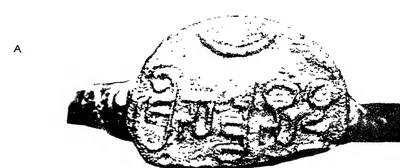
A Sanskrit copper-plate grant of the Vishnukundin king Madhavavarman Janashraya, son of Govindavarman and grandson of Vikramahendra. He made it while crossing the Godavari to conquer the east. It gave the village of Polamuru to a Brahmin whose son received the same village again from the Eastern Chalukya king Jayasimha I. Noticed in 1914 and edited in Telugu-country journals, it is the key to the Vishnukundin chronology. But its regnal year, its date and even its king are disputed.
References
Notes (0)
Sources (6)
Spotted an error on this page? Tell us
Last updated: