Pithapuram
Town in the Godavari country, about twelve miles north by east of Kakinada (Cocanada). It has been identified with Pishtapura, the fortress taken by the Chalukya king Pulakesin II according to his Aihole inscription of 634–35. It has also been identified with the Pishtapura of Samudragupta's Allahabad inscription.
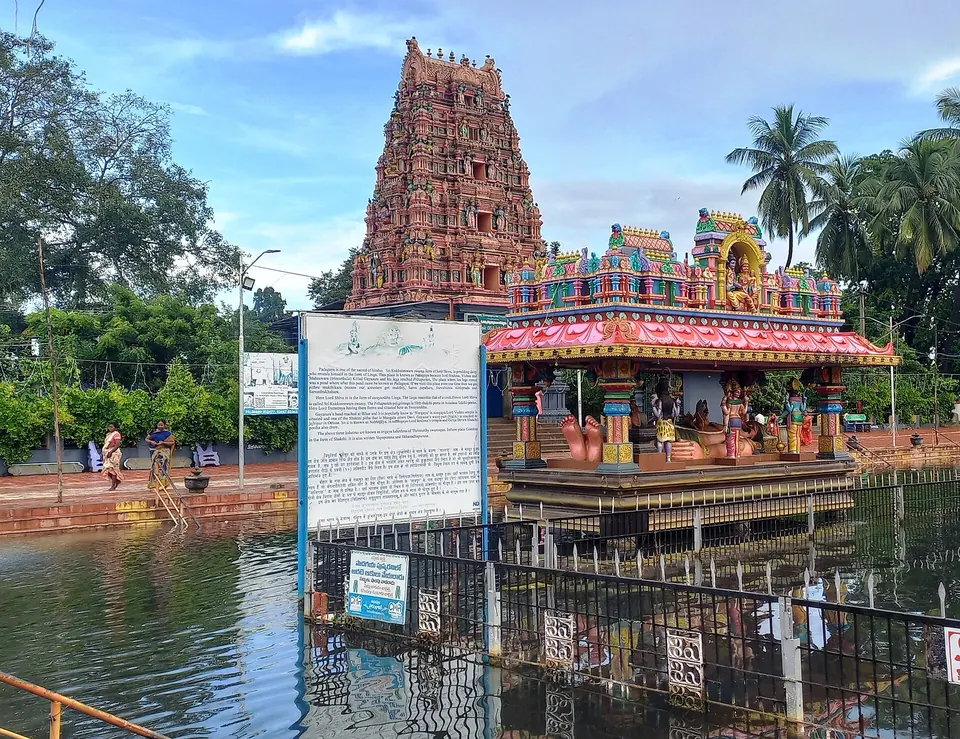
Pithapuram is the Pishtapura of the Aihole inscription of the Chalukya king Pulakesin II. In F. Kielhorn’s translation, “hard pressed (pishta) by Him, Pishtapura became a fortress not difficult of access”.1 Kielhorn identified it with Pithapuram in the Godavari district. The next verse names “the water of Kunala”, which he took to be the Kolleru lake to the south.23 So he argued that the poem follows Pulakesin’s march down the coast from north to south.23 See the Aihole inscription.
J. F. Fleet described Pittapuram as the chief town of an estate of the same name, about twelve miles north by east of Kakinada (then Cocanada) in the Godavari district. He noted that a king Mahendra of Pishtapura is named in the Allahabad pillar inscription of Samudragupta.4 Fleet thought that the Vengi country probably became part of the Chalukya kingdom during the campaign in which Pithapuram fell. Pulakesin’s brother Vishnuvardhana later ruled it as the first of the Eastern Chalukyas.5
Robert Sewell describes the taking of Pithapuram as part of the campaign that drove the Pallava Mahendra I out of the northern Telugu country.6
Seat of the first Eastern Chalukya king
Pithapuram, the ancient Pishtapura, was the residence of Kubja-Vishnuvardhana, founder of the Eastern Chalukyas, in the years after his brother’s conquest of the coast. His Timmapuram plates were dug up in Visakhapatnam (then Vizagapatam) district in 1907.78 They were issued “from (his) residence in the prosperous Pishtapura”.78 They were then the only grant of the king that names his residence.78 E. Hultzsch identified Pishtapura with Pithapuram.78
The pillar in the Kunti-Madhava temple
A pillar at the entrance of the Kunti-Madhava temple carries four inscriptions. E. Hultzsch edited them for Epigraphia Indica in 1896–97. They are in the Telugu alphabet, in Sanskrit with passages of Telugu.910
The second, dated Saka 1117 (1194–96; Saka is an Indian way of counting years), records a grant to the temple by two joint rulers, Mallideva and Manma-Satya.911 They were chiefs of Konamandala, a name that Hultzsch connected with Konasima, the Godavari delta.911 Its account of the Eastern Chalukyas adds a statement missing from other records.911 Kirtivarman I had two sons.911 The elder, Satyasraya (Pulakesin II), took the kingdom of Kuntala, and the younger, Kubja-Vishnuvardhana, took the country of Vengi.911
The third inscription is the one most used by historians of the dynasty. It belongs to Mallapadeva, a descendant of the Eastern Chalukyas, who was anointed in the temple of Kunti-Madhava “at Pithapuri or Sripithapuram”. Hultzsch, with Kielhorn’s calculation, dated the anointing to 1202. On the same day the king gave a village to the temple.1213
The inscription gives the line of kings with the length of each reign.1014 It says that the king Narendra fought 108 battles and founded 108 temples on their sites.1014 It also says that Chalukya-Bhima founded a Shiva temple named after himself.1014 Hultzsch identified this temple with the Bhimesvara temple at Bhimavaram near Samalkot.1014 See Samalkot and Gunaga Vijayaditya III. The record was written by Kantacharya of Sripithapuram, who had also engraved the first two inscriptions on the pillar.13
Other records
The Godavari gazetteer of 1907 counted these four inscriptions as the town’s chief historical records.1516 It said that they give “the genealogies of three lines of chieftains who ruled in the twelfth and thirteenth centuries”.1516 It added that a small mosque in the bazaar street had been built with the materials of an old Hindu shrine.1516 Its pillars were locally said to have come from the Kunti-Madhava temple.1516
The town’s sanctity is also attested in the late 11th century, in the Chellur plates of the Chola-Chalukya viceroy Vira-Choda, which praise a certain Medamarya.17 He founded feeding houses for Brahmins “at holy Draksharama and at the sacred place of Pithapuri”.17
Sewell worked from imperfect copies in 1882.18 He had already noticed long inscriptions “on the Dhvaja Stambha of the principal temple”, dated in 1186 and 1202.18 Their genealogies ran “through all the Eastern Chalukyas to the Cholas”.18
Footnotes
-
Kielhorn, “Aihole Inscription” (1901), p. 11, verse 27 (archive.org (opens in a new tab)). ↩
-
F. Kielhorn, “Aihole Inscription of Pulikesin II”, Epigraphia Indica VI (1901), p. 2 (archive.org (opens in a new tab)). ↩ ↩2
-
Kielhorn, “Aihole Inscription” (1901), p. 3 (archive.org (opens in a new tab)). ↩ ↩2
-
J. F. Fleet, “Dynasties of the Kanarese Districts”, Gazetteer of the Bombay Presidency I, pt. II (1896), p. 350 and notes (archive.org (opens in a new tab)). ↩
-
Fleet, “Dynasties of the Kanarese Districts” (1896), p. 352 (archive.org (opens in a new tab)). ↩
-
Robert Sewell, The Historical Inscriptions of Southern India (1932), p. 22 (archive.org (opens in a new tab)). Paraphrased. ↩
-
E. Hultzsch, “Timmapuram Plates of Vishnuvardhana I Vishamasiddhi”, Epigraphia Indica IX (1907–08), p. 317 (archive.org (opens in a new tab)). ↩ ↩2 ↩3 ↩4
-
Annual Report on Epigraphy, Southern Circle, for 1907–08 (G.O. No. 574, Public, 17 July 1908), Part II, paras. 11–13, p. 49 (archive.org (opens in a new tab)). ↩ ↩2 ↩3 ↩4
-
E. Hultzsch, “Pithapuram Pillar Inscription of Mallideva and Manma-Satya II”, Epigraphia Indica IV (1896–97), p. 83 (archive.org (opens in a new tab)). ↩ ↩2 ↩3 ↩4 ↩5 ↩6
-
E. Hultzsch, “Pithapuram Pillar Inscription of Mallapadeva”, Epigraphia Indica IV (1896–97), p. 226 (archive.org (opens in a new tab)). ↩ ↩2 ↩3 ↩4 ↩5
-
Hultzsch, “Pithapuram Pillar Inscription of Mallideva and Manma-Satya II” (1897), p. 84 (archive.org (opens in a new tab)). ↩ ↩2 ↩3 ↩4 ↩5
-
Hultzsch, “Pithapuram Pillar Inscription of Mallapadeva” (1897), p. 228 (archive.org (opens in a new tab)). ↩
-
Hultzsch, “Pithapuram Pillar Inscription of Mallapadeva” (1897), p. 230 (archive.org (opens in a new tab)). ↩ ↩2
-
Hultzsch, “Pithapuram Pillar Inscription of Mallapadeva” (1897), p. 227 (archive.org (opens in a new tab)). ↩ ↩2 ↩3 ↩4
-
Hemingway, Godavari (1907), p. 238 (archive.org (opens in a new tab)). ↩ ↩2 ↩3 ↩4
-
Hemingway, Godavari (1907), p. 239 (archive.org (opens in a new tab)). ↩ ↩2 ↩3 ↩4
-
E. Hultzsch, South-Indian Inscriptions, Vol. I (1890), No. 39, Chellur plates of Vira-Choda, p. 61 (archive.org (opens in a new tab)). ↩ ↩2
-
Sewell, Lists of the Antiquarian Remains, Vol. I (1882), p. 24 (archive.org (opens in a new tab)). ↩ ↩2 ↩3
Photos
References
Notes (0)
Sources (9)
Spotted an error on this page? Tell us
Last updated: