Pulibumra plates of Jayasimha I
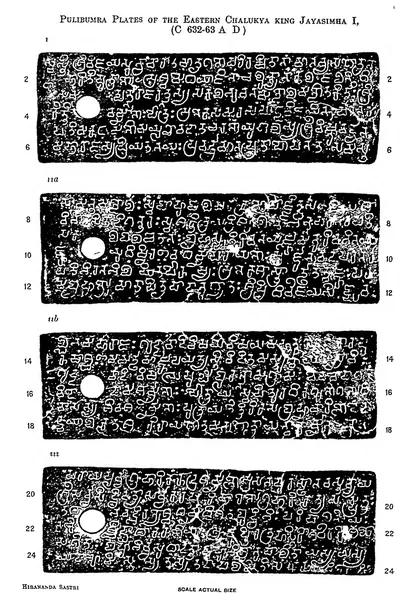
A Sanskrit copper-plate grant of the second Eastern Chalukya king, Jayasimha I. It gives the village of Pulibumra (Polamuru) in the Guddavadi district to Rudrasarman, whose father had received the same village from the Vishnukundin king Madhavavarman. It was noticed in 1914 and edited by V. Rangacharya in 1928. It is dated by number signs that have been read as the 4th, 5th and 15th regnal year, and it fed a long argument over the length of Jayasimha's reign.
This is a grant of Jayasimha I, the son and successor of Kubja-Vishnuvardhana and the second king of the Eastern Chalukyas. Before it came to light in 1914, the only known record of his reign was the Pedda-Maddali grant edited by J. F. Fleet.1 Its importance lies less in the gift itself than in its donee. He was the son of the man to whom the Vishnukundin king Madhavavarman had given the same village.23 So the two grants tie the two dynasties together in time.23
Discovery and description
J. Ramayya Pantulu, Presidency Magistrate at Madras and President of the Telugu Academy, brought the plates to the notice of the Assistant Archaeological Superintendent for Epigraphy at Madras in 1914. He had collected them, with three other Eastern Chalukya grants, “from different parts of the Telugu districts” for publication in the Academy’s journal. They were registered as No. 5 of Appendix A in the report for 1913–14.41 The report does not say where they were found. D. C. Sircar later described the village of Polamuru near Anaparti as the findspot of both this grant and the Vishnukundin grant of the same village.2
V. Rangacharya edited the record in 1928 from ink impressions supplied by the Government Epigraphist.1 There are three plates, a little under six inches by two, strung through ring holes a quarter of an inch across.1 Rangacharya had no information about the seal.1 The plates are numbered, though only the figure on the first is clear.1 There are erasures at the ends of lines 7, 13 and 18.1
Script and language
The record is in Sanskrit prose, except for the curse verse at the end.1 Rangacharya found only minor differences in the letters from those of the Timmapuram plates of Vishnuvardhana I and the Pedda-Maddali plates of Jayasimha I.1 Here the final t is written as a separate letter, and the final m once in a form like o.1 He thought the record freer from grammar mistakes than the grant portion of the Timmapuram plates, though not free of errors.1
Content
The king is called the grandson of Kirtivarman and the beloved son of Vishnuvardhana-Maharaja.1 His own name is given as Prithvi-Jayasingha-vallabha.1 Rangacharya noted that Prithvivallabha had been a title of Kirtivarman I and of Pulakesin II.15 So the Eastern Chalukyas seem to have inherited it from their western ancestors.15
From his victorious camp the king orders the people and officers of Guddavadi.6 He tells them that the village of Pulibumra in the Guddavadi district has been made a tax-free agrahara (Brahmin village).6 The donee was Rudrasarman of Asanapura, of the Gautama gotra (clan) and the Taittiriya school, learned in two Vedas.5 He was the son of Sivasarman and grandson of Damasarman.56
The gift is called Sarvasiddhi-datti, after the king’s title Sarvasiddhi, which also appears in the Pedda-Maddali plates.54 The executors were Hastikosa and Virakosa.5 The report for 1913–14 suggested that these were the officers in command of the elephant force and the infantry.54
The man who received the grant, and the Vishnukundin grant
Sircar noted that Rudrasarman is called purvagraharika, the former holder of the agrahara. He identified Rudrasarman’s father Sivasarman, son of Damasarman, with the donee of the Vishnukundin Madhavavarman’s grant of Puloburu. Jayasimha I was therefore giving the village back to the son of its earlier owner.2 M. Somasekhara Sarma made the same identification.3 He described the grant as a confirmation of the earlier gift.3 The gap between the two grants is one of the main props of Vishnukundin chronology; see the Polamuru plates.2
The village and the district
The name of the village has been read in several ways. Rangacharya printed Pulibumra in his translation and gave Puliburu as a likely variant.5 The 1913–14 report read Pulebumra (Pulebura).54 Somasekhara Sarma pointed out these differences. He read the name as Pulomburu, an early Telugu spelling of Polamuru, with the nasal of one syllable written over the next.3
Rangacharya identified the village with Polamuru in Bhimavaram taluk.5 Following E. Hultzsch, he took Guddavadi to be Gudivada, the taluk headquarters in Krishna (then Kistna) district.5 He thought its antiquities showed it had been an important place before the Chalukyas came.5 He warned that it should not be confused with a Guddavadi in Ramachandrapuram taluk.5 Sircar placed the village instead at Polamuru near Anaparti in Godavari district.2
Date
The grant ends with number signs. Rangacharya’s edition leaves them unread, and an editorial note refers the reader to the 1913–14 report.7 That report read the date as the 15th year of the reign.4 Somasekhara Sarma rejected both that reading and R. Subba Rao’s reading of the 4th year, and read the 5th. He also complained that the rest of the date, after the year, had been left out of the published texts.3 Sircar followed the 5th year and recorded the 15th as the report’s reading. For his own chronology he took the grant to date from about 637.28
Rangacharya used the grant to reopen the question of how long Jayasimha I reigned.5 The records disagree:5
- The Bezwada plates of Chalukya-Bhima I and almost all other grants give him 33 years.5
- The British Museum plates of Amma II give 30.5
F. Kielhorn preferred 33.5 Fleet held that “the statement of the minority is certainly the correct one” and that a reign of 33 years could not be allowed.5 Fleet had reached 30 years by fixing the eclipse in Vishnuvardhana I’s 18th year at 7 July 632.910 He also fixed the accession of Vishnuvardhana II between 14 February and 24 March 663.910 Rangacharya thought both figures were round numbers. Jayasimha could not have come to the throne before July 632.5
Two grants of Vishnuvardhana II, of 13 March 664 and 17 February 668, put that king’s accession between 17 February and 13 March 663. Allowing seven days for Indra-Bhattaraka, Jayasimha therefore reigned about 30 years and a few months.511 By this reckoning he ruled from some time after July 632 to about February or March 663.511
Edition
V. Rangacharya, “The Pulibumra Plates of the Eastern Chalukya King Jayasimha I (c. 632–63 A.D.)”, Epigraphia Indica XIX (1927–28), No. 42, pp. 254–258, with text, translation and plate.1 Summary: Annual Report on Epigraphy for 1913–14, Part II, para. 7.4 For the Pedda-Maddali plates, see Fleet, Indian Antiquary XIII (1884), pp. 137–138.12
Footnotes
-
V. Rangacharya, “The Pulibumra Plates of the Eastern Chalukya King Jayasimha I”, Epigraphia Indica XIX (1927–28), p. 254 (archive.org (opens in a new tab)). ↩ ↩2 ↩3 ↩4 ↩5 ↩6 ↩7 ↩8 ↩9 ↩10 ↩11 ↩12 ↩13 ↩14 ↩15 ↩16
-
D. C. Sircar, The Successors of the Satavahanas in Lower Deccan (1939), p. 108 (archive.org (opens in a new tab)). ↩ ↩2 ↩3 ↩4 ↩5 ↩6 ↩7
-
M. Somasekhara Sarma, “Indrabhattaraka and the Ganga Era”, Journal of the Andhra Historical Research Society V (1930–31), p. 183 and notes 13–14 (archive.org (opens in a new tab)). ↩ ↩2 ↩3 ↩4 ↩5 ↩6
-
Annual Report on Epigraphy, Southern Circle, for 1913–14 (G.O. No. 920, Public, 4 August 1914), Part II, para. 7, p. 85 (archive.org (opens in a new tab)). ↩ ↩2 ↩3 ↩4 ↩5 ↩6
-
Rangacharya, “Pulibumra Plates” (1928), p. 255 (archive.org (opens in a new tab)). ↩ ↩2 ↩3 ↩4 ↩5 ↩6 ↩7 ↩8 ↩9 ↩10 ↩11 ↩12 ↩13 ↩14 ↩15 ↩16 ↩17 ↩18 ↩19 ↩20 ↩21 ↩22
-
Rangacharya, “Pulibumra Plates” (1928), p. 258, translation (archive.org (opens in a new tab)). ↩ ↩2 ↩3
-
Rangacharya, “Pulibumra Plates” (1928), p. 257, text line 24 and note 17 (archive.org (opens in a new tab)). ↩
-
Sircar, Successors of the Satavahanas (1939), p. 110 (archive.org (opens in a new tab)). ↩
-
J. F. Fleet, “The Chronology of the Eastern Chalukya Kings”, Indian Antiquary XX (1891), p. 10 (archive.org (opens in a new tab)). ↩ ↩2
-
Fleet, “Chronology of the Eastern Chalukya Kings” (1891), p. 11 (archive.org (opens in a new tab)). ↩ ↩2
-
Rangacharya, “Pulibumra Plates” (1928), p. 256 (archive.org (opens in a new tab)). ↩ ↩2
-
J. F. Fleet, “Sanskrit and Old-Canarese Inscriptions, No. CXLIV”, Indian Antiquary XIII (1884), p. 137 (archive.org (opens in a new tab)). ↩
Photos
References
Notes (0)
Sources (6)
Spotted an error on this page? Tell us
Last updated: