Suvarnagiri
Seat of Asoka's southern province, named in his Mysore edicts as the residence of a royal prince and his high officers. Its site is unknown: Kanakagiri, the gold country around Maski and a hill in Bihar have all been proposed, and scholars disagree on whether the Kurnool edicts were sent through it.
Suvarnagiri (“golden hill”) was the headquarters of the southern province of the Mauryan empire in the reign of Asoka. It is known only from Asoka’s own edicts, and its site has not been found.12
The evidence
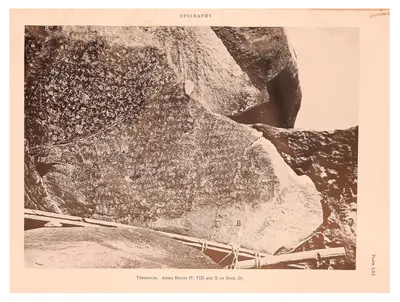
Asoka’s Minor Rock Edicts at Brahmagiri and Siddapura, in the Chitradurga (then Chitaldroog) district of Mysore, open with the same address.31 In E. Hultzsch’s translation the Brahmagiri copy begins:4
From Suvarṇagiri, at the word of the prince (āryaputra) and of the Mahāmātras, the Mahāmātras at Isila must be wished good health and be told this.4
From this Hultzsch concluded that Suvarnagiri was the seat of Asoka’s southernmost province. As at Ujjayini, it was governed by a royal prince, and Isila was a district under it; Hultzsch thought Isila might be the ancient name of Siddapura.1 He noted that the princes at Ujjayini and Tosali were called kumara, probably sons of the king. The title aryaputra used at Suvarnagiri might mean some other relative.5 Vincent Smith counted the prince of Suvarnagiri among four princely viceroys named in the edicts, and called him the viceroy of the South.62 The edicts give no further detail about the province, its boundaries or its other districts.
Proposed sites
Hultzsch summarised the proposals in 1925.4
- Kanakagiri. Hultzsch suggested Kanakagiri, a place in the Nizam’s Dominions whose name has the same meaning. It lies south of Maski, where another Asokan edict had been found in 1915, and north of the ruins of Vijayanagara.17 The editor of Robert Sewell’s book, S. Krishnaswami Aiyangar, supported this. He placed Kanakagiri about twenty miles across from Hampi, and suggested that Isila stood for the Sanskrit name Rishyaka, after the Rishyamukha hill in the Hampi country.8
- The gold country around Maski. H. Krishna Sastri, who published the Maski edict, linked the name “gold mountain” with the country around Maski, which is full of ancient gold workings.4 Smith also thought Suvarnagiri lay in Raichur district, not far from Maski, and hoped its site might yet be found.2
- A hill in Bihar. J. F. Fleet thought the Mysore edicts had been issued by Asoka himself from a hill called Sonagiri near Rajagriha in Bihar.4
None of the sources used here reports an inscription or excavation that names Suvarnagiri at any of these places.
The southern edicts
The proposed sites lie among a group of Asokan edicts in the southern Deccan. Maski, in Raichur district of the Nizam’s Dominions, was found in 1915 by a gold-mining engineer.7 Two more copies of the Minor Rock Edict were found near Kopbal (Koppal) in 1931.9 R. L. Turner gave the distances between the sites as about 78 miles from Maski to the Siddapura group, 54 from Kopbal to Maski and 60 from Kopbal to Siddapura.10 G. Yazdani put Kopbal 21 miles from Hampi.11 To the east, in Kurnool district, are the edicts at Erragudi and Rajula-Mandagiri. D. R. Sahni placed Erragudi about eighty miles north-east of Siddapura.12
Suvarnagiri and the Kurnool edicts
Whether the Telugu country lay in the province of Suvarnagiri is disputed. The Minor Rock Edicts at Erragudi follow the Mysore text but leave out the opening address from Suvarnagiri to Isila.13 Sahni took the remaining words, “at the word of the Beloved of the Gods”, to mean that the Telugu districts were governed directly from Pataliputra rather than through a provincial prince.14 D. C. Sircar, who edited the Erragudi edicts, thought instead that the order there was addressed by the king to the mahamatras stationed at Suvarnagiri.15 Until the site of Suvarnagiri is found, neither view can be tested on the ground.
Footnotes
-
Hultzsch, Inscriptions of Asoka (1925), p. xxxviii (archive.org (opens in a new tab)). ↩ ↩2 ↩3 ↩4
-
Smith, Asoka (1920), p. 94 and n. 1 (archive.org (opens in a new tab)). ↩ ↩2 ↩3
-
Hultzsch, Inscriptions of Asoka (1925), p. xxvii (archive.org (opens in a new tab)). ↩
-
Hultzsch, Inscriptions of Asoka (1925), p. 177 and n. 5 (archive.org (opens in a new tab)). ↩ ↩2 ↩3 ↩4 ↩5
-
Hultzsch, Inscriptions of Asoka (1925), p. xl (archive.org (opens in a new tab)). ↩
-
Vincent A. Smith, Asoka, the Buddhist Emperor of India, 3rd ed. (1920), p. 93 (archive.org (opens in a new tab)). ↩
-
E. Hultzsch, Corpus Inscriptionum Indicarum, Vol. I: Inscriptions of Asoka (1925), pp. xxv–xxvi (archive.org (opens in a new tab)). ↩ ↩2
-
Robert Sewell, The Historical Inscriptions of Southern India (1932), p. 7, editor’s n. 1 (archive.org (opens in a new tab)). ↩
-
Annual Report of the Archaeological Department of His Exalted Highness the Nizam’s Dominions, 1930–31 (1933), p. 9 (archive.org (opens in a new tab)). ↩
-
R. L. Turner, The Gavimath and Palkigundu Inscriptions of Asoka (1932), p. 7 (archive.org (opens in a new tab)). ↩
-
G. Yazdani, “A Note on the Discovery of the Inscriptions at Kopbal”, appendix to Turner, Gavimath and Palkigundu Inscriptions (1932), p. 18 (archive.org (opens in a new tab)). ↩
-
D. R. Sahni, “The Yerragudi Rock Edicts of Asoka”, Annual Report of the Archaeological Survey of India 1928–29 (1933), p. 162 (archive.org (opens in a new tab)). ↩
-
Sahni, “The Yerragudi Rock Edicts of Asoka” (1933), p. 164 (archive.org (opens in a new tab)). ↩
-
Sahni, “The Yerragudi Rock Edicts of Asoka” (1933), p. 167 (archive.org (opens in a new tab)). ↩
-
D. C. Sircar, “Erragudi Edicts of Asoka”, Epigraphia Indica XXXII (1959), p. 9, n. 6 (archive.org (opens in a new tab)). ↩
Related
People
References
Notes (0)
Sources (7)
Spotted an error on this page? Tell us
Last updated: