Tippaluru
Village in the former Kamalapuram taluk of Kadapa district, the Tirpaluru of an early Telugu stone inscription of the Telugu Chola Punyakumara. The letters of the inscription resemble those of the Pallava Mahendravarman I. Its date contains the earliest mention of the hora (planetary hour) then known in south Indian inscriptions.
The Telugu Chola stone
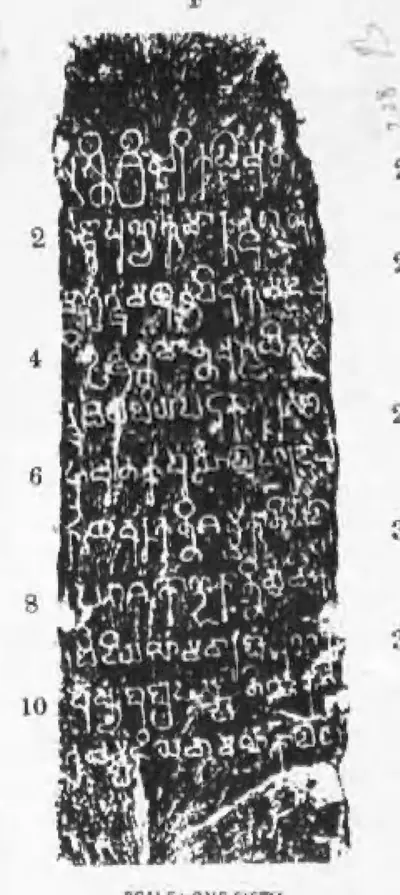
A red stone in Tippaluru, in what was the Kamalapuram taluk of the Kadapa (then Cuddapah) district, carries a deeply cut Telugu inscription.12 The inscription is of Erikalla-Mutturaju Punyakumara, who ruled Renandu from his capital at Chirpali (Chippili).12
It records a grant of fifty units of land at Tirpaluru to a Brahmana of Tarkkapulolu (Takkolu), and the editors took Tirpaluru to be the village itself.12
Its letters closely resemble the Vallam rock inscription of the Pallava Mahendravarman I.13 Its date names the weekday and the hora (planetary hour) of Brihaspati.13 This is the earliest mention of the hora then known in south Indian epigraphy (the study of inscriptions).13 See the Tippaluru inscription and Punyakumara.
Footnotes
-
K. A. Nilakanta Sastri and M. Venkataramayya, “Telugu Chola Records from Anantapur and Cuddapah”, Epigraphia Indica XXVII (1956), p. 231 (archive.org (opens in a new tab)). Paraphrased. ↩ ↩2 ↩3 ↩4 ↩5 ↩6
-
Nilakanta Sastri and Venkataramayya, “Telugu Chola Records” (1956), p. 232 (archive.org (opens in a new tab)). Paraphrased. ↩ ↩2 ↩3
-
Nilakanta Sastri and Venkataramayya, “Telugu Chola Records” (1956), p. 233 (archive.org (opens in a new tab)). Paraphrased. ↩ ↩2 ↩3
Photos
Related
People
Inscriptions
References
Notes (0)
Sources (1)
Spotted an error on this page? Tell us
Last updated: