The Police Action in Hyderabad, 1948
How the Nizam's Hyderabad State, which had not joined India at independence, was brought into the Indian Union. The page follows the Nizam's claim to independence in 1947, the Join India movement and its border camps, the standstill agreement, the Razakars, the appeal to the United Nations, and the Indian Army's operation of 13–18 September 1948, code-named Operation Polo. It ends with the military government and the first steps towards an elected government.
Download
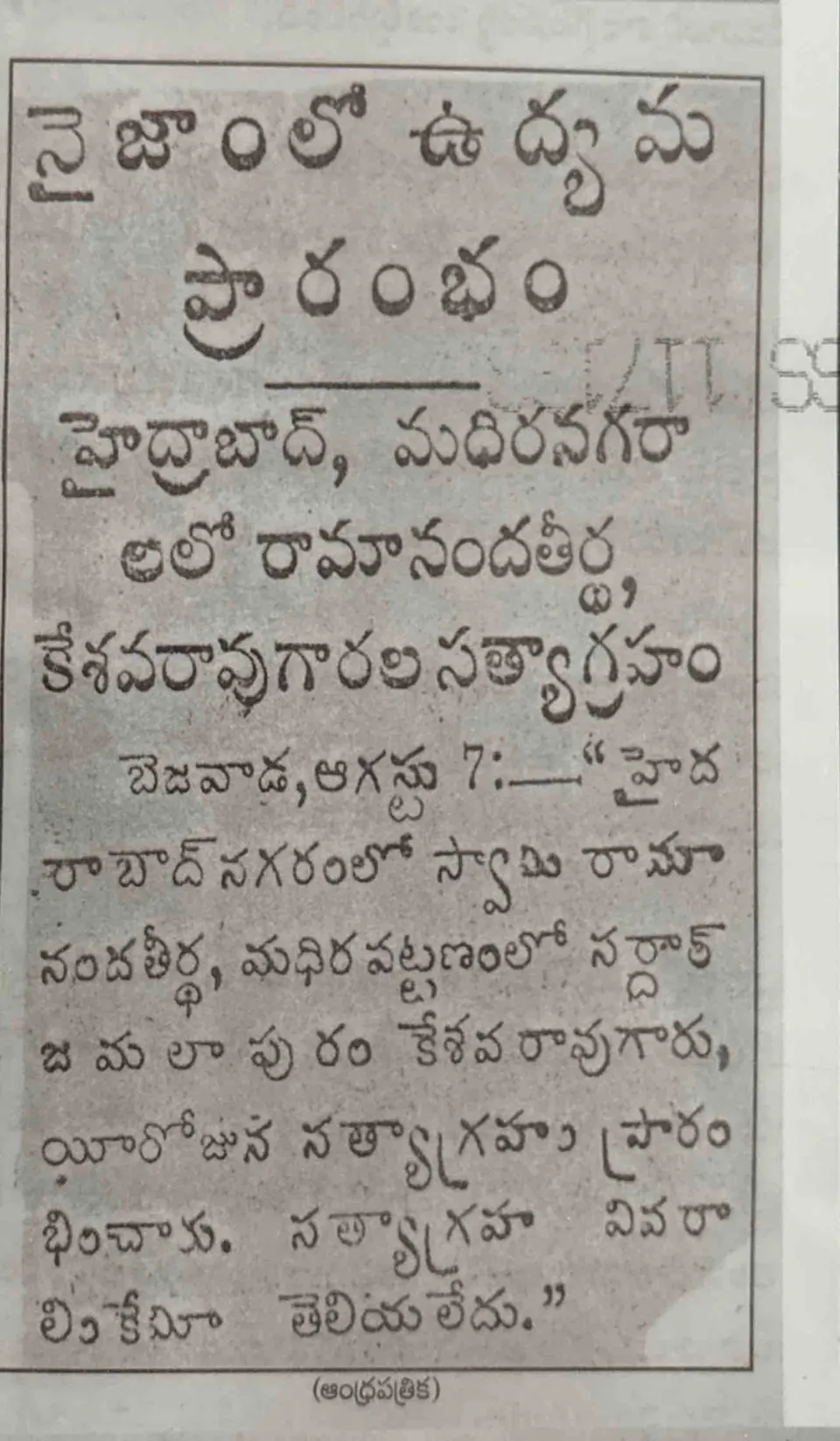
The Police Action was the Indian Army’s entry into the Nizam’s Hyderabad State in September 1948.1 Hyderabad had not joined India when India became free in August 1947.2 The operation of 13–18 September 1948 ended the Nizam’s rule and brought the Telangana districts into the Indian Union.13
The era page Reform, freedom & people’s movements gives the main events in short, with the attacks on villages in 1947–48. This page tells the story more fully, from both Telugu histories and the government’s own reports.24
About the sources. Two Telugu histories give most of the story: P. Raghunadha Rao’s Adhunika Andhrapradesh Charitra (1997) and G. Venkataramarao’s Telangana Charitra (2014). Both write from the side of the movement that wanted Hyderabad to join India.56 The government’s books, Hyderabad Reborn (1949) and the administration report of 1950, tell what the new government did after the operation.47
Hyderabad and Indian independence, 1947
On 3 June 1947 Lord Mountbatten announced that India would be divided into two free countries on 15 August 1947.2 Eight days later, on 11 June, the Nizam issued a farman (royal order).2 It said he had the right to declare Hyderabad independent on 15 August, so he would not send members to India’s Constituent Assembly.2
Many people in the state wanted to join India.2 In May 1947 the Hyderabad State Congress held a public meeting in Hyderabad and resolved to start a “Join India” movement.2 Its leaders, among them Swami Ramananda Tirtha and Burgula Ramakrishna Rao, took part in satyagraha (non-violent protest) and were arrested.5
The movement kept 7 August 1947 as Join India Day.5 On 13 August the Nizam issued a farman declaring his independence, and his government banned the Indian flag.5 People broke the ban and hoisted the flag on 15 August.5 Raghunadha Rao writes that Ramananda Tirtha unfurled a flag that Nehru had given him, at the Sultan Bazar crossing in Hyderabad.5
The standstill agreement, 1947
A Hyderabad delegation held talks in Delhi through October 1947.8 On 27 October, when the Nizam was ready to sign an agreement, crowds of Razakars surrounded the houses of his delegates at 3 a.m.8 Raghunadha Rao puts the crowd at about 25,000.8 The Razakars forced the delegates to say they would not go to Delhi.8
On 29 November 1947 the Nizam signed a standstill agreement with India.8 Under it, defence and external affairs stayed with the Government of India.8 The Government of India’s White Paper of 1950 says the agreement covered defence, external affairs and communications, and so gave India “virtual accession” in these matters.9
Raghunadha Rao writes that the Nizam’s government then broke the agreement in many ways:10
- it declared that Indian money would not be legal in the state
- it banned the export of gold
- it appointed trade agents in London and Karachi
- it took a loan of 200 million rupees from Pakistan
- its army commander, El Edroos, visited Czechoslovakia and France to buy military aircraft10
He adds that an Australian, Sidney Cotton, flew arms into Hyderabad from abroad.10 The Nizam also made Mir Laik Ali Prime Minister, under pressure from Qasim Razvi.10 India’s agent-general, K. M. Munshi, reached Hyderabad on 3 January 1948.11
The Razakars and the border camps, 1948
The Razakars were the armed volunteers of the Ittehad-ul-Muslimeen party.12 Raghunadha Rao writes that the party grew violent after Qasim Razvi became its president in 1946.12 Its volunteers were given military training and wore khaki like soldiers.12 In his account they raided villages on the excuse of hunting communists.12
He describes the events of the year:11
- on 23 May 1948 Razakars attacked the 10-Up Madras–Bombay mail train and killed two passengers
- the people of Paritala, a Hyderabad enclave in Krishna district, declared themselves free and refused to pay taxes to Hyderabad
- on 31 March and 8 April 1948 Razvi made speeches claiming that Hyderabad would recover the Northern Circars11
On 21 August 1948 the young editor Shoebullah Khan, who had criticised the Razakars, was murdered.111
The State Congress fought back from outside the state.13 Venkataramarao counts 21 camps in Madras province, 23 in Bombay and 4 in the Central Provinces.13 He gives these results of the campaign:13
- 14,000 volunteers arrested
- 15,000 students who left their schools and 6,000 village officers who resigned
- about 5 lakh toddy palms cut down, to reduce the state’s excise income
- 615 police stations and Razakar camps destroyed, and 500 of the 750 customs posts round the state
- 200 Razakars and Nizam’s policemen killed, and Congress volunteers killed: 28 in Telangana, 22 in Marathwada and 15 in Karnataka13
The camp at Vijayawada was led by Jamalapuram Keshava Rao, V. B. Raju and T. Hayagrivachari.13 Konda Lakshman led the camp at Sholapur and P. V. Narasimha Rao the camp at Chanda.13
The appeal to the United Nations
Raghunadha Rao writes that Laik Ali went secretly to Karachi and met Pakistan’s leaders.1 They advised him to take the Hyderabad question to the United Nations Security Council.1 On 10 September 1948 a delegation under Moin Nawaz Jung left for the Security Council.1 Venkataramarao notes that Jinnah died on 12 September 1948, and that the Police Action began the next day.13
At the Security Council, Moin Nawaz Jung read out foreign news reports of the Indian operation.14 India’s delegate, Sir Ramaswami Mudaliar, argued that Hyderabad was India’s internal matter, outside the United Nations’ powers.14
Operation Polo, 13–18 September 1948
The Government of India’s own account opens with the operation:4
At dawn on September 13, 1948 … the Government of India moved Indian forces into Hyderabad State in response to the call of the people.
According to Raghunadha Rao, the Indian Army under J. N. Chaudhuri entered the state from five sides.1 Army headquarters gave the operation the code name “Operation Polo”.1 The Nizam’s army under El Edroos surrendered to the Indian Army on 17 September.1 Hyderabad Reborn says that Indian troops entered Secunderabad on the evening of 18 September 1948.15
Venkataramarao writes that the real resistance came from the Razakars, not from the Nizam’s army.14 He says that Chaudhuri, in his autobiography, put the Razakar losses at 2,000 dead and 4,500 captured.14
On 17 September the Nizam spoke on the radio for the first time.16 Venkataramarao prints the broadcast, which went out at 7.30 in the evening.3 In it the Nizam said:3
- his government had resigned and asked him to take over the administration
- he had told India’s Governor-General that the fighting had stopped
- he had ordered the release of Swami Ramananda Tirtha and lifted the ban on the Congress
- he had told his delegates not to press the case at the United Nations3
India’s agent-general, K. M. Munshi, spoke on the radio after him.16 The Nizam also set up an advisory committee on 17 September, but Hyderabad Reborn says it did not prove effective.15
After the operation
Major-General J. N. Chaudhuri took charge of the state’s government on 18 September 1948, as military governor.171 His government ordered all arms to be surrendered, and it disbanded the Razakars and other private armies.15 It arrested only their ringleaders, according to Hyderabad Reborn.15 On 1 October 1948 the state’s jails held 1,912 Razakars.7 Venkataramarao writes that Qasim Razvi was caught at the airport and later sentenced to seven years in the Bibinagar case.18
The standstill agreement stayed in force until the Constitution of India began, by a letter of the Nizam dated 18 November 1948.9 The Nizam then accepted the Constitution for Hyderabad, subject to confirmation by an elected assembly of the state.9 In January 1950 a senior civil servant, M. K. Vellodi, became Chief Minister.19 After the elections of 1952, a ministry under Burgula Ramakrishna Rao took office.1920
The census of 1951 records a darker side of the change.21 It says that life among the Muslims of the state “was considerably disturbed” after the operation, partly because of retaliation by some Hindus.21 The communist-led Telangana armed struggle also went on until 1951, as told on Reform, freedom & people’s movements.22
Where the sources disagree
- When the Nizam withdrew his complaint. Venkataramarao says the Nizam withdrew the case by telegram on 17 September 1948, the day the operation ended.14 Raghunadha Rao says he sent a cable withdrawing it on 23 September.1
- How long the operation lasted. Raghunadha Rao dates it 13–18 September and says it was over in five days.1 Venkataramarao says it ended in four days.14
- What became of Qasim Razvi. Venkataramarao says Razvi tried to fly to Pakistan, was caught at the airport and was sentenced to seven years in prison.18 Raghunadha Rao says Laik Ali and Razvi were arrested, and that both later escaped to Pakistan.1
Footnotes
-
Raghunadha Rao, Adhunika Andhrapradesh Charitra (1997), p. 223 (archive.org (opens in a new tab)). Cite-only; paraphrased. ↩ ↩2 ↩3 ↩4 ↩5 ↩6 ↩7 ↩8 ↩9 ↩10 ↩11 ↩12 ↩13
-
P. Raghunadha Rao, Adhunika Andhrapradesh Charitra (Telugu, revised edition 1997), p. 217 (archive.org (opens in a new tab)). Cite-only; paraphrased. ↩ ↩2 ↩3 ↩4 ↩5 ↩6 ↩7
-
Venkataramarao, Telangana Charitra (2014), p. 246 (in Telugu) (archive.org (opens in a new tab)). Cite-only; paraphrased. ↩ ↩2 ↩3 ↩4
-
Hyderabad Reborn: First Six Months of Freedom (Government of Hyderabad, 1949), p. 13 (archive.org (opens in a new tab)). ↩ ↩2 ↩3
-
Raghunadha Rao, Adhunika Andhrapradesh Charitra (1997), p. 218 (archive.org (opens in a new tab)). Cite-only; paraphrased. ↩ ↩2 ↩3 ↩4 ↩5 ↩6
-
G. Venkataramarao, Telangana Charitra (2014), p. 241 (in Telugu) (archive.org (opens in a new tab)). Cite-only; paraphrased. ↩
-
Report on the Administration of Hyderabad State, September 1948 – March 1950 (1950), p. 77 (archive.org (opens in a new tab)). ↩ ↩2
-
Raghunadha Rao, Adhunika Andhrapradesh Charitra (1997), p. 220 (archive.org (opens in a new tab)). Cite-only; paraphrased. ↩ ↩2 ↩3 ↩4 ↩5 ↩6
-
White Paper on Indian States (1950), p. 113 (archive.org (opens in a new tab)). ↩ ↩2 ↩3
-
Raghunadha Rao, Adhunika Andhrapradesh Charitra (1997), p. 221 (archive.org (opens in a new tab)). Cite-only; paraphrased. ↩ ↩2 ↩3 ↩4
-
Raghunadha Rao, Adhunika Andhrapradesh Charitra (1997), p. 222 (archive.org (opens in a new tab)). Cite-only; paraphrased. ↩ ↩2 ↩3 ↩4
-
Raghunadha Rao, Adhunika Andhrapradesh Charitra (1997), p. 219 (archive.org (opens in a new tab)). Cite-only; paraphrased. ↩ ↩2 ↩3 ↩4
-
Venkataramarao, Telangana Charitra (2014), p. 242 (in Telugu) (archive.org (opens in a new tab)). Cite-only; paraphrased. ↩ ↩2 ↩3 ↩4 ↩5 ↩6 ↩7
-
Venkataramarao, Telangana Charitra (2014), p. 244 (in Telugu) (archive.org (opens in a new tab)). Cite-only; paraphrased. ↩ ↩2 ↩3 ↩4 ↩5 ↩6
-
Hyderabad Reborn (1949), pp. 14–15 (archive.org (opens in a new tab)). ↩ ↩2 ↩3 ↩4
-
Hyderabad Reborn (1949), “Broadcasting”, p. 89 (archive.org (opens in a new tab)). ↩ ↩2
-
Venkataramarao, Telangana Charitra (2014), p. 247 (in Telugu) (archive.org (opens in a new tab)). Cite-only; paraphrased. ↩
-
Venkataramarao, Telangana Charitra (2014), p. 245 (in Telugu) (archive.org (opens in a new tab)). Cite-only; paraphrased. ↩ ↩2
-
Raghunadha Rao, Adhunika Andhrapradesh Charitra (1997), p. 224 (archive.org (opens in a new tab)). Cite-only; paraphrased. ↩ ↩2
-
Sarojini Regani, Highlights of the Freedom Movement in Andhra Pradesh (1956), pp. 232–234 (archive.org (opens in a new tab)). Cite-only; paraphrased. ↩
-
Census of India, 1951, Vol. IX: Hyderabad, Part I-A: Report (1953), pp. 111–112 (archive.org (opens in a new tab)). ↩ ↩2
-
The History of the Andhra Pradesh Police (1861–1961) (1961), pp. 112, 245–246 (archive.org (opens in a new tab)). ↩
Photos
References
Notes (0)
Sources (8)
Spotted an error on this page? Tell us
Last updated: