Municipalities, local boards and panchayats, 1850–1962
How towns and villages in the Telugu lands came to manage their own roads, schools, water and sanitation, side by side in the Madras districts and Hyderabad State. It covers the voluntary town associations of the 1850s, the first municipal councils of 1866, the local fund and local boards of 1871 and 1884, elected councils and chairmen, the Madras reforms of 1920–1934, Hyderabad's city municipality of 1869 and City Improvement Board of 1912, and the three-tier panchayat raj of 1959.
Download
Local self-government means that towns and villages manage some of their own affairs, such as roads, water, cleaning and schools, through bodies they help to choose.1 In the Telugu lands it grew over a hundred years, from voluntary town associations in the 1850s to elected panchayats and zilla parishads in 1959.23 This page follows that growth in the Madras districts and in Hyderabad State. The older village officers, the headman and the accountant, are described on Government & administration.
About the sources. For the Madras districts the page uses the Imperial Gazetteer (1908) and the gazetteers of Vizagapatam (1907), Godavari (1907) and Nellore (1942).1456 For Hyderabad it uses the Imperial Gazetteer (1909), the Statistical Year Book (1938) and the state’s report of 1950.789 For panchayat raj it uses two census handbooks of 1964–65.310
The first town associations
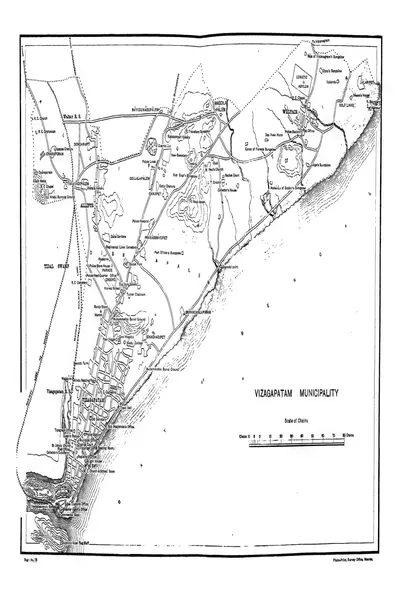
The first step was a law of 1850 that let towns tax themselves, if they wished, to improve their streets.1112 The government added a sum equal to what the town raised.12 Few towns took up the offer.11 Visakhapatnam did so in 1858, with the most successful of these voluntary associations in the Presidency.2
The Visakhapatnam association taxed houses and carts and collected ferry fees.13 It widened and lit the streets and built a municipal hall with a library and a reading room.13 Its payments were called voluntary.13 But people who did not pay the house tax were warned that they would have to clean their own street, and could be fined by the police.13 Bheemunipatnam started a similar association in 1861, paid for mainly by a small tax on carts entering the town.12
Municipal councils, 1866
The Madras Towns Improvement Act of 1865 created municipal councils for the first time.11 Many Telugu towns got one in 1866:514151213
- Kakinada and Rajahmundry514
- Nellore, on 1 November 186615
- Visakhapatnam, Bheemunipatnam and Vizianagaram1213
Not every council lasted. Palakonda was made a municipality in 1869, at the request of the firm that rented the taluk.4 The next year the council quarrelled over who should be vice-president and resigned together.4 The Collector then reported that nobody in the town cared about the municipality, so the government abolished it.4
Elected councils
Later, a commission set up at the wish of Lord Ripon’s government in India asked for more elected members and non-official chairmen.11 The Madras District Municipalities Act of 1884 followed.11 Rajahmundry won the right to elect some members in 1884, and by 1907 it elected twelve councillors and its chairman.14 Kakinada was allowed to elect its chairman in 1886, lost the right in 1893 and got it back in 1897.5
By 1904 the Madras Presidency had 60 municipal councils with 944 members.11 Of these, 450 were elected by the ratepayers and 426 were nominated by the government.11 In 38 councils the chairman was a non-official.11
Water for the towns
The councils’ biggest works were water supplies. Kakinada finished its Victoria water-works in June 1903, drawing water from the Samalkot canal.5 The works were meant to supply 400,000 gallons a day, and cost Rs. 4,44,800.514 Since 1890 water schemes had also been built in Adoni, Kurnool, Kadapa, Tirupati and Visakhapatnam.16 Guntur opened its water-works in 1905.16
Local boards in the countryside
Outside the towns, roads were first paid for by a cess (local tax) on land, collected from 1854.1 The Madras Local Funds Act of 1871 set up the first local boards, to pay for roads, schools and other public needs.17 In Nellore a Local Fund Board was formed in 1872, with the Collector as president.6
The Madras Local Boards Act of 1884 created three levels:117
- a district board for each district, with the Collector as president1
- taluk boards under it, led by the revenue divisional officers1
- unions of large villages, run by panchayats that could levy a house tax1
The boards grew quickly. Between 1872–73 and 1903–04 the Presidency’s local boards increased their roads from 15,759 to 22,015 miles.17 Their hospitals and dispensaries rose from 93 to 350, and their schools from 323 to 2,347.17 In 1907 the Godavari district had fifteen unions, whose chief income was the house tax.5
Reforms in the Madras districts, 1920–1950
The Madras Local Boards Act of 1920 made the boards much more independent.18 In the same year a Village Panchayat Act set up elected panchayats in villages.18 The Nellore district board elected its first non-official president on 30 October 1920.6
A law of 1930 ended nomination and indirect election.6 From then on, district board members were elected directly, with some seats kept for minority communities.619 The taluk boards were abolished from 1 April 1934, because they were poor and their work overlapped with the other boards.20 In 1936 the Nellore district board was split into two, North and South Nellore, each with seats for women and for Adi-Andhras (Dalits).21 By the late 1930s the two boards had 121 and 172 panchayat boards under them.22
In 1946 T. Prakasam, then Chief Minister of Madras, began a Firka Development Scheme for villages.10 The East Godavari census handbook sees it as an early root of panchayat raj.10 The Madras Village Panchayats Act of 1950 made the panchayats separate from the district boards.19
Hyderabad: the city municipality
In Hyderabad, municipal government began in 1869.7 The city was divided into four divisions and the suburbs into five, all under a municipal superintendent.7 In 1881 the suburbs became a separate municipality, Chadarghat.7 The two were joined again in 1903, under a committee of 27 municipal commissioners.7
Some of the commissioners were officials, and others were lawyers, bankers and other citizens.7 The municipality widened streets, built drains and supplied filtered water.23 The water came from the Mir Alam tank to the city and from the Hussain Sagar to Chadarghat.23 By 1901 the state also had 21 municipalities in its district towns.7
In 1343 Fasli (1933–34) the Nizam raised the city municipality to a corporation of 36 members.2425 Citizens who paid at least Rs. 20 a year in tax could now vote.25 The first election was held in 1344 Fasli (1934–35), and about two-thirds of those who could vote took part.25
The City Improvement Board
The great Musi flood of 1908 damaged the riverbanks, and crowded slums spread disease.26 So in 1912 the City Improvement Board was set up.26 Its first work, which took about seven years, was to build walls along both banks of the Musi.26 The land gained was laid out as the Osmania Park.26
The Board then cleared slums in fourteen localities, at a cost of seventy lakh rupees, and built model houses.26 The 1931 census says the city’s health improved after the slum clearance and a campaign against rats begun in 1929.27 By 1950 the Board owned about 4,000 buildings rented to the public.28
Local boards in Hyderabad
In the districts, a Local Fund Department was set up in 1894.8 Each district had a local fund committee under the Talukdar (district officer), and each taluk a committee under the Tahsildar.8 Its members were nominated, and its money came from a cess collected by the village officers.829 About 65 towns could levy small local taxes, and from 1935–36 seven large towns had municipalities with a non-official majority.29
After the end of the Nizam’s rule in 1948, the new government nominated new municipal committees.9 The Hyderabad committee took office on 1 August 1949, and Secunderabad’s on 15 December 1949.9 About 80 local bodies in the districts were reconstituted, and the rule of equal seats for communities was removed.9 Elections planned for March 1950 were postponed until a new law was passed.9 The village panchayats of the state are described on Government & administration.
Panchayat raj, 1959
In the 1950s a national study team led by Balwantrai Mehta asked that elected bodies should run rural development.310 Andhra Pradesh began with a trial: from 1 July 1958 it set up one panchayat samiti in each district.3 The Andhra Pradesh Panchayat Samithis and Zilla Parishads Act of 1959 then set up three tiers:3
- the gram panchayat in each village, with an elected sarpanch330
- the panchayat samiti for each block, made up of the sarpanches3
- the zilla parishad for each district, made up of the samiti presidents and the district’s legislators330
The Act came into force at Shadnagar on 24 September 1959, and in the rest of the state on 2 October 1959.3 The Prime Minister of India opened the first samiti at Shadnagar on 1 October 1959.3 Each samiti had to add two women and a member of the Scheduled Castes, and a member of the Scheduled Tribes where they made up at least 5 per cent of the block’s people.31
The samitis took over the old district boards’ work on schools, health and dispensaries.31 In the Kadapa district the first thirteen samitis began on 1 November 1959.3 The number of village panchayats there rose from 141 to 602 during the Second Five Year Plan.3
Where the sources disagree
The sources tell the early history of the Hyderabad municipality differently:
- The Imperial Gazetteer (1909) says the suburbs became a separate municipality in 1881, and that the two were joined in 1903 under 27 commissioners.7
- The Statistical Year Book of 1938 says the city and Chadarghat were run as two parts from the start, and had two committees of 21 members each from 1304 Fasli (1894–95).24 It says they were joined in 1316 Fasli (1906–07), under one body of 26 members.24
Footnotes
-
Imperial Gazetteer of India, Provincial Series: Madras, Vol. I (1908), p. 108 (archive.org (opens in a new tab)). ↩ ↩2 ↩3 ↩4 ↩5 ↩6 ↩7
-
Francis, Vizagapatam (1907), p. 215 (archive.org (opens in a new tab)). ↩ ↩2
-
A. Chandra Sekhar, Census of India 1961, Andhra Pradesh: District Census Handbook, Cuddapah District (1964), p. lvii (censusindia.gov.in (opens in a new tab)). Paraphrased. ↩ ↩2 ↩3 ↩4 ↩5 ↩6 ↩7 ↩8 ↩9 ↩10 ↩11 ↩12
-
W. Francis, Madras District Gazetteers: Vizagapatam, Vol. I (1907), p. 213 (archive.org (opens in a new tab)). ↩ ↩2 ↩3 ↩4
-
F. R. Hemingway, Madras District Gazetteers: Godavari, Vol. I (1907), p. 197 (archive.org (opens in a new tab)). ↩ ↩2 ↩3 ↩4 ↩5 ↩6 ↩7
-
W. E. Johns, Gazetteer of the Nellore District, brought up to 1938, Vol. A (1942), p. 281 (archive.org (opens in a new tab)). Paraphrased. ↩ ↩2 ↩3 ↩4 ↩5
-
Imperial Gazetteer of India, Provincial Series: Hyderabad State (1909), p. 66 (archive.org (opens in a new tab)). ↩ ↩2 ↩3 ↩4 ↩5 ↩6 ↩7 ↩8
-
H.E.H. the Nizam’s Government: Statistical Year Book 1347 Fasli (1938) (1941), p. 718 (archive.org (opens in a new tab)). Paraphrased. ↩ ↩2 ↩3 ↩4
-
Report on the Administration of the Hyderabad State (1950), p. 83 (archive.org (opens in a new tab)). Paraphrased. ↩ ↩2 ↩3 ↩4 ↩5
-
District Census Handbook, East Godavari (1965), p. lxxxviii (censusindia.gov.in (opens in a new tab)). Paraphrased. ↩ ↩2 ↩3 ↩4
-
Imperial Gazetteer: Madras, Vol. I (1908), p. 110 (archive.org (opens in a new tab)). ↩ ↩2 ↩3 ↩4 ↩5 ↩6 ↩7 ↩8
-
Francis, Vizagapatam (1907), p. 214 (archive.org (opens in a new tab)). ↩ ↩2 ↩3 ↩4 ↩5
-
Francis, Vizagapatam (1907), p. 216 (archive.org (opens in a new tab)). ↩ ↩2 ↩3 ↩4 ↩5 ↩6
-
Hemingway, Godavari (1907), p. 198 (archive.org (opens in a new tab)). ↩ ↩2 ↩3 ↩4
-
Johns, Nellore District Gazetteer (1942), p. 286 (archive.org (opens in a new tab)). Paraphrased. ↩ ↩2
-
Imperial Gazetteer: Madras, Vol. I (1908), p. 111 and note (archive.org (opens in a new tab)). ↩ ↩2
-
Imperial Gazetteer: Madras, Vol. I (1908), p. 109 (archive.org (opens in a new tab)). ↩ ↩2 ↩3 ↩4
-
Census of India 1961, Andhra Pradesh: District Census Handbook, East Godavari District (1965), p. lxxxvi (censusindia.gov.in (opens in a new tab)). Paraphrased. ↩ ↩2
-
District Census Handbook, East Godavari (1965), p. lxxxvii (censusindia.gov.in (opens in a new tab)). Paraphrased. ↩ ↩2
-
Johns, Nellore District Gazetteer (1942), p. 283 (archive.org (opens in a new tab)). Paraphrased. ↩
-
Johns, Nellore District Gazetteer (1942), p. 282 (archive.org (opens in a new tab)). Paraphrased. ↩
-
Johns, Nellore District Gazetteer (1942), p. 284 (archive.org (opens in a new tab)). Paraphrased. ↩
-
Imperial Gazetteer: Hyderabad State (1909), p. 67 (archive.org (opens in a new tab)). ↩ ↩2
-
H.E.H. the Nizam’s Government: Statistical Year Book 1347 Fasli (1938) (1941), p. 716 (archive.org (opens in a new tab)). Paraphrased. ↩ ↩2 ↩3
-
Statistical Year Book 1347 Fasli (1938) (1941), p. 717 (archive.org (opens in a new tab)). Paraphrased. ↩ ↩2 ↩3
-
Statistical Year Book 1347 Fasli (1938) (1941), p. 1144 (archive.org (opens in a new tab)). Paraphrased. ↩ ↩2 ↩3 ↩4 ↩5
-
Census of India 1931, Vol. XXIII: H.E.H. the Nizam’s Dominions, Part I: Report (1933), p. 32 (archive.org (opens in a new tab)). ↩
-
Report on the Administration of the Hyderabad State (1950), p. 89 (archive.org (opens in a new tab)). Paraphrased. ↩
-
Statistical Year Book 1347 Fasli (1938) (1941), p. 719 (archive.org (opens in a new tab)). Paraphrased. ↩ ↩2
-
District Census Handbook, East Godavari (1965), p. lxxxix (censusindia.gov.in (opens in a new tab)). Paraphrased. ↩ ↩2
-
Chandra Sekhar, District Census Handbook, Cuddapah (1964), p. lviii (censusindia.gov.in (opens in a new tab)). Paraphrased. ↩ ↩2
Photos
References
Notes (0)
Sources (10)
Spotted an error on this page? Tell us
Last updated: