Prehistory & megalithic cultures
Stone tools in the river valleys and on the hills, and the stone-built burials (dolmens, cairns, cists and stone circles) found across Coastal Andhra, Rayalaseema and Telangana. This is what surveyors and excavators recorded from the 1860s to the 1930s.
Swipe sideways to see the whole chart; tap a bar for details.
Each bar is a ruling power in its region; time runs left to right. Dashed = approximate dates. Select a bar for details.
Show as a list
Mauryas & Satavahanas 300 BCE – 225 CE
Kingdoms and empires
Mauryas
Open page- Telangana: c. 272 BCE – 185 BCE (c. 87 years)
IG Hyderabad says Asoka's dominions covered a considerable part of the eastern tracts of the Nizam's State; no Telangana edict cited. Asoka 272-231 BCE in IG Hyderabad, 268-226 BCE in Sewell
- Rayalaseema: c. 268 BCE – 185 BCE (c. 83 years)
Asokan edicts at Erragudi and Rajula-Mandagiri, Pattikonda taluk, Kurnool; Bindusara (296-268 BCE) is believed to have extended rule south
- Coastal Andhra: c. 260 BCE – 185 BCE (c. 75 years)
Asoka's Kalinga war (260 BCE in the Godavari gazetteer, 256 BCE in Sewell) and a Mauryan-script record at Amaravati; empire ended 185/184 BCE
Rulers
Inscriptions
Sources (5)
Long before the first inscriptions, people lived in the river valleys and on the rocky hills of the Telugu country.123 They left two main kinds of evidence. The first is stone tools.123 The second is megalithic burials, graves built of large stones (“megalith” means “great stone”).123 This page describes what the older surveys and excavation reports in this site’s library recorded about these remains, and how their authors explained them.
A caution first. All of the sources used here were written between the 1860s and the 1930s. They describe where tools and graves were found, and what was inside the graves that were opened.3 They had no way of dating the remains. Their authors admitted that few sites had been examined scientifically.3 Their ideas about who built the graves reflect their own time, and they are reported below as opinions, not as findings.
Stone tools
The Krishna (then Kistna) District manual of 1883 called stone tools the earliest trace of people in the district.1 Geologists had found quartzite tools along the coast. These looked like the flint hand-axes found at Abbeville in France.1 The geologist Robert Bruce Foote had collected stone axes and spearheads along the Gundlakamma river and east of Mangalagiri hill.1
The manual’s author was careful.1 The tools looked like European Palaeolithic (“Old Stone Age”) ones in shape.1 But no fossils were found in the laterite gravel that held them. So he thought they might be much younger than the European tools.1
Finds were reported from many other places. In 1868 an officer of the Geological Survey took a chipped stone tool out of solid rock.4 This was on the Mantralamma pass across the Nallamalai hills in Kurnool district.4 Prehistoric tools were found along the Gundlakamma in Vinukonda taluk of Guntur district.5 In Anantapur district, “palaeolithic settlements” were reported on hilltops.6
On the Telangana side, the 1909 gazetteer of Hyderabad State noted finds in the black soil of the large river valleys.7 It said Palaeolithic and even Neolithic (“New Stone Age”) tools had been found there.7
The 1908 gazetteer of the Madras Presidency summed up what was then known.2 The earliest people of the south had made rough stone weapons, found on the hilltops of the Deccan. Later they made more finished tools, and built cairns and dolmens.2 They appeared to have passed from a Palaeolithic stage, through a Neolithic one, into an Iron Age. But little more could be said about them.2
Megalithic burials
The monuments most often reported are stone-built graves. Robert Sewell made a list of antiquities in the Madras Presidency in 1882.8 He grouped the graves as dolmens, cromlechs, menhirs, stone circles and cairns.8 He noted that people in the Telugu country called all of them “Rakshasa gundlu”, the “rocks of the Rakshasas” (demons).8 In Kadapa (then Cuddapah) district they were known as Pandavagullu. Local belief linked them with the Pandava heroes of the Mahabharata.3
The Hyderabad Archaeological Department used the following classes, taken from earlier writers on South Indian megaliths:9
- Cairn: a mound of earth and loose stones, often ringed by one or two circles of boulders.9 It covers a stone or clay coffin, or an urn.
- Cromlech: a stone circle around a stone coffin that can be partly or fully seen.
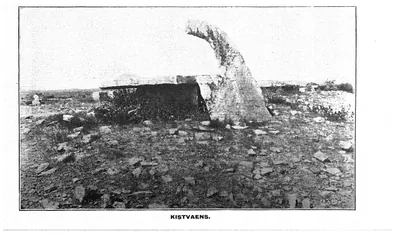
- Dolmen: a stone box built on the ground surface, with one side pierced by a hole or left open.
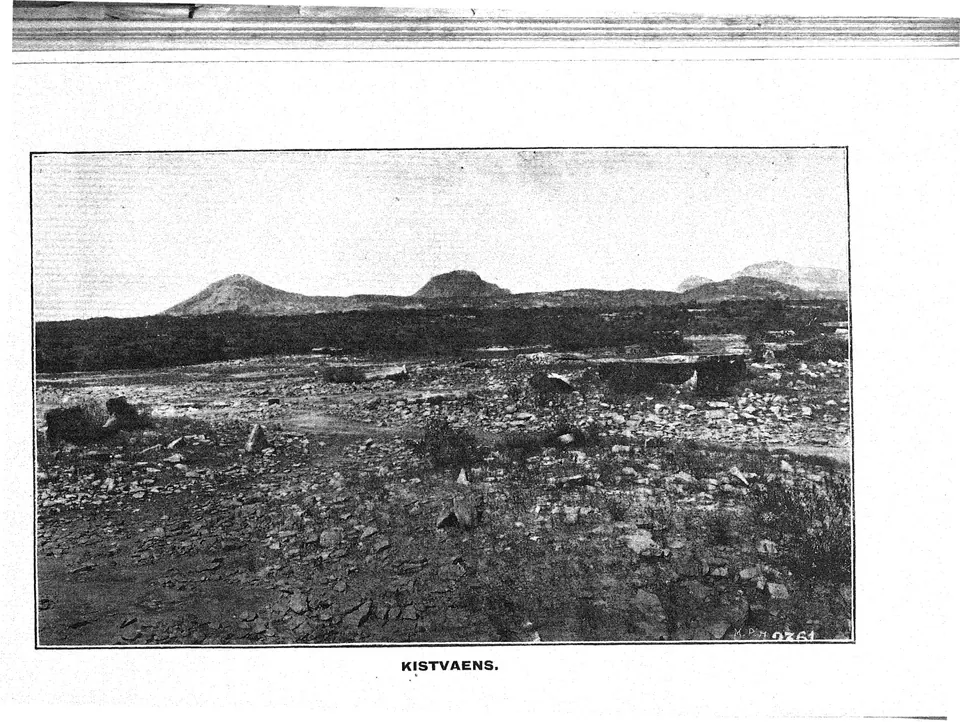
- Kistvaen (cist): the stone box itself, usually made of four upright slabs with a base and a capstone (top slab).9
Where they are found
Reports came from every part of the Telugu country:
- Krishna and Guntur. Sewell wrote that the uplands of the Krishna district “abound in rude stone monuments”.10 He said Nandigama taluk in particular was full of stone circles and dolmens, too many to list.10 At a village on the Paleru river, about 18 miles west of Nandigama, he recorded stone circles and chambered dolmens. Some had several cists stacked one above another.11 The district manual names the inland taluks of Nandigama, Sattenapalle and Palnad as the main areas.1 Stone circles were also reported in Vinukonda taluk.5
- Kurnool. The 1886 district manual lists dolmens near Errakondapalem in Markapur taluk. It lists more at Anumulapalli, Basanepalli, Mallapuram (twelve dolmens) and Narava in Cumbum taluk.12 It also lists “cromlechs” in the Yachavaram valley north-east of Cumbum.12
- Kadapa and Anantapur. The 1915 Cuddapah gazetteer describes two kinds of cist tomb, always found in groups. One kind is of rough unshaped stones, near Yerraguntla.3 The other is of more worked stone.3 At Kalyandurg in Anantapur district there were “some hundreds” of cists on the hill and in the nearby village of Mudigallu. They had round earth mounds ringed by upright slabs.13
- Godavari valley. Upstream from Bhadrachalam there were many stone monuments. They stretched from about fifteen miles below the town to four miles north of Dummagudem.14 They held half-burnt pottery, charred bones and beads of ivory and glass.14
- Telangana. The Hyderabad Archaeological Department reported megalithic remains in Nalgonda, Warangal, Karimnagar and Nizamabad districts. It also reported them in Gulbarga and Raichur, which are outside the Telugu region.15
The Maula Ali excavation, 1916
The most detailed account in the library comes from Maula Ali, just outside Hyderabad. There were two groups of cairns there, covering thirty to forty acres of barren, rocky ground.15 In February 1916 the Superintendent of the Hyderabad Archaeological Department excavated the northern group.15
The cairns measured 8 to 33 feet across.9 Each was ringed by roughly cut stones, usually twenty-four of them.9 Each covered a cist of six slabs: four walls, a base and a lid. The cist lay four to six feet below the packing of stone and earth.9
Around and inside the cists, the excavators found pottery of many shapes and sizes, in red and in black.16 There were large and small pots with ring stands, cups, saucers, dishes and tall vessels shaped like goblets. The smaller vessels had a polished surface.16
The graves also held iron knives, daggers, hatchets and axes.16 The daggers and knives lay near the right hand of the dead, and the hatchets outside the cist.16 One cairn held a three-legged iron lamp and pieces of a bell made of copper or bronze. Another held a cup of copper and tin.17 The excavator concluded that the cemetery had been used over several centuries. He found that the largest cairns were the oldest.17
In June 1916 the excavator visited Raigir, where cairns of the same type had been dug.17 He noticed groups of scratched marks on pots taken from them.17
Iron goods were not reported everywhere. Sewell quoted an earlier report that cairns in the Krishna district had held only rough pottery and bone objects.10 But the district manual stated that graves there held iron tools and glazed pottery.1 The graves near Bhadrachalam had not yet produced weapons.14 These conflicting statements show how little careful excavation had been done when they were written.10114
Old interpretations
The writers of this period offered many explanations for the graves. None rested on systematic excavation.3 They are reported here as part of the history of research, not as evidence:
- The Kistna manual cited Bishop Caldwell’s suggestion that the graves were as old as the “Scytho-Druidical” barrows (burial mounds) of Europe.1 But it noted that the iron tools found in them pointed to a later date.1 It also reported Sewell’s idea that stone circles were the “rude beginnings” of the Buddhist stupa (relic mound).18
- The Kurnool manual linked the dolmens of Cumbum taluk with a Jain community that was thought to have lived there.12 Some villagers called mounds of stones near Poturajuturu “the graves of the Jains”.12
- The 1916 Hyderabad report compared the bell found at Maula Ali with bells buried by “Celto-Scythian” peoples. It compared the marks on the pots with early Indian letters.17
- The Godavari gazetteer of 1907 looked at the position of skeletons around the Bhadrachalam graves. From this it suggested that human sacrifice had gone with the burials.14
- The imperial gazetteers of 1908 and 1909 assigned the builders to a “Dravidian race”.219 They used the racial classifications of the time.
The Cuddapah gazetteer of 1915 was more careful. It noted that the district’s cists had never been surveyed or examined scientifically.3 So their contents and date were still guesses.3
From prehistory to history
It is still not clear exactly when the age of megaliths ended. A. H. Longhurst excavated the Buddhist site at Nagarjunakonda.20 On a hillock there he found a ring of boulders about 20 feet across, covering heavy stone slabs.20 He judged it to be a tomb from before the Buddhist period, although no human remains were found in it.20
Written history begins in the 3rd century BCE. The edicts of the Mauryan emperor Asoka were carved on boulders at Erragudi in Kurnool district.21 According to D. C. Sircar, Asoka reigned about 272–232 BCE.21
The relic caskets from the stupa at Bhattiprolu carry a local form of the Brahmi script.22 G. Bühler dated them to no later than about 200 BCE.22 He argued that this local form showed that writing had a longer history in the south.22 These records are the first written sources for the Telugu country. They are covered in the next era.2122
Footnotes
-
Gordon Mackenzie, A Manual of the Kistna District (1883), p. 2 (archive.org (opens in a new tab)). ↩ ↩2 ↩3 ↩4 ↩5 ↩6 ↩7 ↩8 ↩9 ↩10 ↩11 ↩12 ↩13 ↩14
-
Imperial Gazetteer of India, Provincial Series: Madras, Vol. I (1908), pp. 14–15 (archive.org (opens in a new tab)). ↩ ↩2 ↩3 ↩4 ↩5 ↩6 ↩7
-
C. F. Brackenbury, Madras District Gazetteers: Cuddapah, Vol. I (1915), p. 25 (archive.org (opens in a new tab)). ↩ ↩2 ↩3 ↩4 ↩5 ↩6 ↩7 ↩8 ↩9 ↩10 ↩11
-
Narahari Gopalakristnamah Chetty, A Manual of the Kurnool District (1886), p. 8 (archive.org (opens in a new tab)). ↩ ↩2
-
Imperial Gazetteer of India, Provincial Series: Madras, Vol. I (1908), p. 330 (archive.org (opens in a new tab)). ↩ ↩2
-
Imperial Gazetteer of India, Provincial Series: Madras, Vol. I (1908), p. 474 (archive.org (opens in a new tab)). ↩
-
Imperial Gazetteer of India, Provincial Series: Hyderabad State (1909), p. 7 (archive.org (opens in a new tab)). ↩ ↩2
-
Robert Sewell, Lists of the Antiquarian Remains in the Presidency of Madras, Vol. I (1882), p. 1 (archive.org (opens in a new tab)). ↩ ↩2 ↩3
-
Archaeological Department, H.E.H. the Nizam’s Dominions, Annual Report 1915–16 (1917), p. 7 (archive.org (opens in a new tab)). ↩ ↩2 ↩3 ↩4 ↩5 ↩6
-
Robert Sewell, Lists of the Antiquarian Remains in the Presidency of Madras, Vol. I (1882), pp. 42–43 (archive.org (opens in a new tab)). ↩ ↩2 ↩3 ↩4
-
Robert Sewell, Lists of the Antiquarian Remains in the Presidency of Madras, Vol. I (1882), p. 43 (archive.org (opens in a new tab)). ↩
-
Narahari Gopalakristnamah Chetty, A Manual of the Kurnool District (1886), p. 192 (archive.org (opens in a new tab)). ↩ ↩2 ↩3 ↩4
-
Imperial Gazetteer of India, Provincial Series: Madras, Vol. I (1908), p. 492 (archive.org (opens in a new tab)). ↩
-
F. R. Hemingway, Madras District Gazetteers: Godavari, Vol. I (1907), p. 259 (archive.org (opens in a new tab)). ↩ ↩2 ↩3 ↩4 ↩5
-
Archaeological Department, H.E.H. the Nizam’s Dominions, Annual Report 1915–16 (1917), pp. 6–7 (archive.org (opens in a new tab)). ↩ ↩2 ↩3
-
Archaeological Department, H.E.H. the Nizam’s Dominions, Annual Report 1915–16 (1917), p. 8 (archive.org (opens in a new tab)). ↩ ↩2 ↩3 ↩4
-
Archaeological Department, H.E.H. the Nizam’s Dominions, Annual Report 1915–16 (1917), p. 9 (archive.org (opens in a new tab)). ↩ ↩2 ↩3 ↩4 ↩5
-
Gordon Mackenzie, A Manual of the Kistna District (1883), p. 3 (archive.org (opens in a new tab)). ↩
-
Imperial Gazetteer of India, Provincial Series: Hyderabad State (1909), p. 10 (archive.org (opens in a new tab)). ↩
-
A. H. Longhurst, The Buddhist Antiquities of Nagarjunakonda (1938), p. 7 (archive.org (opens in a new tab)). ↩ ↩2 ↩3
-
D. C. Sircar, “Erragudi Edicts of Asoka”, Epigraphia Indica XXXII (1959), p. 1 (archive.org (opens in a new tab)). ↩ ↩2 ↩3
-
G. Bühler, “The Bhattiprolu Inscriptions”, Epigraphia Indica II (1894), p. 325 (archive.org (opens in a new tab)). ↩ ↩2 ↩3 ↩4
Milestones
Photos
References
Notes (0)
Sources (11)
Spotted an error on this page? Tell us
Last updated: