Siva Sri Satakarni
Satavahana king of the later 2nd century CE. He is known almost only from lead coins found in the Krishna and Godavari districts, among them examples from Gudivada. He was probably a successor, perhaps a brother, of Vasishthiputra Pulumavi.
Vasishthiputra Siva Sri Satakarni was a king of the Satavahana dynasty. No inscription can be attributed to him with certainty.1 E. J. Rapson knew him from lead coins, and noted that these show him ruling only in Andhradesa, the Krishna–Godavari country.1 So he is one of the few Satavahana kings whose evidence comes entirely from the Telugu country.
Coins
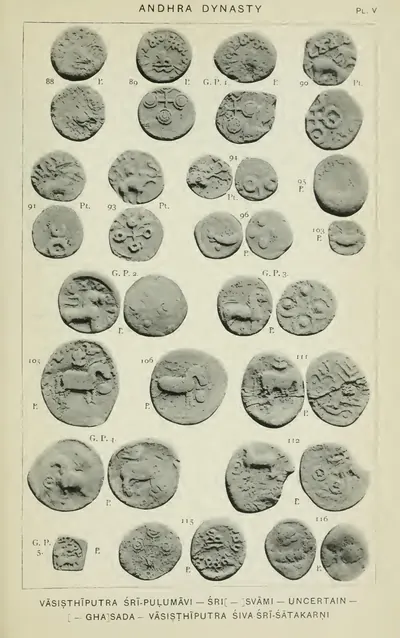
His coins belong to the class Rapson called Fabric A.23 On one side they have a stupa (chaitya) of three arches over a wavy line.23 Around it runs the legend Rano Vasithiputasa Siva-Siri-Satakamnisa, “of King Siva Sri Satakarni, son of Vasishthi”.23 On the other side is the “Ujjain symbol”.23
The same designs appear on lead coins of Vasishthiputra Pulumavi and of Chandra Sati, and in a later form on those of Yajna Sri.34 Rapson warned that when the legend is incomplete, Siva Sri’s coins are hard to tell from Chandra Sati’s.2
Rapson’s catalogue lists examples collected by Walter Elliot and by Robert Sewell, whose coin came from Gudivada. The catalogue also includes a coin from Gudivada published by Alexander Rea.2 Rea’s Gudivada coins with a stupa, which he numbered 1 to 9, include one whose legend he read as “…putasa—Siva”.56 Vincent Smith suggested that all of Rea’s coins numbered 2 to 9 should be assigned to this king.2
Place in the dynasty
The order of the later kings rests on coins and on the Puranas. Rapson found that Siva Sri’s coins link him with Pulumavi and Chandra Sati by their shared design. The Vishnu and Matsya Puranas place a Siva Sri directly after Pulumavi, and the coins do not contradict them.7
Rapson thought Siva Sri and Chandra Sati might have been Pulumavi’s brothers.1 He identified Siva Sri with the Siva-sri to whom the Matsya Purana gives seven years.1 Smith reported D. R. Bhandarkar’s view that Pulumavi was succeeded in turn by his brothers Siva Sri Satakarni and Sri Chandra Sati.8
Writers have given different dates:
- James Burgess (1887): about 163–170 CE.9
- Robert Sewell (1932), after Vincent Smith: accession about 170 CE and a reign of seven years. Sewell adds that L. D. Barnett placed his accession about 163 CE and found him living in 155.10
- Smith (1924): accession about 156 CE and seven years, as Puranic king No. 25, “Sivasri Puloma[vi III]”. Smith attributed the Andhradesa coins of Vasishthiputra Siva Sri Satakarni to him “probably”.11
The Amaravati fragment
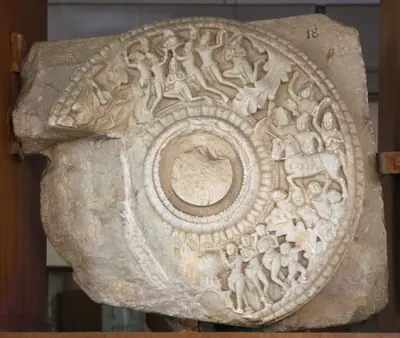
A broken inscription on a coping stone from the Amaravati stupa names a “king Sri Sivamaka Sada”.121 Rapson suggested that he might be Siva Sri Satakarni, since that king’s coins are found in the same region.121 He noted that the letters of the inscription belonged to a late period.121 James Burgess had instead wondered whether Sivamaka was Simuka, the founder of the dynasty.13
D. C. Sircar thought a king with a name ending in sada need not have been a Satavahana at all.14 He pointed to a Maharaja of the Aira family, of the same time and region, whose name also ended in sada.14 See Amaravati inscription of King Sri Sivamaka Sada.
Footnotes
-
E. J. Rapson, Catalogue of the Coins of the Andhra Dynasty, the Western Ksatrapas, the Traikutaka Dynasty, and the “Bodhi” Dynasty (1908), p. xl and n. 2 (archive.org (opens in a new tab)). ↩ ↩2 ↩3 ↩4 ↩5 ↩6 ↩7
-
Rapson, Catalogue of the Coins of the Andhra Dynasty (1908), catalogue p. 29 and notes (archive.org (opens in a new tab)). ↩ ↩2 ↩3 ↩4 ↩5 ↩6 ↩7
-
Rapson, Catalogue of the Coins of the Andhra Dynasty (1908), p. lxxii (archive.org (opens in a new tab)). ↩ ↩2 ↩3 ↩4 ↩5
-
Rapson, Catalogue of the Coins of the Andhra Dynasty (1908), p. lxxxix (archive.org (opens in a new tab)). ↩
-
Alexander Rea, South Indian Buddhist Antiquities (1894), p. 23 (archive.org (opens in a new tab)). ↩
-
Rea, South Indian Buddhist Antiquities (1894), p. 24 (archive.org (opens in a new tab)). ↩
-
Rapson, Catalogue of the Coins of the Andhra Dynasty (1908), p. lxxiii (archive.org (opens in a new tab)). ↩
-
Vincent A. Smith, The Early History of India, 4th ed. (1924), p. 224, n. 1 (archive.org (opens in a new tab)). ↩
-
James Burgess, The Buddhist Stupas of Amaravati and Jaggayyapeta (1887), p. 5 (archive.org (opens in a new tab)). ↩
-
Robert Sewell, The Historical Inscriptions of Southern India (1932), p. 325 (archive.org (opens in a new tab)). ↩
-
Smith, Early History of India (1924), table “The Later Andhra Kings and Connected Dynasties”, PDF p. 271 (archive.org (opens in a new tab)). ↩
-
Rapson, Catalogue of the Coins of the Andhra Dynasty (1908), p. lii (archive.org (opens in a new tab)). ↩ ↩2 ↩3
-
Burgess, Amaravati and Jaggayyapeta (1887), p. 61, n. 2 (archive.org (opens in a new tab)). ↩
-
D. C. Sircar, “Two Inscriptions from Guntur District”, Epigraphia Indica XXXII (1959), pp. 84–85 (archive.org (opens in a new tab)). ↩ ↩2
Photos
Related
Dynasties
References
Notes (0)
Sources (6)
Spotted an error on this page? Tell us
Last updated: