Mangi-yuvaraja
Fifth king of the Eastern Chalukyas of Vengi (about 672–696), son of Vishnuvardhana II. His own grants call him Sarvalokasraya, 'asylum of all mankind', and his seal Vijayasiddhi. Only the later grants give the name Mangi-yuvaraja, and no source explains why the title yuvaraja stuck to it. Two of his grants survive; one of them, from Chendalur in the Ongole country, is dated 6 May 673. Three of his sons reigned after him: Jayasimha II, Kokkili and Vishnuvardhana III.
Mangi-yuvaraja was the fifth king of the Eastern Chalukyas of Vengi.12 All the later grants that give the length of reigns agree that he ruled for twenty-five years.12 J. F. Fleet dated the reign 672–696, and Robert Sewell’s table follows him.13
Names and titles
The name Mangi-yuvaraja is used only in the later grants of the dynasty.1 Fleet wrote in 1891 that “there is nothing to shew why the title Yuvaraja is always attached to his proper name”.1 Yuvaraja means crown prince. He had the title sarvalokasraya, “asylum of all mankind”, and the seal of his grant gives him the surname Vijayasiddhi.1
E. Hultzsch edited the Chendalur plates in 1906.4 He pointed out that the king’s own grant calls him only Sarvalokasraya and Vijayasiddhi.4 He added that “in later inscriptions of the Eastern Chalukya dynasty this king Vijayasiddhi or Sarvalokasraya is named Mangiyuvaraja”.4
The two editors explained the surname differently, from the texts in front of them.14 In Fleet’s grant he is the one “who achieved the success of victory in controversies (?) of metaphysics and other sciences”.14 In the Chendalur grant he is the one “who has obtained the accomplishment of victory (vijaya-siddhi) by crushing the daring (of enemies) in many battles”.14 Fleet noted that some kings, Mangi-yuvaraja and Kokkili among them, seem to be known only by personal names given at birth.5
Family
Mangi-yuvaraja was the son of Vishnuvardhana II.14 His grandfather was Indra-Bhattaraka, called Indrabhattarakavarman in the Chendalur grant, and his great-grandfather was Vishnuvardhana I.4 See Vishnuvardhana II.
Jayasimha II was the eldest son of Mangi-yuvaraja and succeeded him.67 Kokkili was the youngest son of Mangi-yuvaraja, a half-brother of Jayasimha II by a different mother.86 Vishnuvardhana III was also a son of Mangi-yuvaraja, since Hultzsch identified the Vijayasiddhi named as his father in the Ipur plates with Mangi-yuvaraja.9
The grants do not say whether Vishnuvardhana III was older or younger than Jayasimha II.6 Fleet followed Hultzsch in placing him between his two brothers.6 See Jayasimha II and Vishnuvardhana III.
His grants
Two grants of Mangi-yuvaraja were known by 1906. One is in the Madras Museum. Fleet edited it in 1891, without knowing where it had been found.1011 Its seal reads Sri-Vijayasiddhi.1011 The grant was made at the winter solstice in the twentieth year of the reign.1011 It gave land to a Brahmin at the village of Nutulapayu in the Karma-rashtra country.1011 Hultzsch later suggested that this village might be “Nutulapad”, about fifteen miles west of Bapatla.12
The other is the Chendalur grant.13 It gives the village of Chendarura in Kamma-rashtra, identified with Chendalur itself, to six Brahmins.13 It was made on a lunar eclipse in the second year of the reign.13 F. Kielhorn fixed the date as 6 May 673, which Hultzsch took as confirming Fleet’s chronology.13 Sewell entered this grant as showing the king ruling that country, and dated his accession to 672.14
Hultzsch noticed that the Chendalur grant copied some of its praises of the king’s ancestors from the Pallavas.4 In his words, they came “from inscriptions or office records of the Pallavas, who had been supplanted by the Eastern Chalukyas” in that region.4 Hultzsch also edited the Penukaparu grant of Mangi-yuvaraja’s son Jayasimha II, also in Karma-rashtra.7 He found its alphabet like that of the Chendalur plates.7
A grant of Jayasimha I examined in 1919–20 names Mangi-yuvaraja as the master of the man who received it.15 The epigraphist thought it “not impossible that Mangi-yuvaraja was already a grown-up prince during the last years of the reign of Jayasimha-Vallabha”.15 Jayasimha-Vallabha was the elder brother of Mangi-yuvaraja’s grandfather.15
The other Mangi
Mangi-yuvaraja should not be confused with another Mangi.1617 According to the grants, Gunaga Vijayaditya III cut off this other Mangi’s head in battle.1617 Fleet suggested that this Mangi may have been a Chola king.16 Sewell, summing up the Maliyapundi grant, described him as ruling the Nolamba country.17 See Gunaga Vijayaditya III.
The reign in other reckonings
Hultzsch’s pedigree of 1890 gave the reign in Saka years, from about Saka 586–87 (Saka is an Indian way of counting years) to 611–12, that is about 664–690.18 Fleet’s later reckoning, which the site follows, put it eight years later.81
Footnotes
-
Fleet, “The Chronology of the Eastern Chalukya Kings” (1891), p. 98 (archive.org (opens in a new tab)). ↩ ↩2 ↩3 ↩4 ↩5 ↩6 ↩7 ↩8 ↩9 ↩10 ↩11
-
E. Hultzsch, “Pithapuram Pillar Inscription of Mallapadeva”, Epigraphia Indica IV (1896–97), p. 239 (archive.org (opens in a new tab)). ↩ ↩2
-
Sewell and Aiyangar, Historical Inscriptions of Southern India (1932), p. 336, pedigree of the Eastern Chalukya dynasty (archive.org (opens in a new tab)). ↩
-
E. Hultzsch, “Chendalur Plates of Sarvalokasraya; A.D. 673”, Epigraphia Indica VIII (1905–06), p. 237 (archive.org (opens in a new tab)). ↩ ↩2 ↩3 ↩4 ↩5 ↩6 ↩7 ↩8 ↩9 ↩10
-
Fleet, “The Chronology of the Eastern Chalukya Kings” (1891), p. 96, note (archive.org (opens in a new tab)). ↩
-
Fleet, “The Chronology of the Eastern Chalukya Kings” (1891), p. 99 (archive.org (opens in a new tab)). ↩ ↩2 ↩3 ↩4
-
E. Hultzsch, “Penukaparu Grant of Jayasimha II”, Epigraphia Indica XVIII (1925–26), p. 314 (archive.org (opens in a new tab)). ↩ ↩2 ↩3
-
J. F. Fleet, “The Chronology of the Eastern Chalukya Kings”, Indian Antiquary XX (1891), p. 12, “List of the Eastern Chalukya Kings” (archive.org (opens in a new tab)). ↩ ↩2
-
E. Hultzsch, “Ipur Plates of Vishnuvardhana III”, Epigraphia Indica XVIII (1925–26), p. 58 (archive.org (opens in a new tab)). ↩
-
J. F. Fleet, “Madras Museum Copper-plate Grant of Mangi-Yuvaraja”, Indian Antiquary XX (1891), p. 104 (archive.org (opens in a new tab)). ↩ ↩2 ↩3 ↩4
-
Fleet, “Madras Museum Copper-plate Grant of Mangi-Yuvaraja” (1891), p. 105 (archive.org (opens in a new tab)). ↩ ↩2 ↩3 ↩4
-
E. Hultzsch, “Vemalurpadu Plates of Ammaraja II”, Epigraphia Indica XVIII (1925–26), p. 228 (archive.org (opens in a new tab)). ↩
-
Hultzsch, “Chendalur Plates of Sarvalokasraya” (1906), p. 238 (archive.org (opens in a new tab)). ↩ ↩2 ↩3 ↩4
-
Robert Sewell and S. Krishnaswami Aiyangar, The Historical Inscriptions of Southern India (1932), p. 26 (archive.org (opens in a new tab)). ↩
-
Annual Report on Epigraphy, Madras, for 1919–20 (G.O. No. 985, Home (Education), 31 August 1920), Part II, para. 11, p. 99 (archive.org (opens in a new tab)). ↩ ↩2 ↩3
-
Fleet, “The Chronology of the Eastern Chalukya Kings” (1891), p. 103 (archive.org (opens in a new tab)). ↩ ↩2 ↩3
-
Sewell and Aiyangar, Historical Inscriptions of Southern India (1932), p. 35 (archive.org (opens in a new tab)). ↩ ↩2 ↩3
-
E. Hultzsch, South-Indian Inscriptions, Vol. I (1890), p. 32, pedigree of the Eastern Chalukya dynasty (archive.org (opens in a new tab)). ↩
Photos
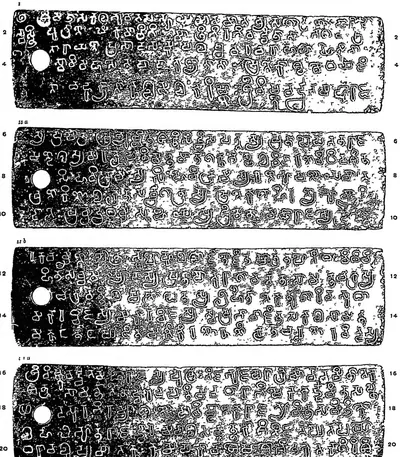 "Chendalur plates of Sarvalokasraya.—A.D. 673", plates i, ii a, ii b and iii a (Epigraphia Indica VIII, plate between pp. 238 and 239 (PDF p. 301))Inscription rubbing · 1906
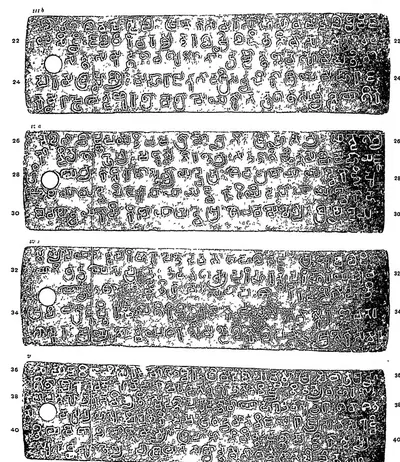 "Chendalur plates of Sarvalokasraya.—A.D. 673", plates iii b, iv a, iv b and v (Epigraphia Indica VIII, plate between pp. 238 and 239 (PDF p. 302))Inscription rubbing · 1906
Related
Dynasties

References
Notes (0)
Sources (7)
Spotted an error on this page? Tell us
Last updated: