Amma I
Eastern Chalukya king of Vengi (918–925), grandson of Chalukya-Bhima I. He came to the throne against a conspiracy of his own relatives allied with the Rashtrakutas. His surname Raja-Mahendra led J. F. Fleet to suggest that Rajahmundry (Rajamahendrapuram) was named after him. His death in 925 opened nine years of civil war among the branches of the dynasty. His son Beta-Vijayaditya V, deposed as a child, founded the line of the Chalukya princes of Pithapuram.
Amma I ruled the Eastern Chalukya kingdom of Vengi for seven years.12 J. F. Fleet dated his reign from September 918 to August 925, and Robert Sewell gives the same years.12
His grants call him Amma, or once Amba.3 Like other kings of the dynasty he bore a second name, Vishnuvardhana (VI in Fleet’s numbering), and the surname Raja-Mahendra.3
Family
Amma I was the eldest son of Vijayaditya IV, called Kollabhiganda, and a grandson of Chalukya-Bhima I.34 Melamba was a queen of Vijayaditya IV, and is named in two later grants.5 She was the mother of Amma I’s half-brother, the later king Chalukya-Bhima II.678 His grant calls him “the son of Melamba and Vijayaditya”.678
Beta-Vijayaditya V was the eldest son of Amma I.9 Bhima, who reigned for eight months in 926–927 (Bhima III in Fleet’s numbering, Bhima II in Sewell’s), was another son of Amma I and a younger brother of Beta.810
His father’s short reign
Vijayaditya IV reigned for only six months, in 918.45 His grants call him Vijayaditya, Kollabiganda or Kollabhiganda-Vijayaditya, and one of them calls him Kaliyarttyanka.45
One record says that he ruled over the Vengi country “together with the forests of Trikalinga”, the three Kalingas.5 Another says that he conquered the rulers of Kalinga.5 Bhandanaditya, also called Kuntaditya, of the Pattavardhini family, served him.511 Bhandanaditya’s ancestor Kalakampa had fought for the founder of the dynasty, Kubja Vishnuvardhana.511
A disputed succession
Amma I’s own grant from Idara was edited by Hultzsch in 1890.11 It says that he “drew his sword, which broke the dishonest hearts of his feudatory relatives, who had joined the party of his natural adversaries”.11 In this way, it says, he won over the subjects and the army of his father and grandfather.11
Hultzsch took the natural adversaries to be the Rashtrakutas under Indra III (Prabhutavarsha), whose inscription is dated in 920.11 Fleet read the passage the same way.312 In his view some members of the family had conspired with the Rashtrakutas to keep Amma from the throne, and failed.312
Grants
Two grants of Amma I were known to Fleet:39
- The Masulipatam plates were first published by Sewell in 1879. They give the village of Drujjuru in the Pennatavadi district to Mahakala, who had been a general of Chalukya-Bhima I. F. Kielhorn re-edited them in 1899 and added that Mahakala was the son of a foster-sister of Bhima I.313 Sewell identified Drujjuru with Zuzzuru in the Nandigama taluk of the Krishna (then Kistna) district. Kielhorn thought this possible but could not find the boundary villages near it.14 Fleet noted that this grant, or the Idara grant, is the earliest record to give the full historical genealogy of the dynasty with the length of each reign.3
- The Idara plates were presented to the Madras Museum by the zamindar (landholder) of Nuzvid. They grant the village of Gonturu with twelve hamlets, in the Kanderuvadi district, to Bhandanaditya alias Kuntaditya.1511 He was one of the king’s military officers and had already served his father.1511
The seals of his grants bear the boar and the family motto Sri-Tribhuvanankusa, “the glorious elephant-goad of the three worlds”.313
Raja-Mahendra and Rajahmundry
Fleet noticed that Amma I’s surname Raja-Mahendra occurs in one of his own grants. He suggested that the city of Rajamahendrapuram, or Rajahmundry, on the north bank of the Godavari, was first occupied by the Eastern Chalukyas under Amma I.163 In his view it was named after this king.163 Amma II, his nephew, bore the same surname.17 (See Rajahmundry.)
After Amma I: the civil war of 925–934
Sewell summed up the years after Amma I’s death as a time of great confusion in the Vengi country.2 The rulers followed one another quickly:188219
- Amma I’s son Beta-Vijayaditya V reigned for only fifteen days9
- Tadapa, a son of Yuddhamalla I of the junior branch, drove Beta out9 and held the throne for a month188219
- Vikramaditya II, Amma I’s uncle, overthrew Tadapa (one grant says he killed him) and reigned for eleven months
- Amma I’s younger son Bhima defeated Vikramaditya and reigned for eight months, until Tadapa’s son Yuddhamalla II killed him188219
The grants say that Beta had been anointed as a child, by the tying on of a necklet (kanthika).9 Hultzsch explained Beta’s other name, Kanthika-Beta, from this necklet.20 He took it to be the sign of the heir-apparent.20
Beta and the Pithapuram line
Nothing in the records says that Beta died as a child. Fleet pointed out that two later inscriptions make him the founder of a separate line.9 In the end this line came to hold the Vengi country again.9 Beta’s son was Satyasraya, and his descendants, the Chalukya princes of Pithapuram, are the subject of the Pithapuram pillar inscription of Mallapadeva of 1202.1821
Sewell thought that Beta retired into private life.19 He noted that the Maliyapundi grant of Amma II says that Chalukya-Bhima II banished Beta.19 That grant says the king banished a Kanthika-Vijayaditya along with Yuddhamalla II.22 Hultzsch identified this Kanthika-Vijayaditya with Beta.22
Footnotes
-
J. F. Fleet, “The Chronology of the Eastern Chalukya Kings”, Indian Antiquary XX (1891), p. 12, list of kings (archive.org (opens in a new tab)). ↩ ↩2
-
Robert Sewell and S. Krishnaswami Aiyangar, The Historical Inscriptions of Southern India (1932), p. 43 (archive.org (opens in a new tab)). ↩ ↩2 ↩3 ↩4 ↩5 ↩6
-
Fleet, “Chronology of the Eastern Chalukya Kings” (1891), pp. 266–267 (archive.org (opens in a new tab)). ↩ ↩2 ↩3 ↩4 ↩5 ↩6 ↩7 ↩8 ↩9 ↩10 ↩11
-
Fleet, “Chronology of the Eastern Chalukya Kings” (1891), p. 103 (archive.org (opens in a new tab)). ↩ ↩2 ↩3
-
Fleet, “Chronology of the Eastern Chalukya Kings” (1891), p. 104 (archive.org (opens in a new tab)). ↩ ↩2 ↩3 ↩4 ↩5 ↩6 ↩7
-
F. Kielhorn, “Six Eastern Chalukya Copper-plate Inscriptions”, grant of Chalukya-Bhima II, Epigraphia Indica V (1898–99), p. 135 (archive.org (opens in a new tab)). ↩ ↩2
-
E. Hultzsch, South-Indian Inscriptions, Vol. I (1890), p. 32, pedigree of the Eastern Chalukya dynasty (archive.org (opens in a new tab)). ↩ ↩2
-
Fleet, “Chronology of the Eastern Chalukya Kings” (1891), p. 269 (archive.org (opens in a new tab)). ↩ ↩2 ↩3 ↩4 ↩5 ↩6
-
Fleet, “Chronology of the Eastern Chalukya Kings” (1891), p. 267 (archive.org (opens in a new tab)). ↩ ↩2 ↩3 ↩4 ↩5 ↩6 ↩7
-
Sewell and Aiyangar, Historical Inscriptions of Southern India (1932), p. 337 (archive.org (opens in a new tab)). ↩
-
Hultzsch, South-Indian Inscriptions, Vol. I (1890), No. 36, p. 38 (archive.org (opens in a new tab)). ↩ ↩2 ↩3 ↩4 ↩5 ↩6 ↩7 ↩8
-
J. F. Fleet, “Dynasties of the Kanarese Districts”, Gazetteer of the Bombay Presidency, Vol. I, Part II (1896), p. 417 (archive.org (opens in a new tab)). ↩ ↩2
-
F. Kielhorn, “Six Eastern Chalukya Copper-plate Inscriptions”, E, Masulipatam plates of Amma I, Epigraphia Indica V (1898–99), p. 131 (archive.org (opens in a new tab)). ↩ ↩2
-
Kielhorn, “Six Eastern Chalukya Copper-plate Inscriptions” (1899), p. 132 (archive.org (opens in a new tab)). ↩
-
Hultzsch, South-Indian Inscriptions, Vol. I (1890), No. 36, p. 37 (archive.org (opens in a new tab)). ↩ ↩2
-
Fleet, “Chronology of the Eastern Chalukya Kings” (1891), p. 94 (archive.org (opens in a new tab)). ↩ ↩2
-
Fleet, “Chronology of the Eastern Chalukya Kings” (1891), p. 270 (archive.org (opens in a new tab)). ↩
-
Fleet, “Chronology of the Eastern Chalukya Kings” (1891), p. 268 (archive.org (opens in a new tab)). ↩ ↩2 ↩3 ↩4
-
Sewell and Aiyangar, Historical Inscriptions of Southern India (1932), p. 44 (archive.org (opens in a new tab)). ↩ ↩2 ↩3 ↩4 ↩5
-
E. Hultzsch, “Pithapuram Pillar Inscription of Mallapadeva”, Epigraphia Indica IV (1897), p. 227 (archive.org (opens in a new tab)). ↩ ↩2
-
Hultzsch, “Pithapuram Pillar Inscription” (1897), p. 228 (archive.org (opens in a new tab)). ↩
-
E. Hultzsch, “Maliyapundi Grant of Ammaraja II”, Epigraphia Indica IX (1907–08), p. 49 (archive.org (opens in a new tab)). ↩ ↩2
Photos
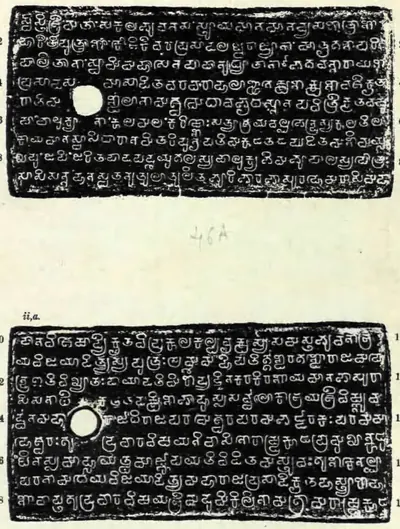 "Chevuru Plates of Eastern Chalukya Amma I", plates i and ii a (Epigraphia Indica XXVII, plate between pp. 46 and 47 (PDF p. 86))Inscription rubbing · 1956
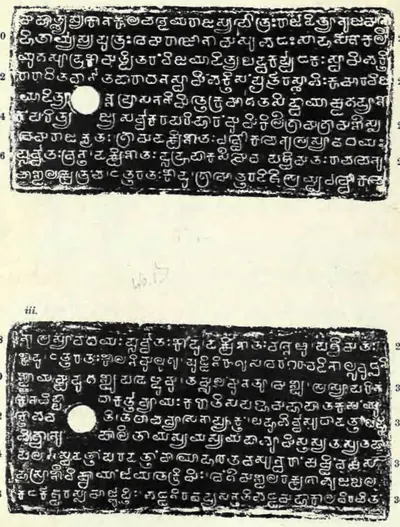 "Chevuru Plates of Eastern Chalukya Amma I", plates ii b and iii (Epigraphia Indica XXVII, plate between pp. 46 and 47 (PDF p. 87))Inscription rubbing · 1956
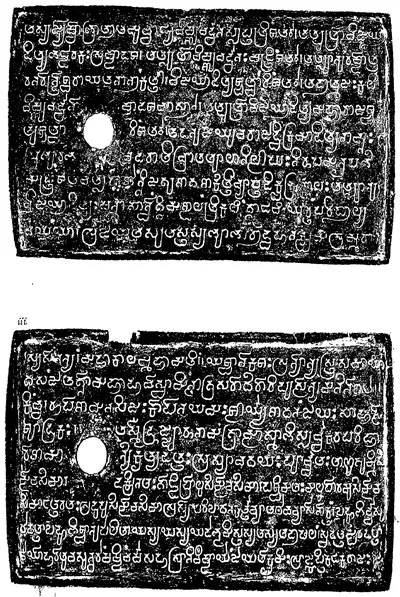 "D.—Masulipatam Plates of Amma I.", plates ii a and iii (Epigraphia Indica V, plate between pp. 132 and 133 (PDF p. 184))Inscription rubbing · 1899
Related
Dynasties

References
Notes (0)
Sources (7)
Spotted an error on this page? Tell us
Last updated: