Gooty rock inscription of Bukka I
A single Sanskrit verse cut on a rock near the top of the Gooty fort in the Anantapur district. It praises 'Gutti-durga, the king of forts' as the centre of the wheel of king Bukka's rule over the earth. It compares the rock to Vishnu's conch with right-turning whorls. E. Hultzsch, who edited it in 1890, took the king to be Bukka I of Vijayanagara. Sewell's lists of 1882 had suggested an officer of Krishnadeva Raya.
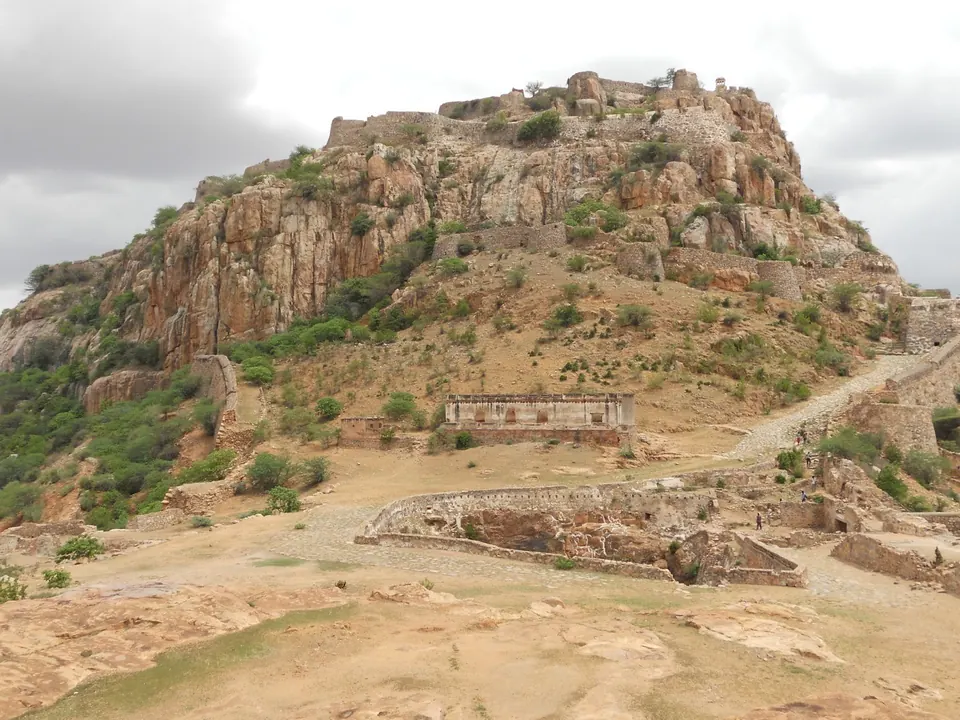
The rock and the verse
E. Hultzsch published the inscription in 1890, in the first volume of South-Indian Inscriptions.1 He wrote that it “is engraved on a rock not far from the summit of the fort of Gutti (Gooty) in the Anantapur District”.1 It “consists of one verse in the Sragdhara metre.”1 He noted that the same fort bears three rough rock inscriptions in Kanarese (Kannada) of the Western Chalukya king Vikramaditya VI.1 Two of them are dated in 1121–22 and 1122–23.1
V. Rangacharya’s list of 1919 gives the verse as No. 85 of the Government Epigraphist’s collection for 1903.2 It places the verse “on a rock near the deserted Narasimhasvami temple on the local hill”.2 There it stands among a group of damaged Kanarese records, one of them dated 1507.2
Hultzsch translated the verse.1 It begins: “Prosperity! Victorious is the king of forts, the best of mountains, Gutti-durga by name!”1 It calls the hill “the nave of the wheel of the sovereignty over the whole earth of the illustrious king Bukka”.1 (The nave is the centre of a wheel.) The verse says that Bukka is “another form (assumed by) Vishnu for protecting the world”.1
The hill is also Bukka’s “ancient auspicious conch-shell with convolutions from left to right (dakshinavarta-sankha)”.1 So, the verse says, it is like “the centre of the discus of (Vishnu) the lord of Lakshmi, and his conch-shell Panchajanya.”1
The Anantapur gazetteer of 1905 quoted the translation.3 It added Hultzsch’s explanation of the comparison with the conch.3 A conch with right-handed whorls is “a very rare article and one which always brings prosperity to its fortunate owner”.3 The comparison “was suggested by the shape of the Gooty rock and the windings round it of the path which leads to its summit.”3
Which Bukka?
Hultzsch wrote that the fort “belonged to king Bukka”.1 He went on: “By this, the well-known king of the first dynasty of Vijayanagara, whose inscriptions range between Saka-1276 [current] and 1290 [expired], seems to be meant”.1 These dates are about 1353 to 1368.1 The gazetteer accepted that this was Bukka I of Vijayanagar, “who ruled from 1343 to 1379”.3 See Bukka I.
Robert Sewell’s lists of 1882 had read the verse differently.4 They describe “a Sanskrit sloka in praise of ‘Bukka Nripati’, probably Bukka Raja, one of Krishnadeva Raya’s officers, who built the fort”.4 They also record the local belief that the fort was “said to have been constructed by Krishnadeva Raya”.4
The gazetteer of 1905 gave an answer to this.3 It agreed that Krishnadeva Raya “is popularly credited with having built” the fortifications.3 But it pointed out that “it has been stated above that they had been begun many years before his time”.3 See the Gooty fort and Krishnadeva Raya.
Gooty under Vijayanagara
The gazetteer found little else on record for the Vijayanagara period.3 In its words, “The fort doubtless continued a possession of the Vijayanagar kings until the overthrow of their dynasty at the battle of Talikota in 1565”.3 Inscriptions at Tadpatri show that Gooty was the capital of a rajya (or province), and they give the names of one or two of its governors.3 Apart from this, “nothing is on record regarding its history during that time.”3
A copper-plate grant of Sadasiva of 1548 places the village of Kanuma in “Gutti valita”.5 A stone record of Venkatapati of 1603 gives a village to the god Raghunayaka “on the hill-fort of Gutti”.5 See the Kanuma grant and Gooty.
Footnotes
-
E. Hultzsch, South-Indian Inscriptions, Vol. I (1890), p. 167, No. 154, “A rock-inscription at the fort of Gutti” (archive.org (opens in a new tab)). ↩ ↩2 ↩3 ↩4 ↩5 ↩6 ↩7 ↩8 ↩9 ↩10 ↩11 ↩12 ↩13 ↩14
-
V. Rangacharya, A Topographical List of the Inscriptions of the Madras Presidency, Vol. I (1919), p. 4, Anantapur Nos. 20–27 (archive.org (opens in a new tab)). ↩ ↩2 ↩3
-
W. Francis, Madras District Gazetteers: Anantapur (1905), p. 156 (archive.org (opens in a new tab)). ↩ ↩2 ↩3 ↩4 ↩5 ↩6 ↩7 ↩8 ↩9 ↩10 ↩11 ↩12
-
Robert Sewell, Lists of the Antiquarian Remains in the Presidency of Madras, Vol. I (1882), p. 115 (archive.org (opens in a new tab)). ↩ ↩2 ↩3
-
Rangacharya, Topographical List, Vol. I (1919), p. 5, Anantapur Nos. 28 and 33 (archive.org (opens in a new tab)). ↩ ↩2
Photos
References
Notes (0)
Sources (4)
Spotted an error on this page? Tell us
Last updated: