Pedda-Vegi plates of Jayasimha I
An undated Sanskrit copper-plate grant of the second Eastern Chalukya king, Jayasimha I Sarvasiddhi. It was found two or three feet underground near Pedda-Vegi, the old capital of Vengi. It gives the village of Kombaru, identified with Komali in Repalle taluk, to a Brahmin from Kukkanur. It is the only grant of the dynasty that opens with a prayer to the sun, and it calls the founder Vishnuvarman. It was registered in 1917–18 and edited by V. Rangacharya in 1928.
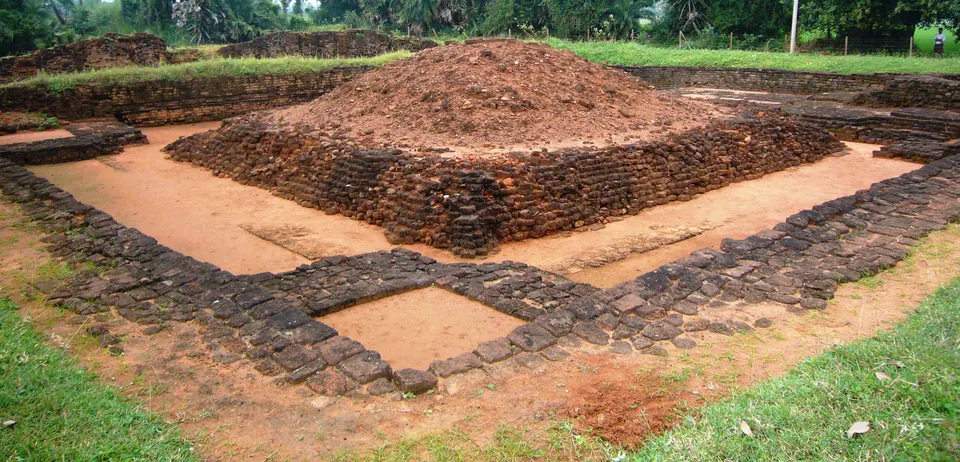
This grant of Jayasimha I, son and successor of Kubja-Vishnuvardhana, was found near Pedda-Vegi (Vengi), the old capital of the Eastern Chalukyas near Eluru (then Ellore). The epigraphical report that first described it in 1918 called the records of this king “very rare”.12
Discovery and description
V. Rangacharya edited the grant in 1928. He wrote that a relative of his had brought the plates to his notice several years before. He was told that they had been found “two or three feet below the surface of the earth during some excavations near Pedda-Vegi in the vicinity of Ellore”. They were registered as No. 11 of Appendix A in the Madras epigraphical report for 1917–18.1 That report reviewed the record on page 130.1
There are three plates, about 7¾ inches long and 2¼ inches broad.3 The first side is blank, and the last carries a single line.3 They hang on a ring about 3½ inches across.3 The ring carries a fixed round seal with the title Sri-Sarvasiddhi in relief.3 The engraving is generally clear.3 But the ends of lines 16 and 17 on the second plate and of lines 19 and 20 on the third are badly defaced.3
The report for 1917–18 noted that the same title appears on the seals of the king’s two other known grants.2 These are the Pedda-Maddali plates and a grant registered in 1917.2 Fleet had recorded Sri-Sarvasiddhi on the seal of the Pedda-Maddali plates.4
Script and language
The language is Sanskrit.3 Rangacharya found the letters the same as those of the Pulibumra plates and the Niduparu plates.3 He saw nothing special in the alphabet or spelling.3 The Dravidian ṟ occurs in lines 13 and 14.3 The upadhmaniya, a special sign for the breath before p, occurs in lines 18 and 25.3
Content
The report for 1917–18 pointed out several features that set the record apart:2
- It is the only grant of the family that begins with a prayer, here to the sun-god Savitri.2
- Its family line starts with Kirtivarman, described as the “elevator of the Chalukyas”.2
- It names Kubja-Vishnuvardhana as Vishnuvarman, “using the title varman which is not generally seen in Eastern Chalukya names”.2
Rangacharya’s abstract describes the donor as Jayasimha-Vallabha-Maharaja, surnamed Sarvasiddhi, “the son of Vishnuvarman, the youngest son of Kirttivarman”.5 The king speaks to the residents of the village of Kombaru.5 Kombaru lay in the district of Kantheyuvati, a gavyuti (a measure of distance) to the south of Vienturu.5
The king makes the village a tax-free agrahara (Brahmin village).5 He gives it to Somasarman of Kukkanur, of the Gargya gotra (clan) and the Taittiriya school, a learned and hospitable scholar.35 The gift was made on the full moon of Karttika, on the day of the equinox (vishuvadina).35 The executor (ajnapti) was Narasimhabarman, the king’s “beloved preceptor”.5
The edition gives the donee’s father two different names.35 He is Sivasarman in Rangacharya’s introduction and Svamisarman in his abstract.35
The places
Rangacharya did not discuss the place names, because the epigraphical report had already done so.3 The report read the name of the district as Kantheruvati.2 It took this to be the Ganderuvati district of another grant of the same king.2 That name was later corrupted into Kanderuvati and Kandravati.2
The report took Vientuju to be a corrupt form of Velanturu, very likely Vellaturu in Repalle taluk of Guntur district.2 It identified Kombaru with the village of Komali in the same taluk.2
The report suggested that Kukkanur, the donee’s home, might be the place of that name in the Nizam’s dominions.2 That place is often mentioned in later western Chalukya inscriptions.2 If so, the report thought, it might have lain in the Eastern Chalukya country when the grant was made.2
Date
The abstract gives no regnal year, only the day: the full moon of Karttika.5 Rangacharya placed Jayasimha I’s reign from some time after July 632 to about February or March 663.67
Edition
V. Rangacharya, “The Pedda-Vegi Plates of the Eastern Chalukya King Jayasimha I”, Epigraphia Indica XIX (1927–28), No. 43, pp. 258–261, with text and abstract.1 Summary: Annual Report on Epigraphy for 1917–18, Part II, para. 3.2
Footnotes
-
V. Rangacharya, “The Pedda-Vegi Plates of the Eastern Chalukya King Jayasimha I”, Epigraphia Indica XIX (1927–28), p. 258 (archive.org (opens in a new tab)). ↩ ↩2 ↩3 ↩4
-
Annual Report on Epigraphy, Southern Circle, for 1917–18 (G.O. No. 1172, Home (Education), 6 September 1918), Part II, para. 3, p. 130 (archive.org (opens in a new tab)). ↩ ↩2 ↩3 ↩4 ↩5 ↩6 ↩7 ↩8 ↩9 ↩10 ↩11 ↩12 ↩13 ↩14 ↩15 ↩16
-
Rangacharya, “Pedda-Vegi Plates” (1928), p. 259 (archive.org (opens in a new tab)). ↩ ↩2 ↩3 ↩4 ↩5 ↩6 ↩7 ↩8 ↩9 ↩10 ↩11 ↩12 ↩13 ↩14 ↩15 ↩16
-
J. F. Fleet, “Sanskrit and Old-Canarese Inscriptions, No. CXLIV”, Indian Antiquary XIII (1884), p. 137 (archive.org (opens in a new tab)). ↩
-
Rangacharya, “Pedda-Vegi Plates” (1928), p. 261, abstract of contents (archive.org (opens in a new tab)). ↩ ↩2 ↩3 ↩4 ↩5 ↩6 ↩7 ↩8 ↩9 ↩10
-
V. Rangacharya, “The Pulibumra Plates of the Eastern Chalukya King Jayasimha I”, Epigraphia Indica XIX (1927–28), p. 255 (archive.org (opens in a new tab)). ↩
-
Rangacharya, “Pulibumra Plates” (1928), p. 256 (archive.org (opens in a new tab)). ↩
Photos
References
Notes (0)
Sources (3)
Spotted an error on this page? Tell us
Last updated: