Niduparu grant of Jayasimha I
A Sanskrit copper-plate grant of the second Eastern Chalukya king, Jayasimha I Sarvasiddhi, issued from Asanapura. It gives the village of Niduparu, near the royal residence of Ganderu, to the Brahmin Katisarman, whose grandfather belonged to the college (ghatika) of Asanapura. It was examined in 1916–17, and E. Hultzsch edited it in 1926. Ganderu has been identified with Kanteru and Niduparu with Nidamarru, both in Guntur taluk.
This is a grant of Jayasimha I, the son and successor of Kubja Vishnuvardhana and the second king of the Eastern Chalukyas.1 It is undated except for the day of the gift, the full moon of Karttika.1 J. F. Fleet put Jayasimha’s reign at thirty years, from 633 to 663.2
Discovery and description
M. Ramakrishnakavi of the Oriental Manuscripts Library, Madras, sent the plates for examination in 1916–17.34 They were registered as No. 7 of Appendix A in that year’s epigraphical report.34 The report does not say where they were found.34 E. Hultzsch edited them in 1926 from ink impressions sent to him by H. Krishna Sastri.4
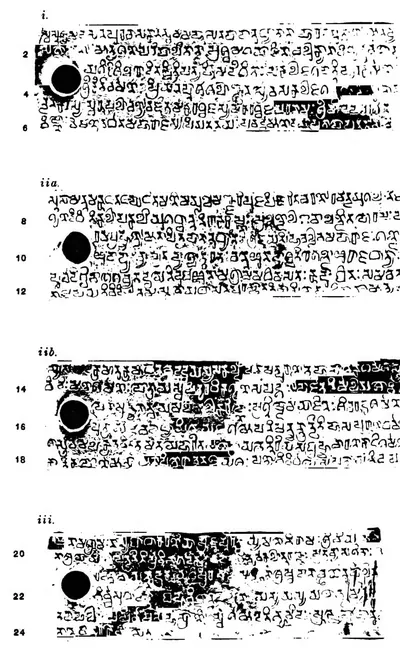
There are three oblong plates, and the second is inscribed on both sides.4 Their margins are “only very slightly raised into rims”.4 They are 2 inches high, and the first two are 7 inches broad.4 The third, cut on its right side, is a little less broad.4
The ends of the ring are fixed in a round seal bearing the legend Sri-Sarvvasiddhi, with a crescent above and a nine-petalled lotus below.4 The plates, ring and seal weigh 70 tolas.4 The writing is fairly well preserved, but two or three letters are lost at the ends of the first five lines of the third plate.4
Script and language
Hultzsch found the alphabet like that of other early Eastern Chalukya grants.4 He noted the syllable ru, written with the Telugu letter, in the Telugu place names Ganderu, Vanneru and Niduparu.4 The text is in Sanskrit prose up to line 19, followed by four Sanskrit verses on the last plate.4 The rules of sandhi (joining sounds between words) are often neglected.4
Content
The order is issued from Asanapura.41 It names the king as Jayasimha-Vallabha-Maharaja, of the family of the Chalukyas.41 He is the dear son of Vishnuvardhana-Maharaja, whose other name was Makaradhvaja, and the dear grandson of Kirtivarman.41
Hultzsch explained the surname Makaradhvaja, that is Cupid, from the text’s claim that Vishnuvardhana I surpassed Cupid in beauty.41 The epigraphical report of 1917 pointed out that the same surname was later borne by Vishnuvardhana IV.3
The king addresses the ryots (cultivators) of the village of Nidubaru in the Ganderuvati district.1 The village was “north of the Vyaghra river and on the bank of the Vanneru river”.1 It lay “at (a distance of) two gavyutis on the eastern side of the royal residence (rajadhani) of Ganderu”.1
He gives them notice that he has given the village to Katisarman of the Harita gotra (clan) and the Taittiriya school.1 He made the gift on the full-moon day of Karttika.1 Katisarman was the son of Sivarudrasarman and grandson of Mandasarman.1 Hultzsch suggested that the donee’s name should perhaps be read Kotisarman.4
The grandfather lived in the town of Asanapura and was a member of its college (ghatika).1 He is said to have studied two Vedas with their pada, krama and anukrama recitations.1 The father performed Agnishtoma sacrifices.1 The donee himself had studied two Vedas, sacrificial lore, the Upanishads, the meaning of the mantras, the Itihasa, the Puranas and the Dharmasastra.1
The executor (ajnapti) was a man who “knew royal politics, the Vedangas, and all arts”.15 His name is lost in a break.15 Hultzsch thought it may have been Sarvajanasraya, and that he was perhaps a Brahmin minister.15 The record ends with three verses “sung by Vyasa”.15
The places
The epigraphist of 1917 took Ganderuvati to be the Kanderuvadi district of later grants, named after the modern village of Kanteru in the Guntur taluk.3 He identified the village granted with Nidamarru in the same taluk, “which is actually about 2 gavyutis” east of Kanteru.3
Hultzsch accepted both identifications, and made Ganderu the residence of Jayasimha I.6 Robert Sewell told him that Kanteru lies a few miles north-east of Guntur, on the road to Vijayawada (then Bezwada).6 He also told him that Nidamarru lies a few miles north-north-east of it.6 Neither could trace the Vyaghra and Vanneru rivers or the town of Asanapura.6
There is a second pair of villages named Kanteru and Nidamarru, in the Tanuku and Bhimavaram taluks of the Godavari district.6 Sewell agreed with the Guntur identification because Kanteru in Guntur was “a far more important place”.6 He also noted that the Godavari pair were “not very close together”.6
Notable points
The report of 1917 read the river’s name as Manneru, where Hultzsch read Vanneru.36 It also judged the grant important for its date.23 Fleet had known only one grant of Jayasimha I, from Pedda-Maddali in the Krishna (then Kistna) district.23 He was “not quite satisfied as to its authenticity”.23
The 1917 report called the Niduparu grant “above suspicion”, and the second record of the king to be found.23 It noted that the surname Sarvasiddhi on its seal is also on the seal of the Pedda-Maddali plates.23 Fleet’s list explains the surname, from the Pedda-Maddali grant, as “he who acquired all (kinds of) success by the strength of his arm”.2 See also the Pulibumra plates and the Pedda-Vegi plates of the same king.
Asanapura appears in several early grants. Hultzsch noted that the grandfather of the donee of a grant of Vishnuvardhana II also lived there.4
M. Somasekhara Sarma edited three more grants of Jayasimha I in 1960.7 He observed that two of them were issued from Asanapura, and that the donee of the Pulibumra grant had also moved there.7 The Niduparu donee’s grandfather belonged to its ghatika.7 So Somasekhara Sarma concluded that Asanapura was a centre of learning and culture in early Eastern Chalukya times, although he could not identify it.7 See the Gudivada plates.
Footnotes
-
Hultzsch, “Niduparu Grant of Jayasimha I” (1926), p. 57, text and abstract of contents (archive.org (opens in a new tab)). ↩ ↩2 ↩3 ↩4 ↩5 ↩6 ↩7 ↩8 ↩9 ↩10 ↩11 ↩12 ↩13 ↩14 ↩15 ↩16 ↩17 ↩18 ↩19 ↩20
-
J. F. Fleet, “The Chronology of the Eastern Chalukya Kings”, Indian Antiquary XX (1891), p. 97 (archive.org (opens in a new tab)). ↩ ↩2 ↩3 ↩4 ↩5 ↩6 ↩7
-
Annual Report on Epigraphy, Madras, for 1916–17 (G.O. No. 1035, Home (Education), 10 August 1917), Part II, para. 19, p. 115 (archive.org (opens in a new tab)). ↩ ↩2 ↩3 ↩4 ↩5 ↩6 ↩7 ↩8 ↩9 ↩10 ↩11 ↩12
-
E. Hultzsch, “Niduparu Grant of Jayasimha I”, Epigraphia Indica XVIII (1925–26), p. 55 (archive.org (opens in a new tab)). ↩ ↩2 ↩3 ↩4 ↩5 ↩6 ↩7 ↩8 ↩9 ↩10 ↩11 ↩12 ↩13 ↩14 ↩15 ↩16 ↩17 ↩18 ↩19 ↩20 ↩21
-
Hultzsch, “Niduparu Grant of Jayasimha I” (1926), p. 58 and note 1 (archive.org (opens in a new tab)). ↩ ↩2 ↩3 ↩4
-
Hultzsch, “Niduparu Grant of Jayasimha I” (1926), p. 56 and note 2 (archive.org (opens in a new tab)). ↩ ↩2 ↩3 ↩4 ↩5 ↩6 ↩7 ↩8
-
M. Somasekhara Sarma, “Three Grants of Chalukya Jayasimha I”, Epigraphia Indica XXXI (1955–56, publ. 1960), p. 134 (archive.org (opens in a new tab)). ↩ ↩2 ↩3 ↩4
Photos
References
Notes (0)
Sources (4)
Spotted an error on this page? Tell us
Last updated: