Rachakonda inscriptions of Anapota (1365)
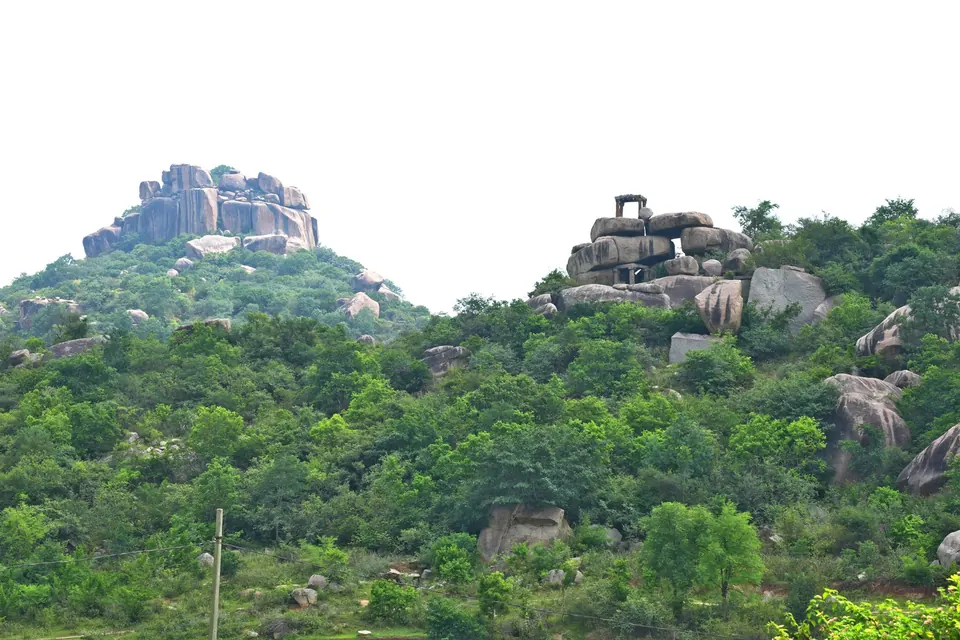
Three Telugu inscriptions of August 1365 at Rachakonda fort. In them the Recherla Velama chief Anapota-nayaka records the stone fortifications and wells he built on the twin hills of Rajukonda and Naganayanikonda. They also record the tank Anapota-samudram, dug between the hills, and an image of Bhairava set up under his title Pratigandabhairava.
What they are
Three short Telugu inscriptions at Rachakonda record the building works of Anapota Nayaka.12 He was the Recherla chief who made the hill fort his capital, and all three records are of the same day in August 1365.12 They are the earliest dated records of the family’s rule at Rachakonda, four years before the Inavolu inscription of 1369.13
Their texts were printed in 1910, in the appendix to the family chronicle of the Velugoti Rajas of Venkatagiri.45 They were edited again in the volume of inscriptions of the Nalgonda district published in 1992, which Epigraphia Telanganica summarises.1 See Rachakonda Fort and the Recherla Velamas.
Where they are
The two editions place the stones differently.4513 The 1910 appendix places them like this:45
- one at the place called Bhairavagandi, south-east of Rachakonda45
- one at the northern foot of the Rachakonda hill, near an image of Bhairava at the corner of a tank bund45
- one on the hill east of the Ramaswami temple, near an image of Anjaneya45
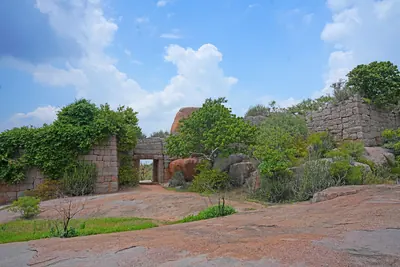
Epigraphia Telanganica places the first of its three on the wall near the entrance of the fort.13 It places the second near another gate, and the third perhaps near a Bhairava temple.13
Date
The records are dated in Saka 1287 (Saka is an Indian way of counting years), the year Visvavasu, in the dark half of the month Sravana.45 The 1910 text of the third adds that the day was a Sunday.45 Epigraphia Telanganica converts the date to 10 August 1365.1
Contents
Each record opens with the same list of titles:451
- Mahamandalesvara
- Andhradesadhisvara (lord of the Andhra country)
- Gajadala-vibhala (destroyer of elephant troops)
- Raya-gaya-gopala
- Pancha-Pandya-dala-vibhala (destroyer of the armies of the five Pandyas)
- Pratigandabhairava
- Bhujabala-Bhima
- Khadga-Narayana
- Kakati-rajya-sthapanacharya (establisher of the Kakatiya kingdom)
- Ashta-dikku-raya-manobhayankara (terror of the kings of the eight quarters)
- Somakula-Parasurama451
The records name him as the son of Singama-nayaka and grandson of Dachi-nayaka (Eradachi-nayaka in one copy) of the Recherla family.451 They say that he lived at Rajagiri and ruled the whole earth.451
The fullest record lists Anapota’s works.51 He built stone fortifications and wells on the hill of Rajukonda, to the south of the tank Anapota-samudram.51 He did the same on Naganayanikonda, to the north of the tank, and raised earthen walls to the west.51 He dug the tank between the two hills for the good of all beings, and named it with his title.51
A second record repeats the account of the fortifications and adds an entrance gate.1 The third records that Anapota set up an image of the god Pratigandabhairava in the tank Anapota-samudram, for the good of all beings.43 He named the god after his own title.43
All three end with the name of their writer, Chilamaraju Tippana.451 He was the karanam (clerk) of Raya-gaya-gopala, that is, of the king himself.451
Related records
The same appendix prints two more records of Anapota from Rachakonda.67 One is near the image of Gannerla Bhairava on the eastern side of the town.67 It is dated Saka 1302, the year Raudri (1380), and records a tank called Rayasamudram and another image of Pratigandabhairava.67 The other is near an image of Ganesa by the Bhuvanagiri pass to the north.67 It is dated Saka 1300, the year Kalayukti (1378), and breaks off after the date.67
Alladi Jagannatha Sastri wrote a family history in 1922.85 It dates the tank and the Pratigandabhairava temple on its bund to 1368.85 This year does not agree with the inscriptions as printed in 1910.85
Footnotes
-
Gajjala Vasanta Lakshmi (ed.), Epigraphia Telanganica, vol. 4 (2023), p. 17, Nos. 1–2. Cite-only; paraphrased. ↩ ↩2 ↩3 ↩4 ↩5 ↩6 ↩7 ↩8 ↩9 ↩10 ↩11 ↩12 ↩13 ↩14 ↩15 ↩16 ↩17 ↩18 ↩19
-
V. Yashoda Devi, After the Kakatiyas (1975), p. 64 and note 126. Cite-only; paraphrased. ↩ ↩2
-
Epigraphia Telanganica, vol. 4 (2023), pp. 17–18, No. 3. Cite-only; paraphrased. ↩ ↩2 ↩3 ↩4 ↩5 ↩6
-
Sadasiva Sastri, Velugotivari Vamsacaritramu (1910), appendix, p. 27, inscription No. 6 (archive.org (opens in a new tab)). Telugu; paraphrased. ↩ ↩2 ↩3 ↩4 ↩5 ↩6 ↩7 ↩8 ↩9 ↩10 ↩11 ↩12 ↩13 ↩14 ↩15 ↩16
-
Sadasiva Sastri, Velugotivari Vamsacaritramu (1910), appendix, pp. 28–29, inscriptions Nos. 7 and 8 (archive.org (opens in a new tab)). Telugu; paraphrased. ↩ ↩2 ↩3 ↩4 ↩5 ↩6 ↩7 ↩8 ↩9 ↩10 ↩11 ↩12 ↩13 ↩14 ↩15 ↩16 ↩17 ↩18 ↩19 ↩20 ↩21
-
Vellala Sadasiva Sastri, Velugotivari Vamsacaritramu (1910), appendix, p. 26, inscription No. 5 (archive.org (opens in a new tab)). Telugu; paraphrased. ↩ ↩2 ↩3 ↩4 ↩5
-
Sadasiva Sastri, Velugotivari Vamsacaritramu (1910), appendix, p. 30, inscription No. 9 (archive.org (opens in a new tab)). Telugu; paraphrased. ↩ ↩2 ↩3 ↩4 ↩5
-
Alladi Jagannatha Sastri, A Family History of Venkatagiri Rajas (1922), p. 21 (archive.org (opens in a new tab)). ↩ ↩2 ↩3
Photos
References
Notes (0)
Sources (4)
Spotted an error on this page? Tell us
Last updated: