Inavolu inscription of Recherla Anapota
A Sanskrit and Telugu inscription of 19 July 1369 at the Mailara (Mallikarjuna) temple of Inavolu near Warangal. In it the Recherla Velama chief Anapota-nayaka, who ruled Orugallu after the Kakatiyas, grants the village to the god. Its family history says his grandfather Dacaya conquered the Pandyas for Prataparudra.
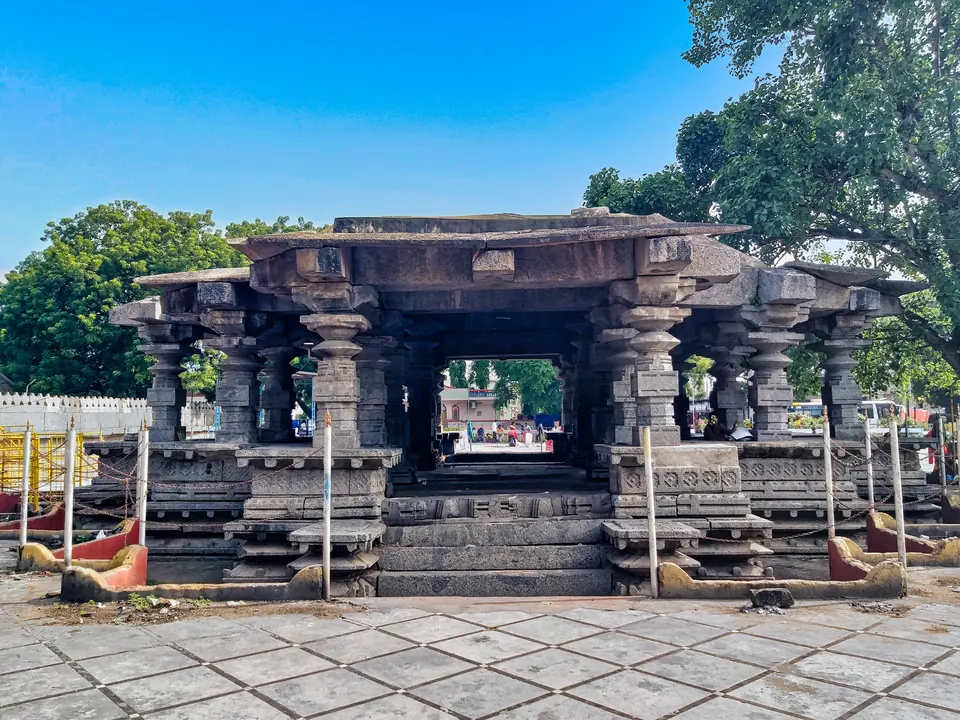
What it is
This inscription stands near the flagstaff (dhvaja-stambha) of the Mailara temple at Inavolu (Ainavolu).1 Inavolu is a village about 8 miles from Warangal, off the road to Khammam.1 It belongs to the period after the fall of the Kakatiyas. It records that Anapota-nayaka of the Recherla family granted the village of Ayyanavolu to the god Mailaradeva.12
Anapota made the grant during a campaign of conquest (digvijaya).12 It is included here because its account of the Recherla family is one of the sources for the family’s service under the last Kakatiya king, Prataparudra.1
The stone
The 1956 Corpus describes the stone as a broken piece set up near the flagstaff of the Mailaru temple.1 The Annual Report on Indian Epigraphy for 1957–58 describes it as a pillar in the compound of the Malleshvara temple.12
The text is in Sanskrit verse and Telugu prose.1 According to the summary in Epigraphia Telanganica, the Sanskrit portion has 27 verses and is called Nakshatramala, that is, a garland of stars.3
Date
The grant is dated Saka 1291 (Saka is an Indian way of counting years), the cyclic year Saumya, the fifteenth day of the bright half of Sravana, a Thursday.1 The year is also given in word-numerals (words that stand for numbers), sasi-nanda-bhaskara. The modern editors convert the date to Thursday, 19 July 1369.2
Contents
The genealogy begins by saying that among many royal lines the Recherla family had been honoured by the Kakatiyas.12 In it was born Vennayya-nayaka, and his son was Dacaya.12 On Prataparudra’s orders Dacaya conquered the Pandyas.12 He won the title Pandya-raya-gaja-kesari, a lion against the elephant that was the Pandya king.12
Dacaya’s son Singama-nayaka won many titles.12 Singama’s sons, Anapota-nayaka and Madhava-nayaka, are said to have ruled together.12 When he made the grant, Anapota was ruling Orugallu (Warangal), Tribhuvanagiri, Rajukonda, Singavaram and the rest of the Telugu country.1 The record identifies the god Mailara with Mallara, and the goddess beside him, Madaci, with Parvati.1
The poem was composed by Naganatha, son of Pasupati of the Kaushika gotra (clan).1 The 1964 catalogue of the state’s inscriptions adds that Naganatha also wrote a Telugu Vishnupurana, which is now lost.3
The Pandya war
Parabrahma Sastry used this family’s chronicle, the Velugotivari-vamsavali, for the Recherla chiefs’ part in Prataparudra’s southern wars. It credits Era Dacha and his cousin Nala Dacha with defeating five Pandya princes.4 It also says that they received from Prataparudra titles such as Pandya-gaja-kesari.4 He warned that the chronicle gives the Velamas credit for a joint campaign. Other generals, such as the Indulur chiefs and Muppidi-nayaka, bore the same titles.45
It was Muppidi-nayaka who took Kanchi.45 In his account of the battle near Kanchi, Parabrahma Sastry lists Recherla Era Dacha among the generals who fought beside Prataparudra.6
He also notes that the Recherla Velamas held Rachakonda and Devarakonda after the Kakatiyas fell.5 He adds that several later Velama houses of Andhra traced their descent from them.5
Footnotes
-
P. Sreenivasachar (ed.), A Corpus of Inscriptions in the Telingana Districts of Andhra Pradesh, Part III (1956), p. 119, No. Wg. 1 (archive.org (opens in a new tab)). Paraphrased. ↩ ↩2 ↩3 ↩4 ↩5 ↩6 ↩7 ↩8 ↩9 ↩10 ↩11 ↩12 ↩13 ↩14 ↩15 ↩16 ↩17 ↩18
-
Gajjala Vasanta Lakshmi (ed.), Epigraphia Telanganica, vol. 4 (2023), p. 18, No. 5. Paraphrased. ↩ ↩2 ↩3 ↩4 ↩5 ↩6 ↩7 ↩8 ↩9 ↩10
-
Epigraphia Telanganica, vol. 4 (2023), p. 19, No. 5. Paraphrased. ↩ ↩2
-
Parabrahma Sastry, The Kakatiyas of Warangal (1978), p. 165. ↩ ↩2 ↩3 ↩4
-
Parabrahma Sastry, The Kakatiyas of Warangal (1978), p. 166. ↩ ↩2 ↩3 ↩4
-
P. V. Parabrahma Sastry, The Kakatiyas of Warangal (1978), p. 133. ↩
Photos
References
Notes (0)
Sources (3)
Spotted an error on this page? Tell us
Last updated: