Rachakonda
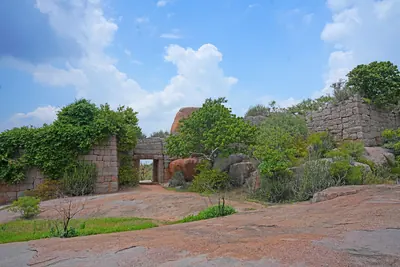
Village and ruined hill fort in the hills east of Hyderabad, the Rajukonda or Rajachala of the inscriptions. It was the capital of the Recherla Velama kings of the late fourteenth and fifteenth centuries. Anapota Nayaka fortified it in 1365, and Sultan Quli of Golconda took it early in the sixteenth century.
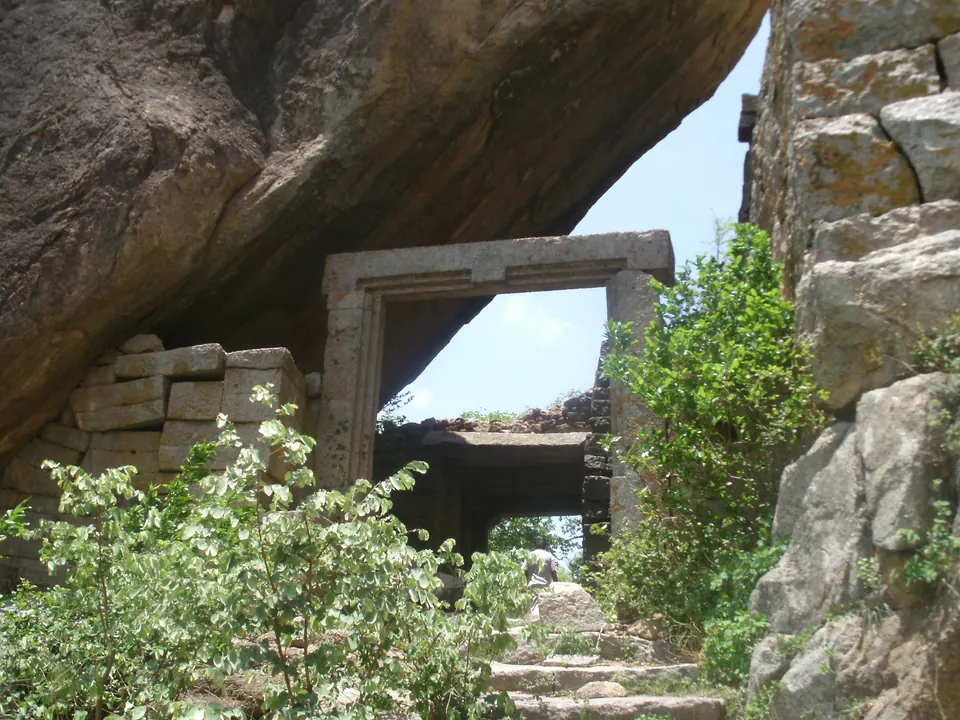
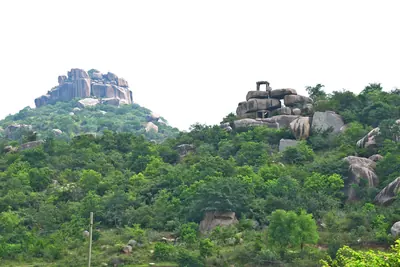
According to the census survey of the Nalgonda district published in 1964, Rachakonda lies among wooded hills about 7 miles from Narayanapur, 30 miles from Hyderabad and 40 miles from Nalgonda.1
In 1922 Alladi Jagannatha Sastri put it about six miles west of Narayanapuram and thirty-two miles east of Hyderabad.2 He placed it thirty miles south of Bhuvanagiri (Bhongir) and as far north-west of Devarakonda.2 It stands in a ring of hills about thirty miles round.2 In 1917 the Nizam’s Archaeological Department had put it about thirty-five miles south-east of Hyderabad.3
Its inscriptions call it Rajukonda or Rajagiri, “the king’s hill”.4 The Sanskrit Rasarnavasudhakara calls it Rajachala.5 The census survey says that the capital was first named Recharlakonda, after the Recherla family, and that the name became Rechakonda or Rachakonda, but it gives no source for this.1 See Rachakonda Fort.
Capital of the Recherla kings
V. Yashoda Devi writes that Singama Nayaka moved his seat to Rajukonda, because the hills made it safer than the plains.6 He built a fort there, and it remained one of the two capitals of the Velamas.6 The Rasarnavasudhakara, written at the end of the fourteenth century, calls Rajachala the capital that had come down in the king’s family.5
The family chronicle printed in 1910 says that after 1361 Anapota Nayaka gave Devarakonda to his brother Mada and himself lived at Rachakonda.7 Three inscriptions of Anapota are dated August 1365.849 They record that he fortified the hills of Rajukonda and Naganayanikonda and dug the tank Anapota-samudram between them.849
In July 1369 he made his grant at Inavolu.10 He was then ruling Warangal (Orugallu), Tribhuvanagiri, Rajukonda, Singavaram and the rest of the Telugu country.10 See the Rachakonda inscriptions of 1365.
The town also had a queen’s tank. An inscription of 1429 stands on the bund of the Nagasamudram, near the village of Nagaram, north of Rachakonda.11 It records that Nagamba, the wife of Ravu Madhava, dug the tank near Rajasaila, the king’s hill.11 See the Devalanagaram inscription of Nagamba.
The Bahmanis and Golconda
The Burhan-i Ma’asir was translated by J. S. King in 1900.12 It says that the Bahmani sultan Ahmad Shah invaded Telingana and took Warangal.12 Then “the Rayas of Devarkonda and Rajkonda”, afraid of his army, sent envoys with presents and agreed to pay tribute.12
John Briggs translated a Golconda chronicle.1314 It relates that Sultan Quli Qutb Shah first repaired the fort of Golconda.1314 He then besieged “the fortress of Rajconda, the ray of which place had lately made an attack on the Kootb Shahy dominions”.1314 He breached its walls with heavy artillery and took it by storm.1314 He carried the raja, “Venkutty Naig”, a prisoner to Golconda.1314 See Sultan Quli.
The ruins
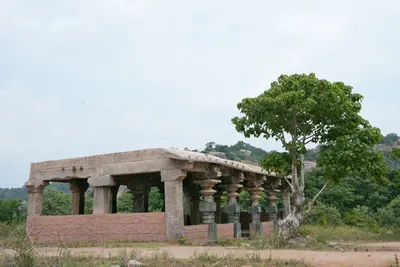
Jagannatha Sastri described the town as almost entirely in ruins.215 He saw traces of palace and bazaar streets, and four great gateways with temples and inscriptions beside them.215 The temples of Rama and Virabhadra were still in use.215
The prose chronicle of 1910 adds that the Rama temple’s sanctum lies about two yards below ground and is reached by steps.16 A cave on the hill of Vedagiri, south of Rachakonda, holds an image of Varaha-Narasimha, which was said to have been the family deity of the Recherla kings.16
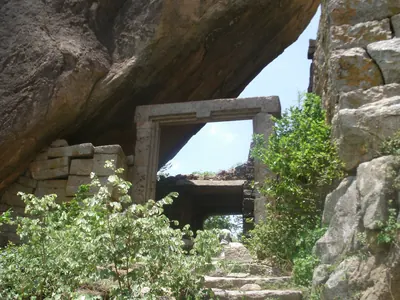
The Archaeological Department of the Nizam’s Dominions visited Rajkonda in 1915–16 and recorded new inscriptions there.1718 It photographed these sites:1718
- the Horse-Pond hill
- the Ramachandra Swami temple
- a Jami Masjid
- the Kachahri hill
- the ruined town
- an image of Bhairava
- the doorway of a Vishnu temple in the valley1718
The census survey of 1964 described the area as forest without roads, and it recorded stories told about the last king of the fort.1
Footnotes
-
A. Chandra Sekhar (ed.), Census of India 1961, Vol. II, Part VII-B (20): Fairs and Festivals, Nalgonda District (1964), Section I (Nalgonda taluk), entry “Rajkonda” (PDF pp. 23–24) (censusindia.gov.in (opens in a new tab)). Paraphrased. ↩ ↩2 ↩3
-
Alladi Jagannatha Sastri, A Family History of Venkatagiri Rajas (1922), p. 22 (archive.org (opens in a new tab)). ↩ ↩2 ↩3 ↩4 ↩5 ↩6
-
Annual Report of the Archaeological Department of His Highness the Nizam’s Dominions, 1915-16 (1917), p. 4 (archive.org (opens in a new tab)). ↩
-
Sadasiva Sastri, Velugotivari Vamsacaritramu (1910), appendix, pp. 28–29, inscriptions Nos. 7 and 8 (archive.org (opens in a new tab)). Telugu; paraphrased. ↩ ↩2 ↩3
-
Singabhupala, The Rasarnavasudhakara, ed. T. Ganapati Sastri (Trivandrum Sanskrit Series No. L, 1916), p. 7, verse 41 (archive.org (opens in a new tab)). Translation ours. ↩ ↩2
-
V. Yashoda Devi, After the Kakatiyas (1975), p. 52. Cite-only; paraphrased. ↩ ↩2
-
Vellala Sadasiva Sastri, Velugotivari Vamsacaritramu (1910), pp. 32–33 (archive.org (opens in a new tab)). Telugu; paraphrased. ↩
-
Sadasiva Sastri, Velugotivari Vamsacaritramu (1910), appendix, pp. 26–27, inscriptions Nos. 5 and 6 (archive.org (opens in a new tab)). Telugu; paraphrased. ↩ ↩2
-
Gajjala Vasanta Lakshmi (ed.), Epigraphia Telanganica, vol. 4 (2023), pp. 17–18, Nos. 1–3. Cite-only; paraphrased. ↩ ↩2
-
P. Sreenivasachar (ed.), A Corpus of Inscriptions in the Telingana Districts of Andhra Pradesh, Part III (1956), p. 119, No. Wg. 1 (archive.org (opens in a new tab)). Paraphrased. ↩ ↩2
-
Sadasiva Sastri, Velugotivari Vamsacaritramu (1910), appendix, pp. 43–47 (archive.org (opens in a new tab)). Sanskrit; paraphrased. ↩ ↩2
-
J. S. King, The History of the Bahmani Dynasty, founded on the Burhan-i Ma’asir (1900), p. 52 (archive.org (opens in a new tab)). ↩ ↩2 ↩3
-
Muhammad Qasim Ferishta, tr. John Briggs, History of the Rise of the Mahomedan Power in India, Vol. III (1829), p. 354 (archive.org (opens in a new tab)). ↩ ↩2 ↩3 ↩4 ↩5
-
Ferishta, tr. Briggs, Vol. III (1829), p. 355 (archive.org (opens in a new tab)). ↩ ↩2 ↩3 ↩4 ↩5
-
Jagannatha Sastri, Family History of Venkatagiri Rajas (1922), p. 23 (archive.org (opens in a new tab)). ↩ ↩2 ↩3
-
Sadasiva Sastri, Velugotivari Vamsacaritramu (1910), pp. 38–39 (archive.org (opens in a new tab)). Telugu; paraphrased. ↩ ↩2
-
Annual Report of the Archaeological Department of His Highness the Nizam’s Dominions, 1915-16 (1917), p. viii (archive.org (opens in a new tab)). ↩ ↩2 ↩3
-
Annual Report of the Archaeological Department … 1915-16 (1917), p. 19 and p. 26, Appendix E, photographs Nos. 227–234 (archive.org (opens in a new tab)). ↩ ↩2 ↩3
Photos
Related
Dynasties
People
Singama Nayaka (Recherla)
c. 1336–1361 CE
Recherla chief of the mid-fourteenth century, son of Dacaya and father of Anapota and Mada, the founders of the Velama kingdoms of Rachakonda and Devarakonda. He fought the Musunuri chief Kapaya Nayaka and settled Brahmins on the Krishna. The family chronicle says he was stabbed to death while besieging the fort of Jallipalli, about 1361.
Anapota Nayaka (Recherla)
c. 1361–1384 CE
Recherla Velama chief (r. c. 1361–1384), son of Singama Nayaka. He fortified Rachakonda in 1365 and overthrew the Musunuri chief Kapaya Nayaka about 1368. By July 1369 he ruled Warangal, Bhongir and Rachakonda. With his brother Mada of Devarakonda he made the Recherla family the leading power of Telangana.
Singabhupala (Recherla)
c. 1384–1399 CE
Recherla Velama king of Rachakonda (late 14th century), son of Anapota Nayaka. He wrote the Rasarnavasudhakara, a Sanskrit book on drama whose opening verses are the fullest early account of his family. Later tradition calls him, or a namesake of the next century, Sarvajna ('the all-knowing') Singa, patron of Srinatha and Potana. Who was who is disputed.
Ahmad Shah I
1422–1435 CE
Ninth Bahmani sultan (1422–1435), called Wali, 'the Saint'. He took the throne from his brother Firuz and defeated Vijayanagara. In 1424 or 1425 he took Warangal, killing its raja, and the Velama rayas of Devarakonda and Rachakonda then paid him tribute. He moved the capital from Gulbarga to Bidar. He had to march into Telangana again to put down the chiefs who rose while he fought Gujarat and Malwa.
Mahmud Shah Bahmani
1482–1518 CE
Fourteenth Bahmani sultan (1482–1518). He came to the throne at twelve and spent his reign as the puppet of his ministers, while the governors became kings. Telangana stayed loyal longest. He campaigned at Warangal in 1486 and gave the province to Sultan Quli Qutb-ul-Mulk in the 1490s. Bahmani mosques of his reign stand at Rachakonda (1484) and Golconda (1518), the latter still naming him as sovereign.
Sultan Quli Qutb-ul-Mulk
before 1543 CE
Persian-born officer of the Bahmani sultanate who governed Telingana from Golconda. He conquered much of Telangana and the Krishna–Godavari coast, and founded the Qutb Shahi dynasty. He was assassinated in 1543. According to the Golconda chronicle, he was killed at prayer in the mosque of Golconda fort. According to Ferishta, a slave killed him while he was examining jewels.
Monuments
Inscriptions
Rachakonda inscriptions of Anapota (1365)
1365 CE
Three Telugu inscriptions of August 1365 at Rachakonda fort. In them the Recherla Velama chief Anapota-nayaka records the stone fortifications and wells he built on the twin hills of Rajukonda and Naganayanikonda. They also record the tank Anapota-samudram, dug between the hills, and an image of Bhairava set up under his title Pratigandabhairava.
Rachakonda mosque inscription
1484 CE
An Arabic inscription of AH 889 (1484), in the reign of the Bahmani king Mahmud Shah, recording the building of a mosque at Rachakonda by Malik An-Ni'mat, son of Mubarak. G. Yazdani, who translated it, took Malik An-Ni'mat to be the Bahmani governor and the mosque to have been a Hindu temple. Rachakonda had earlier been held by the rayas (chiefs) of Rajkonda, who paid tribute to Ahmad Shah I.
References
Notes (0)
Sources (10)
Spotted an error on this page? Tell us
Last updated: