Anapota Nayaka (Recherla)
Recherla Velama chief (r. c. 1361–1384), son of Singama Nayaka. He fortified Rachakonda in 1365 and overthrew the Musunuri chief Kapaya Nayaka about 1368. By July 1369 he ruled Warangal, Bhongir and Rachakonda. With his brother Mada of Devarakonda he made the Recherla family the leading power of Telangana.
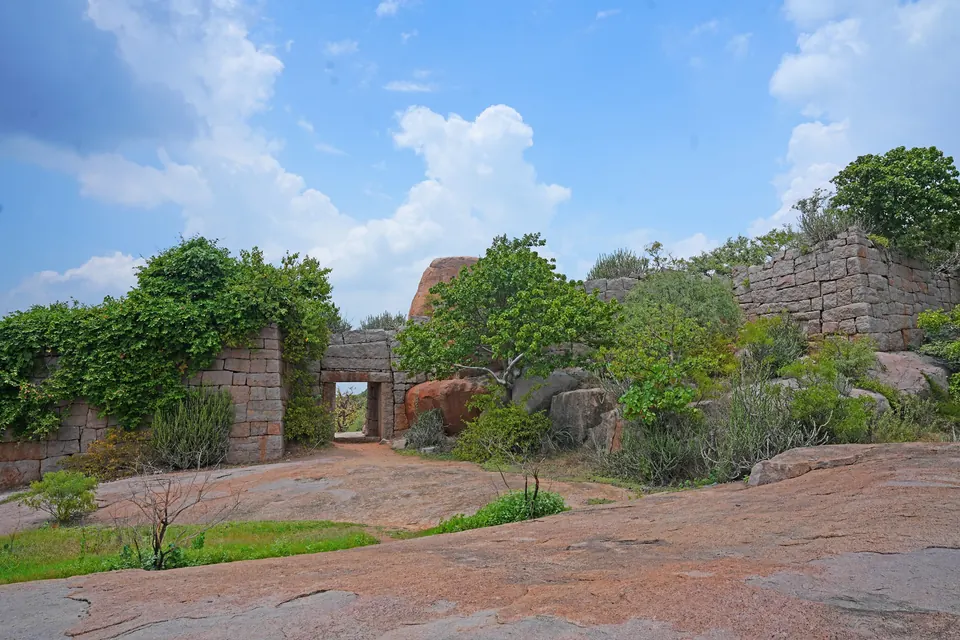
Anapota-nayaka, also written Anavota or Annavota, was the elder son of Singama Nayaka of the Recherla family.123 With his younger brother Mada Nayaka he avenged their father’s death and overthrew the Musunuri chief Kapaya Nayaka.123 They made the family the masters of Telangana.123 He himself ruled from Rajukonda, the hill fort of Rachakonda.123 See the Recherla Velamas.
Family
The Inavolu inscription of 1369 says that Singama’s sons, Anapota-nayaka and Madhava-nayaka, ruled the kingdom together.1 His son Singabhupala wrote the Rasarnavasudhakara, which plays on his two names.4 It says he bore the name Anapota because he was never pierced (a-prota) by the faults of kings.4 He bore the name Ananta because he held up the earth.4
The poem names his wife as Annamamba.5 According to the Rasarnavasudhakara, Anapota and Annamamba had two sons: the elder, Devagirisvara, and the younger, Singabhupala, the author of the work.5 The family chronicle printed in 1922 gives his sons instead as Pedda Singama Naidu and Dharma Naidu.6
An inscription of 1464 at Sayampeta, near Warangal, traces the family line of its donor, Dharma-ravu.7 It traces him back to Annavota-naya through Pedda-Singamma-naya.7
Revenge and conquest
The family chronicle says that Singama was killed at Jallipalli.8 Anapota and Mada then fought the Chalukya princes who held Jallipalli and their Reddi allies near Moguluru in the Chejarla country, and killed them.8 They offered their father’s funeral offerings with the blood of his enemies.8
The chronicle goes on to a second victory at Inukurthi (Inugurti).9 There they beat an army of a hundred and one lunar-race princes and their Kamma allies.9 The chronicle dates this to the bright half of Karttika in Saka 1283 (Saka is an Indian way of counting years), the year Sarvari (1361).9 The author notes that older family histories had put this victory in Saka 1223, which he took for a mistake.9
Epigraphia Telanganica follows the same chronicle and dates the storming of Jallipalli to 1361.10 The chronicle says that for these victories the brothers took the title Somakula-Parasurama, “Parasurama to the lunar race”.112
The chronicle then makes Mada ruler of Devarakonda, while Anapota lived in the family’s old capital of Rachakonda.9 The Rasarnavasudhakara also calls the capital, by its Sanskrit name Rajachala, the capital that had come down in the family (our translation of verse 41).12
Three inscriptions of Anapota at Rachakonda are dated Saka 1287, the year Visvavasu (August 1365).131415 They record these works:131415
- stone walls and wells on the hill of Rajukonda, south of the tank Anapota-samudram
- stone walls and wells on the hill of Naganayanikonda, north of the tank
- earthen walls to the west
- the tank itself, dug between the two hills, with an image of the god Bhairava set up under his own title Pratigandabhairava131415
See the Rachakonda inscriptions of 1365 and Rachakonda Fort.
The fall of Kapaya Nayaka
Yashoda Devi follows the family chronicle.23 She describes a war in which Anapota marched on Warangal and defeated and killed Kapaya Nayaka in a battle at Bhimavaram.23 After this he took Tribhuvanagiri (Bhongir), Orugallu (Warangal) and Singavaram.23 He took the titles Andhradesadhisvara (lord of the Andhra country) and Pratigandabhairava.23 She dates the battle to 1368, between the Akkalapundi grant, in which Kapaya is still alive, and the Inavolu inscription.23
According to the Inavolu inscription, on 19 July 1369 Anapota was on a campaign of conquest (digvijaya).1 He ruled Orugallu, Tribhuvanagiri, Rajukonda, Singavaram and the rest of the Telugu country.1 On that day he gave the village of Ayyanavolu to the god Mailara.1
Epigraphia Telanganica reads the record differently.10 The chronicle says that Anapota took the title “Sultan of the Andhra country” (Andhra-suratrana) after killing Kapaya.10 The inscription does not use this title, so Epigraphia Telanganica places Kapaya’s death later, in the second half of 1369.10 The census survey of the Nalgonda district (1964) says that in 1368 Anapota killed the king of Bhimavaram in battle.16 See the Inavolu inscription.
The Reddis and the Bahmanis
The chronicle claims that Anapota and Mada defeated the Reddi king Anapota of Kondavidu at Dharanikota about Saka 1283 (1361).1718 J. Ramayya noted in 1906 that this is also the year of an inscription at Amaravati that names the Reddi king’s minister.1718 Robert Sewell recorded the victory under 1361.1718
Epigraphia Telanganica credits the brothers with a war on two fronts against the Reddis late in the reign.19 In it Anapota marched against southern Kalinga, and the book cites an inscription of his dated Saka 1302 at Simhachalam.19
It also identifies Anapota as the “Raja of Telingana” in Ferishta’s history.19 This raja, allied with Bukka I of Vijayanagara, demanded Kaulas back from the Bahmani sultan Muhammad Shah I.19 Epigraphia Telanganica identifies him as well with the ruler who later bought peace by giving Golconda to the Bahmanis.19 The census survey likewise says he gave up Golconda fort and sought the favour of the Bahmani sultans.16 Other writers give these events to Kapaya Nayaka: see Kapaya Nayaka and the Bahmanis.
Later works and the end of the reign
The appendix of the 1910 chronicle has an inscription said to stand near the image of Gannerla Bhairava, on the eastern side of Rachakonda.13 It is dated Saka 1302, the year Raudri (1380).13 It records that Anapota made a tank called Rayasamudram and set up a Pratigandabhairava image beside it.13
Epigraphia Telanganica sums up a Sanskrit inscription of January 1380 at Rayavaram in the Medak district.20 It records a tank of the same name made by Anapota.20 It praises him as an incarnation of Parasurama who had killed a prince of the lunar race.20
The Rasarnavasudhakara says he made the holy mountain of Srisailam open to all by a path of fine steps (our translation of verse 21).519 But an inscription at Jatararevu gives the steps near Srisailam to his brother Mada instead.519
A. S. Ramanatha Ayyar noted inscriptions of Anapota up to Saka 1307 (1385–86).212216 Epigraphia Telanganica ends his reign in 1383, and the census survey in 1384.212216
Footnotes
-
P. Sreenivasachar (ed.), A Corpus of Inscriptions in the Telingana Districts of Andhra Pradesh, Part III (1956), p. 119, No. Wg. 1 (archive.org (opens in a new tab)). Paraphrased. ↩ ↩2 ↩3 ↩4 ↩5 ↩6 ↩7 ↩8
-
V. Yashoda Devi, After the Kakatiyas (1975), p. 64. Cite-only; paraphrased. ↩ ↩2 ↩3 ↩4 ↩5 ↩6 ↩7 ↩8 ↩9 ↩10
-
Yashoda Devi, After the Kakatiyas (1975), p. 65. Cite-only; paraphrased. ↩ ↩2 ↩3 ↩4 ↩5 ↩6 ↩7 ↩8 ↩9
-
Singabhupala, The Rasarnavasudhakara, ed. T. Ganapati Sastri (Trivandrum Sanskrit Series No. L, 1916), p. 3, verses 15–17 (archive.org (opens in a new tab)). Translation and paraphrase ours. ↩ ↩2 ↩3
-
Singabhupala, Rasarnavasudhakara, ed. Ganapati Sastri (1916), p. 4, verses 21–26 (archive.org (opens in a new tab)). Translation and paraphrase ours. ↩ ↩2 ↩3 ↩4
-
Alladi Jagannatha Sastri, A Family History of Venkatagiri Rajas (1922), pp. 27–28 (archive.org (opens in a new tab)). ↩
-
Sreenivasachar (ed.), Corpus, Part III (1956), pp. 161–162, No. Wg. 18 (archive.org (opens in a new tab)). Paraphrased. ↩ ↩2
-
Vellala Sadasiva Sastri, Velugotivari Vamsacaritramu (1910), pp. 30–31 (archive.org (opens in a new tab)). Telugu; paraphrased. ↩ ↩2 ↩3
-
Sadasiva Sastri, Velugotivari Vamsacaritramu (1910), pp. 32–33 (archive.org (opens in a new tab)). Telugu; paraphrased. ↩ ↩2 ↩3 ↩4 ↩5
-
Epigraphia Telanganica, vol. 4 (2023), p. 26, No. 10. Cite-only; paraphrased. ↩ ↩2 ↩3 ↩4
-
Epigraphia Telanganica, vol. 4 (2023), p. 25, No. 10. Cite-only; paraphrased. ↩
-
Singabhupala, Rasarnavasudhakara, ed. Ganapati Sastri (1916), p. 7, verses 41–42 (archive.org (opens in a new tab)). Translation ours. ↩
-
Sadasiva Sastri, Velugotivari Vamsacaritramu (1910), appendix, pp. 26–27, inscriptions Nos. 5 and 6 (archive.org (opens in a new tab)). Telugu; paraphrased. ↩ ↩2 ↩3 ↩4 ↩5 ↩6
-
Sadasiva Sastri, Velugotivari Vamsacaritramu (1910), appendix, pp. 28–29, inscriptions Nos. 7 and 8 (archive.org (opens in a new tab)). Telugu; paraphrased. ↩ ↩2 ↩3
-
Epigraphia Telanganica, vol. 4 (2023), pp. 17–18, Nos. 1–3. Cite-only; paraphrased. ↩ ↩2 ↩3
-
A. Chandra Sekhar (ed.), Census of India 1961, Vol. II, Part VII-B (20): Fairs and Festivals, Nalgonda District (1964), Section I (Nalgonda taluk), entry “Rajkonda” (PDF p. 23) (censusindia.gov.in (opens in a new tab)). Paraphrased. ↩ ↩2 ↩3 ↩4
-
J. Ramayya, “Madras Museum Plates of Vema, A.D. 1345”, Epigraphia Indica VIII (1905–06), p. 12 (archive.org (opens in a new tab)). ↩ ↩2 ↩3
-
Robert Sewell, The Historical Inscriptions of Southern India (1932), p. 195 (archive.org (opens in a new tab)). Paraphrased. ↩ ↩2 ↩3
-
Epigraphia Telanganica, vol. 4 (2023), pp. 27–28, No. 10. Cite-only; paraphrased. ↩ ↩2 ↩3 ↩4 ↩5 ↩6 ↩7
-
Epigraphia Telanganica, vol. 4 (2023), p. 32, No. 14. Cite-only; paraphrased. ↩ ↩2 ↩3
-
A. S. Ramanatha Ayyar, “Conjeeveram Inscription of Brahma-tantra-svatantra-Jiyar: Saka 1282”, Epigraphia Indica XXV (1939–40), p. 324 (archive.org (opens in a new tab)). Paraphrased. ↩ ↩2
-
Gajjala Vasanta Lakshmi (ed.), Epigraphia Telanganica, vol. 4 (2023), p. 11, list of rulers. Cite-only; paraphrased. ↩ ↩2
Photos
Related
Dynasties
References
Notes (0)
Sources (10)
Spotted an error on this page? Tell us
Last updated: