Vishnugopa (Pallava crown prince)
Pallava prince of the Nellore–Guntur line, son of Skandavarman II and father of Simhavarman. As crown prince (yuvamaharaja) he issued the Uruvupalli grant from Palakkada, dated in the 11th year of a king Simhavarman, giving land to a temple at Kandukura. Scholars disagree whether he ever reigned, and who the Simhavarman of his grant was.
Vishnugopa was a Pallava prince of the line that issued grants in the Guntur and Nellore country.1 He is called yuvamaharaja, crown prince, both in his own grant and in the grants of his son.1 J. F. Fleet published his one charter, the Uruvupalli grant, in 1876 from Sir Walter Elliot’s facsimiles (exact copies).2 He is a different person from Vishnugopa of Kanchi, the enemy of Samudragupta.3
Family
Vishnugopa was the son of Skandavarman II. The Uruvupalli grant names his father Skandavarman, his grandfather Viravarman and his great-grandfather Skandavarman.21 The grants of his son repeat the line from Viravarman.21 See Skandavarman II. His son was Simhavarman, who issued the Pikira, Mangalur, second Omgodu and Vilavatti grants.14
Whose reign is the grant dated in?
Vishnugopa made the grant, but it is dated “in the eleventh of the victorious years of the Great King Simhavarma”.5 Scholars have explained this in three ways:216
- Fleet supposed that this Simhavarman was an elder brother of Vishnugopa, then reigning, and placed Simhavarman I before Vishnugopa in his table of the family.27 G. Jouveau-Dubreuil agreed in 1920.89 He made Vishnugopa a governor of Palakkada under his brother.89
- Hultzsch held instead that the Uruvupalli grant was dated in the reign of Vishnugopa’s own son Simhavarman.110 He argued that Vishnugopa, always called crown prince, never took the throne, perhaps because he declined it.110 In this view Vishnugopa lived on in his son’s reign.110
- C. R. Krishnamacharlu proposed a third answer.611 In his view the grant was first Vishnugopa’s own, but his son Simhavarman formally issued it in his own eleventh year.611
Did he reign?
Hultzsch, Fleet and Jouveau-Dubreuil all thought that he never ruled as king.1212 Krishnamacharlu disagreed.136 The Chura grant of Vishnugopa’s grandson calls him Maharaja.136 The Eastern Chalukya king Mangi-Yuvaraja was called yuvaraja all his life, though he reigned for twenty-five years.136 So, Krishnamacharlu concluded, Vishnugopa’s title did not prove that he never reigned.136
D. C. Sircar thought him a provincial governor with his headquarters at Palakkada.1415 He noted that Vishnugopa described himself as a ruler of subjects.1415
The Uruvupalli grant
The grant was issued from “the glorious and victorious locality of Palakkada”.5 In it Vishnugopa told the villagers of Uruvupalli, in the country of Munda, of a gift of two hundred nivartanas (a land measure) there.5 In Fleet’s translation, the land had been made “a possession of the gods at Kandukura for the family of Vishnuharadeva which was founded by the general Vishnuvarma”.5
Krishnamacharlu corrected Fleet.16 In his reading the land was given as temple land to a temple of Vishnuhara built by a general, not to a family.16 The temple seemed to him one of the early temples of Kandukur.16 Mundarashtra, he showed, was the country round Kovur in the Nellore district.17
Religion
Vishnugopa opens his grant with the words “Victory has been achieved by the holy one”.5 He calls himself an excellent worshipper of the holy one, that is, of Vishnu.5 Sircar concluded that he and his son were Vaishnavas (worshippers of Vishnu).15
Footnotes
-
E. Hultzsch, “Pikira Grant of Simhavarman”, Epigraphia Indica VIII (1905–06), p. 160 (archive.org (opens in a new tab)). ↩ ↩2 ↩3 ↩4 ↩5 ↩6 ↩7 ↩8 ↩9 ↩10
-
J. F. Fleet, “Sanskrit and Old-Canarese Inscriptions, No. XII”, Indian Antiquary V (1876), p. 50 (archive.org (opens in a new tab)). ↩ ↩2 ↩3 ↩4 ↩5 ↩6
-
H. Krishna Sastri, “Two Pallava Copper-plate Grants”, Epigraphia Indica XV (1919–20), p. 248 (archive.org (opens in a new tab)). ↩
-
Krishna Sastri, “Two Pallava Copper-plate Grants” (1920), p. 249 (archive.org (opens in a new tab)). ↩
-
Fleet, “Sanskrit and Old-Canarese Inscriptions, No. XII” (1876), pp. 52–53, translation (archive.org (opens in a new tab)). ↩ ↩2 ↩3 ↩4 ↩5 ↩6
-
C. R. Krishnamacharlu, “Vilavatti Grant of Pallava Simhavarman”, Epigraphia Indica XXIV (1937–38), p. 299 (archive.org (opens in a new tab)). ↩ ↩2 ↩3 ↩4 ↩5 ↩6 ↩7
-
Fleet, “Sanskrit and Old-Canarese Inscriptions, No. XV”, Indian Antiquary V (1876), p. 154 (archive.org (opens in a new tab)). ↩
-
G. Jouveau-Dubreuil, Ancient History of the Deccan (1920), p. 63 (archive.org (opens in a new tab)). ↩ ↩2
-
Jouveau-Dubreuil, Ancient History of the Deccan (1920), p. 68 (archive.org (opens in a new tab)). ↩ ↩2
-
Hultzsch, “Pikira Grant of Simhavarman” (1906), p. 161 (archive.org (opens in a new tab)). ↩ ↩2 ↩3
-
Krishnamacharlu, “Vilavatti Grant” (1938), p. 300 (archive.org (opens in a new tab)). ↩ ↩2
-
G. Jouveau-Dubreuil, The Pallavas (1917), p. 16 (archive.org (opens in a new tab)). ↩
-
C. R. Krishnamacharlu, “Chura Grant of Pallava Vijaya-Vishnugopavarman”, Epigraphia Indica XXIV (1937–38), p. 139 (archive.org (opens in a new tab)). ↩ ↩2 ↩3 ↩4
-
D. C. Sircar, The Successors of the Satavahanas in Lower Deccan (1939), p. 170 (archive.org (opens in a new tab)). ↩ ↩2
-
Sircar, Successors of the Satavahanas (1939), p. 205 (archive.org (opens in a new tab)). ↩ ↩2 ↩3
-
Krishnamacharlu, “Vilavatti Grant” (1938), p. 302, notes (archive.org (opens in a new tab)). ↩ ↩2 ↩3
-
Krishnamacharlu, “Vilavatti Grant” (1938), p. 301 (archive.org (opens in a new tab)). ↩
Photos
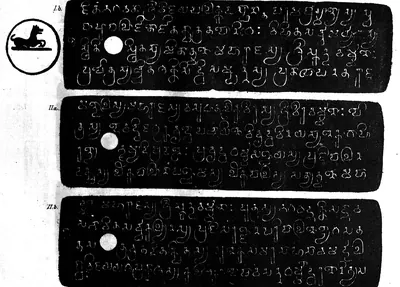 "Uruvupalli Copper-plate Grant of the Pallava Dynasty", plates I b, II a and II b, with the seal (Indian Antiquary V, 1876, plate at p. 50, printed sideways (PDF p. 66))Inscription rubbing · 1876
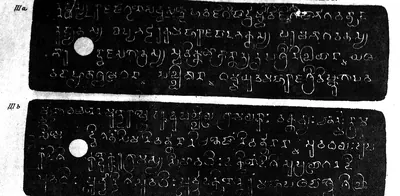 "Uruvupalli Copper-plate Grant of the Pallava Dynasty", plates III a and III b (Indian Antiquary V, 1876, plate at p. 51, printed sideways (PDF p. 67))Inscription rubbing · 1876
Related
Dynasties

References
Notes (0)
Sources (8)
Spotted an error on this page? Tell us
Last updated: