Velicherla grant of Prataparudra Gajapati (1510 or 1511)
Three copper plates, registered in 1920–21 when the District Munsiff of Kavali sent them to the epigraphist, and edited by G. Ramadas in 1958. They record a gift by the Gajapati Prataparudra to a Brahmin, made while he held court in the great fort of Undrakonda. He gave the village of Velicherla, east of the fort of Udayagiri in the Jaladanki country of Pakanadu. The grant is dated Saka 1432 in a chronogram (a date hidden in words). Its first editor read the date as 4 October 1510, and Ramadas as 24 October 1511. It shows the Gajapati still master of the Nellore country just before Krishnadeva Raya's campaigns.
By this copper-plate grant, the Gajapati king Prataparudra gave the village of Velicherla, east of the fort of Udayagiri, to a Brahmin.1 G. Ramadas dated it to 24 October 1511.2 R. D. Banerji took the plates as proof that the Nellore district and Udayagiri were still part of the empire of Orissa in 1511.3
The plates
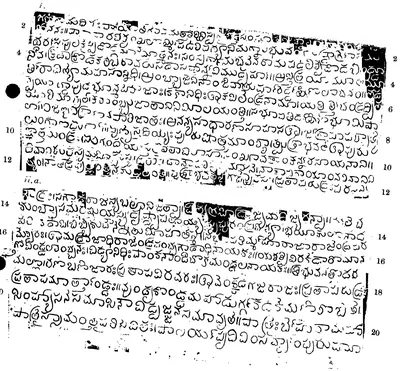
The District Munsiff (judge) of Kavali sent the plates to the Assistant Archaeological Superintendent for Epigraphy in 1920–21.45 They were registered in his report as No. 12 of Appendix A.45 There are three copper plates, about 8 by 3¾ inches, on a ring with a fixed seal whose surface was blank.45
The plates had been filed as evidence in a court case of 1917.45 The case was between the Brahmin holders of the village and its cultivators.45 Ongole Venkatarangayya had already edited the grant in English and in Telugu.45 Then G. Ramadas edited it again in Epigraphia Indica XXVIII, with a photograph.45 R. D. Banerji, writing from the epigraphist’s report of 1921, called them the “Kavali plates”.63
The script is Telugu.4 Lines 1 to 32 are Sanskrit verse, and the boundaries of the village are given in Telugu prose in lines 32 to 36.4 The grant ends with verses that curse anyone who breaks it.4
Ramadas described the seal drawn at the end as a stylised lion, a long sword and a dagger.7 He thought these were simplified from the emblems of Purushottama’s grant.7 He suggested that the lion stood for the goddess Durga, whom the donor worshipped.7
Contents
The grant opens with verses to Ganesa and to Vishnu as the Boar.28 It then traces the donor’s family from the Sun, through Kapilesvara and his son Purushottama, to Prataparudra.28 Prataparudra is praised for defeating the king of Gauda (Bengal), and for his learning.28
His titles include lord of the five Gaudas, lord of the Cholamandala, Vidyanidhi and Rana-banijara.8 Ramadas explained the last title as meaning a trader in battles.8
The king was holding court in the great fort of Undrakonda.1 Scholars, patras, behara-mahapatras (officers) and vassals attended him.1 He gave the village of Velicherla, with all rights and free of the thirty-six imposts (taxes).1 The village lay east of the fort of Udayachala (Udayagiri), in the Jaladanki sthala of the Pakanadu sima (both are land divisions).1
The gift went to a Brahmin named Kondaya of the Bharadvaja gotra (clan).1 He was the son of Tammaya and grandson of Narayana-yajvan, and he lived at Pulugulla.1
The date
The date is given by a chronogram for Saka 1432 (Saka is an Indian way of counting years).2 It is the third day of the bright half of Kartika, a Friday, in the year after Pramoda.2 Venkatarangayya had read it as 4 October 1510, and the epigraphist’s report as 1510–11.2 The editor of the journal in which Venkatarangayya published it preferred 24 October 1511.2
Ramadas argued that the words mean the year after Pramoda, that is Prajapati, Saka 1433.2 He fixed the date at 24 October 1511.2 Oriya and Sanskrit works place Prataparudra in the south in his seventeenth year.28 From these and from the grant, Ramadas concluded that the Gajapati was still in the south in October 1511.28 He disputed the epigraphist’s view that Krishnadeva Raya had taken Udayagiri in 1510.28
Significance
Banerji wrote that the plates “prove that even in 1511 the Nellore district and the former Vijayanagara capital of Udayagiri was included in the empire of Orissa”.3 He added that they were issued shortly before the Vijayanagara conquest of Kondavidu.3 Ramadas identified Undrakonda with one of the forts that Krishnadeva Raya is said to have taken.1 See Prataparudra, Udayagiri, Kavali and the Gajapatis.
Footnotes
-
Ramadas, “Velicherla Grant of Prataparudra Gajapati”, Epigraphia Indica XXVIII (1949–50), p. 208 (archive.org (opens in a new tab)). Paraphrased. ↩ ↩2 ↩3 ↩4 ↩5 ↩6 ↩7 ↩8
-
Ramadas, “Velicherla Grant of Prataparudra Gajapati”, Epigraphia Indica XXVIII (1949–50), p. 206 (archive.org (opens in a new tab)). Paraphrased. ↩ ↩2 ↩3 ↩4 ↩5 ↩6 ↩7 ↩8 ↩9 ↩10 ↩11 ↩12 ↩13
-
Banerji, History of Orissa, Vol. I (1930), p. 335 (archive.org (opens in a new tab)). ↩ ↩2 ↩3 ↩4
-
G. Ramadas, “Velicherla Grant of Prataparudra Gajapati: Saka 1432”, Epigraphia Indica XXVIII (1949–50), p. 205 (archive.org (opens in a new tab)). Paraphrased. ↩ ↩2 ↩3 ↩4 ↩5 ↩6 ↩7 ↩8 ↩9 ↩10
-
Ramadas, “Velicherla Grant of Prataparudra Gajapati”, Epigraphia Indica XXVIII (1949–50), plate between pp. 210 and 211 (archive.org (opens in a new tab)). Paraphrased. ↩ ↩2 ↩3 ↩4 ↩5 ↩6 ↩7
-
R. D. Banerji, History of Orissa from the Earliest Times to the British Period, Vol. I (1930), p. 328 (archive.org (opens in a new tab)). ↩
-
Ramadas, “Velicherla Grant of Prataparudra Gajapati”, Epigraphia Indica XXVIII (1949–50), p. 209 (archive.org (opens in a new tab)). Paraphrased. ↩ ↩2 ↩3
-
Ramadas, “Velicherla Grant of Prataparudra Gajapati”, Epigraphia Indica XXVIII (1949–50), p. 207 (archive.org (opens in a new tab)). Paraphrased. ↩ ↩2 ↩3 ↩4 ↩5 ↩6 ↩7 ↩8
Photos
References
Notes (0)
Sources (2)
Spotted an error on this page? Tell us
Last updated: