Prataparudra (Gajapati)
Gajapati king of Orissa from 1496–97 to about 1540, son of Purushottama, and the last great king of the Suryavamsi line. At his accession his empire reached from Bengal to the Guntur and Nellore country. In 1512–19 the Vijayanagara king Krishnadeva Raya took Udayagiri, Kondavidu and Kondapalli, captured his son Virabhadra, marched to Simhachalam and married his daughter. The Qutb Shahi sultan of Golconda then took the Godavari–Krishna country. The legal digest Sarasvativilasa bears his name. He was a disciple of Chaitanya.
Prataparudra, son of Purushottama, was the third king of the Suryavamsi Gajapati dynasty of Orissa. At his accession, Banerji wrote, his empire reached from Bengal to the Guntur district of Madras.1 The Vijayanagara king Krishnadeva Raya later took Udayagiri, Kondavidu and Kondapalli from him.2345
His reign is dated in different ways:
- Monmohan Chakravarti calculated from his only anka (regnal year) date at Puri, in July 1499, that he came to the throne in 1496–97.6
- R. D. Banerji gives 1497.1
- The temple chronicle, in W. W. Hunter’s version, dates him 1504–1532.78
- The Kondavidu chronicle gives him a single year, 1496–97, followed by Virabhadra.9
See the Gajapatis. He is not the Kakatiya king of the same name. See Prataparudra (Kakatiya).
Family
The Velicherla grant of 1510 or 1511 traces Prataparudra’s descent from Kapilesvara through his father Purushottama.10 Prataparudra’s son Virabhadra was taken prisoner when Krishnadeva Raya captured Kondavidu in 1515.1112
According to the temple chronicle, Prataparudra was succeeded by two of his sons, Kalua Deva and Kakharua Deva, whom his minister Govinda Vidyadhara murdered in turn.1314
Nuniz says that Prataparudra gave Krishnadeva Raya a daughter in marriage.15 The Rayavachakamu names her Jaganmohini.16 Tradition calls this princess Tukka, and ascribes to her five verses lamenting her husband’s neglect.17 It says that she lived apart at Kambam in the Kadapa (then Cuddapah) district.17 See Purushottama and Kapilendra.
The empire when he came to the throne
Banerji wrote that at his accession Prataparudra “ruled over an empire extending from the Hughly and the Medinipur districts of Bengal to the Guntur district of Madras”.1 Krishnadeva Raya’s records show him holding the uplands of Khammam as well.1 As a prince of fifteen, according to G. Ramadas, he governed the Srikurmam country and wrote a Sanskrit treatise on hawking.18
An inscription of his at Srikurmam is dated Saka 1425 (1503; Saka is an Indian way of counting years).19 One at Simhachalam, of Saka 1432 (1510), records a gift of the village of Anantakapalli by a certain Timma.20
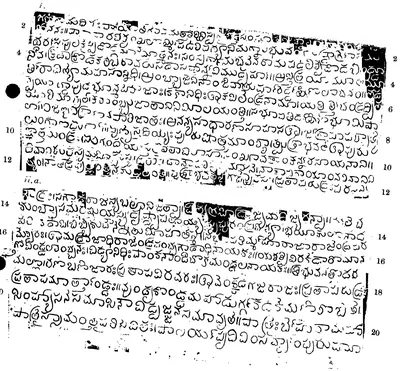
He made his copper-plate grant of Velicherla while he held court in the great fort of Undrakonda.2110 It gave a village in the Jaladanki country of Pakanadu to a Brahmin.2110 Ramadas dated it to 24 October 1511, but the editor of an earlier reading had given 4 October 1510.2110 See the Velicherla grant.
Krishnadeva Raya’s campaigns
Sewell dated the chronicle of Nuniz to about 1536 or 1537.22 Nuniz tells how Krishnadeva Raya took Udayagiri, which “belonged to the King of Orya”, after a siege of a year and a half, and captured an aunt of the Orissan king there.2345
Krishnadeva then besieged Kondavidu, defeated the king of Orissa in a battle across a river of salt water, and took the fort.2345 He also took Kondapalli, where he captured a wife and a son of the king.2345
Inscriptions at Udayagiri say that Krishnadeva made grants there after capturing Tirumala Raghava Raya.23119 He was then returning from his pursuit of Prataparudra up to Kondavidu.23119 V. Rangacharya’s summary calls Tirumala Raghava Raya the Gajapati’s nephew.23 Banerji and Sewell call him Prataparudra’s uncle.119
Kondavidu fell on 23 June 1515.11 See Udayagiri, Kondaveedu Fort and Kondapalli Fort.
The war ended in the north. Nuniz says that Krishnadeva halted six months at “Symamdary”, challenging the king of Orissa to battle.515 Peace was made when the king sent his daughter as a bride.515 Krishnadeva then restored “the lands on the other side of the river, and kept those on the hither side for himself” (the lands on this side).515
The Rayavachakamu sets the scene at Potnuru-Simhadri, where Krishnadeva planted a pillar of victory.16 It makes the Gajapati give up all the country south of the Krishna as his daughter’s dowry.16 Banerji wrote that Prataparudra had to give up everything south of the Godavari.24 See Potnuru and Vijayanagara and the Qutb Shahis.
A record of Saka 1448 (1525–26) of “Gajapati Virarudra Pratapa” is at Undavalli, the village of the rock-cut Anantasayana temple.2526 It mentions the building of a temple at Mangalagiri.2526 The 1942 gazetteer of the Nellore district took it as a sign of a brief Gajapati revival after Krishnadeva’s wars.26
Golconda
A Golconda chronicle translated by John Briggs tells how Sultan Quli Qutb Shah defeated an alliance led by “Raja Ramchundur, the son of Gujputty, who held his court at Condapilly”.272829 Sultan Quli then took Kondapalli, Eluru (then Ellore) and Rajahmundry.272829 He made peace with “Gujputty” (the Gajapati), accepting the Godavari as the boundary between Golconda and Orissa.272829
Banerji noted that no Orissan king of those years was called Ramachandra, and with Chakravarti he dated the invasion to about 1522.3031 Chakravarti added that in 1532, according to the temple chronicle, Prataparudra fought a long war with the Qutb Shah in which neither side won.14 See Sultan Quli.
Learning and religion
Prataparudra’s name is attached to the Sarasvativilasa, a digest of law.32 S. Krishnaswami Aiyangar noted that the scholar Lolla Lakshmidhara lists it among his own works.32 Lakshmidhara also wrote Krishnadeva Raya’s inscriptions at Kondavidu and Kaza.32
The Bengali Vaishnava saint Chaitanya came to Puri in his reign.3334 The biographies say that Prataparudra became his disciple.3334 His officer Ramananda Raya, at one time governor of Rajahmundry, was among the most prominent of the king’s officers who followed the saint.3334 Banerji, writing in 1930, blamed this religious movement for the political decline of Orissa.3134
Death
Chakravarti deduced that Prataparudra died about 1539–40.635 He worked this out from the date of Govinda Vidyadhara’s accession, in 1541–42, and from the chronicle’s reigns of Prataparudra’s two sons.635
Footnotes
-
R. D. Banerji, History of Orissa from the Earliest Times to the British Period, Vol. I (1930), p. 322 (archive.org (opens in a new tab)). ↩ ↩2 ↩3 ↩4
-
Fernao Nuniz, “Chronicle”, in Robert Sewell, A Forgotten Empire (Vijayanagar) (1900), p. 316 (archive.org (opens in a new tab)). ↩ ↩2 ↩3 ↩4
-
Nuniz, in Sewell, A Forgotten Empire (1900), p. 317 (archive.org (opens in a new tab)). ↩ ↩2 ↩3 ↩4
-
Nuniz, in Sewell, A Forgotten Empire (1900), p. 318 (archive.org (opens in a new tab)). ↩ ↩2 ↩3 ↩4
-
Nuniz, in Sewell, A Forgotten Empire (1900), p. 319 (archive.org (opens in a new tab)). ↩ ↩2 ↩3 ↩4 ↩5 ↩6 ↩7
-
Monmohan Chakravarti, “The last Hindu Kings of Orissa”, Journal of the Asiatic Society of Bengal, Vol. LXIX, Part I (1900), p. 185 (archive.org (opens in a new tab)). ↩ ↩2 ↩3
-
W. W. Hunter, Orissa, Vol. II (1872), Appendix VII, p. 188 (archive.org (opens in a new tab)). ↩
-
Hunter, Orissa, Vol. II (1872), Appendix VII, p. 189 (archive.org (opens in a new tab)). ↩
-
Robert Sewell, Lists of Inscriptions, and Sketch of the Dynasties of Southern India (1884), p. 188 and note 4 (archive.org (opens in a new tab)). ↩ ↩2 ↩3 ↩4
-
Ramadas, “Velicherla Grant of Prataparudra Gajapati”, Epigraphia Indica XXVIII (1949–50), p. 206 (archive.org (opens in a new tab)). Paraphrased. ↩ ↩2 ↩3 ↩4
-
Banerji, History of Orissa, Vol. I (1930), p. 324 (archive.org (opens in a new tab)). ↩ ↩2 ↩3 ↩4 ↩5
-
Krishnaswami Aiyangar, Sources of Vijayanagar History (1919), p. 133, extract from the Amuktamalyada (archive.org (opens in a new tab)). ↩
-
Banerji, History of Orissa, Vol. I (1930), p. 337 (archive.org (opens in a new tab)). ↩
-
Chakravarti, “The last Hindu Kings of Orissa”, JASB LXIX, Part I (1900), p. 187 (archive.org (opens in a new tab)). ↩ ↩2
-
Nuniz, in Sewell, A Forgotten Empire (1900), p. 320 (archive.org (opens in a new tab)). ↩ ↩2 ↩3 ↩4
-
S. Krishnaswami Aiyangar, Sources of Vijayanagar History (1919), p. 116, extract from the Rayavachakamu (archive.org (opens in a new tab)). ↩ ↩2 ↩3
-
Krishnaswami Aiyangar, Sources of Vijayanagar History (1919), p. 143, the Tukka Panchakam (archive.org (opens in a new tab)). ↩ ↩2
-
Ramadas, “Velicherla Grant of Prataparudra Gajapati”, Epigraphia Indica XXVIII (1949–50), p. 208 (archive.org (opens in a new tab)). Paraphrased. ↩
-
V. Rangacharya, A Topographical List of the Inscriptions of the Madras Presidency, Vol. I (1919), p. 691, Ganjam No. 224 (archive.org (opens in a new tab)). ↩
-
Rangacharya, Topographical List, Vol. III (1919), p. 1686, Vizagapatam No. 198 (archive.org (opens in a new tab)). ↩
-
G. Ramadas, “Velicherla Grant of Prataparudra Gajapati: Saka 1432”, Epigraphia Indica XXVIII (1949–50), p. 205 (archive.org (opens in a new tab)). Paraphrased. ↩ ↩2 ↩3
-
Robert Sewell, A Forgotten Empire (Vijayanagar) (1900), preface, p. vi (archive.org (opens in a new tab)). ↩
-
Rangacharya, Topographical List, Vol. II (1919), p. 1154, Nellore Nos. 788 and 791 (archive.org (opens in a new tab)). ↩ ↩2 ↩3
-
Banerji, History of Orissa, Vol. I (1930), p. 326 (archive.org (opens in a new tab)). ↩
-
Rangacharya, Topographical List, Vol. II (1919), p. 767, Guntur No. 169-A (archive.org (opens in a new tab)). ↩ ↩2
-
Gazetteer of the Nellore District, brought up to 1938, Vol. A (1942), p. 56 (archive.org (opens in a new tab)). Paraphrased. ↩ ↩2 ↩3
-
Muhammad Qasim Ferishta, tr. John Briggs, History of the Rise of the Mahomedan Power in India, Vol. III (1829), p. 362 (archive.org (opens in a new tab)). ↩ ↩2 ↩3
-
Ferishta, tr. Briggs, Vol. III (1829), p. 363 (archive.org (opens in a new tab)). ↩ ↩2 ↩3
-
Ferishta, tr. Briggs, Vol. III (1829), p. 364 (archive.org (opens in a new tab)). ↩ ↩2 ↩3
-
Banerji, History of Orissa, Vol. I (1930), p. 329 (archive.org (opens in a new tab)). ↩
-
Banerji, History of Orissa, Vol. I (1930), p. 330 (archive.org (opens in a new tab)). ↩ ↩2
-
Krishnaswami Aiyangar, Sources of Vijayanagar History (1919), p. 151, commentary on the Mahimnastava (archive.org (opens in a new tab)). ↩ ↩2 ↩3
-
Chakravarti, “The last Hindu Kings of Orissa”, JASB LXIX, Part I (1900), p. 186 (archive.org (opens in a new tab)). ↩ ↩2 ↩3
-
Banerji, History of Orissa, Vol. I (1930), p. 331 (archive.org (opens in a new tab)). ↩ ↩2 ↩3 ↩4
-
Banerji, History of Orissa, Vol. I (1930), p. 338 (archive.org (opens in a new tab)). ↩ ↩2
Photos
References
Notes (0)
Sources (13)
Spotted an error on this page? Tell us
Last updated: