Tirumala inscriptions of Krishnadeva Raya and his queens (1513–1514)
Telugu, Kannada and Tamil inscriptions on the walls of the first and second enclosures of the Venkatesvara temple on the Tirumala hill. Two of Saka 1434 (1512–13) record gifts by Krishnadeva Raya's queens Chimnaji Amma and Tirumalamma. Four of Saka 1436 (1514–15) are in three languages, and one of them mentions his attack on Prataparudra Gajapati, his pursuit of him to Kondavidu and his capture of Udayagiri. The temple also keeps the copper statues of the king and his two queens, which the Telugu Rayavachakamu says he set up before the god.
These inscriptions on the walls of the Venkatesvara temple at Tirumala record gifts of the Vijayanagara king Krishnadeva Raya and his queens.12 One of them mentions his war against Prataparudra Gajapati.1
The records
V. Rangacharya’s list of 1919 summarises these records under “Tirumalai (Tirupati)”, in the Chandragiri taluk.31 Their numbers, such as “53 of 1889”, place them in the Government Epigraphist’s collection for 1889.1 No. 53 of 1889, in Telugu, is on the south wall of the second enclosure.1 Rangacharya describes it as “a record of Krishnaraya in S. 1436, expired, Bhava.”1 It “Mentions Krishnaraya’s attack on Prataparudra Gajapati, his pursuing him as far as Kondavidu and his capture of Udayagiri.”1
Beside it are records of the king of the same year in Kannada (No. 54) and Tamil (No. 55).1 On the east wall is another in Kannada (No. 56).1 Saka 1436 expired (Saka is an Indian way of counting years) corresponds to 1514–15.4 F. Kielhorn, for example, dated another record of Krishnaraya, of Saka 1436 and the year Bhava, to 16 February 1515.4 See Krishnadeva Raya and Prataparudra Gajapati.
The queens’ gifts
On the north wall of the first enclosure are two Telugu records of Saka 1434, Angirasa (1512–13):2
- No. 65 is “a record of Krishnaraya … Gift by Chimnaji Amma, queen of Krishnaraya”.2
- No. 66 is a “Gift by Tirumalamma, the queen of Krishnaraya”.2
A Tamil record of Saka 1453 (1531), No. 567 of 1912, is on the central shrine of the Srinivasa-Perumal temple.5 It registers a gift of 3,000 panam (coins).5 It “refers also to an earlier grant by Krishnaraya-Maharaya”.5 See Tirupati and the Tirumala temple.
The order of the campaign
Rangacharya’s summary of No. 53 makes the king pursue the Gajapati “as far as Kondavidu” and take Udayagiri.1 H. Luders, who edited the Amaravati inscription, followed Nuniz’s account of the long siege of Udayagiri, and dated the surrender of Kondavidu to 23 June 1515.6 See the Amaravati inscription.
The statues
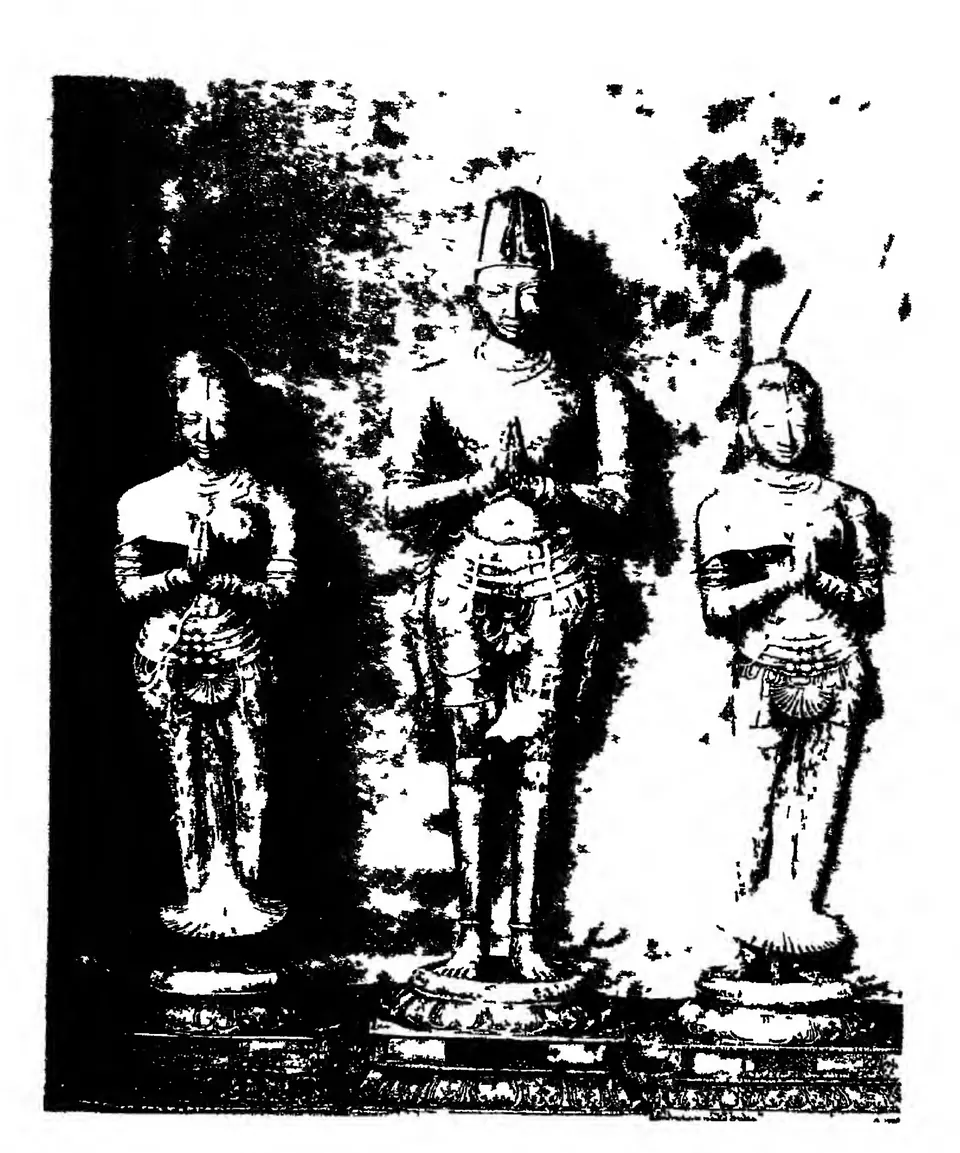
S. Krishnaswami Aiyangar summarised the Telugu prose chronicle Rayavachakamu in 1919.7 According to it, the king came to Tirupati after the eastern war.7 There “he performed all the sixteen danas as laid down in the sastras, and presented to the god valuable jewels and gold.”7 He also had copper statues cast of himself and his two queens, Tirumala Devi and Chinna Devi.7 He “set them before the god of the place that they may signify his constant worship.”7
In 1915 H. Krishna Sastri published a photograph of the statues taken for the purpose.8 His note explains the plate.8 Beside a labelled copper statue of Venkatapatiraya are stone images of a king and queen “which … do not bear labels.”8 “They may represent the parents of Venkata, viz., the first Karnata king Tirumala and his queen Vengalamba.”8
He added “three other metallic statues preserved in the temple on the Tirumala hill and found to the right of Venkatapatiraya on the plate.”8 “The central figure represents the great Krishnaraya of the second Vijayanagara dynasty; to his right is his queen Chinnadevi and to his left, queen Tirumaladevi.”8 Rangacharya refers for a description of these statues to the Epigraphist’s report for 1904.5 See Venkatapati II and Tirumala.
Footnotes
-
V. Rangacharya, A Topographical List of the Inscriptions of the Madras Presidency, Vol. I (1919), p. 472, Chittoor Nos. 9-A to 9-D (archive.org (opens in a new tab)). ↩ ↩2 ↩3 ↩4 ↩5 ↩6 ↩7 ↩8 ↩9 ↩10
-
Rangacharya, Topographical List, Vol. I (1919), p. 473, Chittoor Nos. 9-M and 9-N (archive.org (opens in a new tab)). ↩ ↩2 ↩3 ↩4
-
Rangacharya, Topographical List, Vol. I (1919), p. 471, Chandragiri taluk (archive.org (opens in a new tab)). ↩
-
F. Kielhorn, “A List of the Inscriptions of Southern India”, appendix to Epigraphia Indica VII (1902–03), p. 86, Nos. 505–506 (archive.org (opens in a new tab)). ↩ ↩2
-
Rangacharya, Topographical List, Vol. I (1919), p. 475, Chittoor No. 20 (archive.org (opens in a new tab)). ↩ ↩2 ↩3 ↩4
-
Luders, “Amaravati Inscription of Krishnaraya”, Epigraphia Indica VII (1902–03), p. 19 (archive.org (opens in a new tab)). ↩
-
S. Krishnaswami Aiyangar (ed.), Sources of Vijayanagar History (1919), p. 117, extract from the Rayavachakamu (archive.org (opens in a new tab)). ↩ ↩2 ↩3 ↩4 ↩5
-
H. Krishna Sastri, “The Third Vijayanagara Dynasty; its Viceroys and Ministers”, Archaeological Survey of India, Annual Report 1911–12 (1915), p. 189 and note 3, with plate LXXVI (archive.org (opens in a new tab)). ↩ ↩2 ↩3 ↩4 ↩5 ↩6
Photos
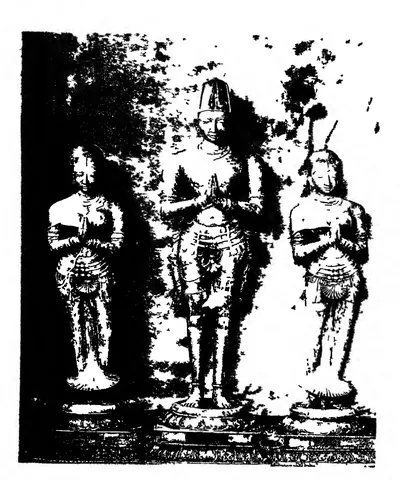 "Chinnadevi", "Krishnaraya-Maharaya" and "Tirumaladevi", copper statues in the Tirumala temple (ASI Annual Report 1911-12, plate LXXVI, figs. 1-3 (PDF p. 354))Historic photograph · 1915
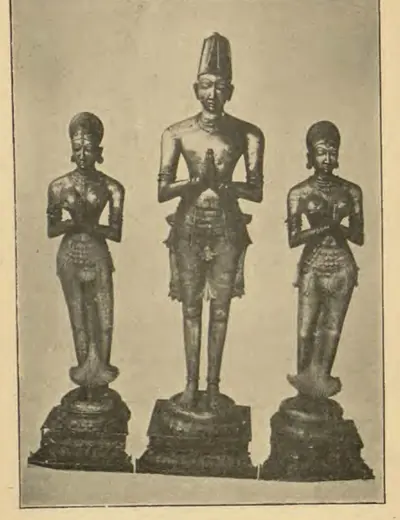 "Metal images of Krishna Raya and his two queens, Tirupati Temple, Chittoor District" (Longhurst, Hampi Ruins, 3rd ed. 1933, fig. 14, p. 42 (PDF p. 56))Historic photograph · 1933
References
Notes (0)
Sources (4)
Spotted an error on this page? Tell us
Last updated: