Humayun Shah
Eleventh Bahmani sultan (1458–1461), remembered as Zalim, 'the Cruel'. In Telangana he put down the revolt of his cousin Sikandar Khan, who claimed the province. He sent an army against the Velama fort of Devarakonda, which was routed by its defenders and an Orissan relief force in 1459. He camped at Warangal, left Mahmud Gawan to hold Telangana, and returned to Bidar to take a savage revenge on a rising there.
Humayun Shah was the eleventh king of the Bahmani dynasty. His short reign is remembered for its cruelty.123 But most of its fighting was in Telangana (then Telingana).123 There a Bahmani prince with a claim to the province, and the Telugu chiefs of Devarakonda, both took up arms against him.123
Family and coming to the throne
Humayun was the eldest son of Ala-ud-din Ahmad Shah II, who named him heir despite his evil reputation.43 His chief queen, Makhduma-i-Jahan, was a daughter of Mubarak Khan, a younger son of Firuz Shah.56 She was the mother of his sons Nizam Shah and Muhammad Shah, who both reigned after him, and of a third son, Jamshid.56
When his father died in 1458, some of the nobles set up his younger brother Hasan Khan.783 But Humayun fought his way to the palace, took the throne and had his brother blinded.783 He made Mahmud Gawan his chief minister.89 Ferishta says the government of Telangana went to Malik Shah, entitled Khwaja Jahan, with an estate in the province.8
Sikandar Khan, son of Jalal Khan and a former companion of the king, was “disappointed at not having the government of Tulingana”.1 He joined his father in his fort and raised troops.1 When the king offered him a pardon, Sikandar replied, in Ferishta’s account, that he too was a grandson of Ahmad Shah I, through his daughter.10 He was “consequently his partner in the kingdom of their grandfather”.10 So the king must give up Telangana to him, or fight.10 He was killed in the battle that followed.103
Ferishta says the king’s elephant seized him.10 Haig says he was thrown down by an elephant and trampled by his own cavalry.3 Ferishta calls the fort Nowlgoond, while Haig calls it Balkonda.13 The Burhan-i Ma’asir says Sikandar was advancing on Golconda.9
Devarakonda
Haig says the Hindus of Telangana, “and especially those of the district of Deurkonda”, had supported Sikandar.3 Early in 1459, he says, Humayun marched to Warangal and sent a force to capture Devarakonda.3 Ferishta says the fort belonged to “a zemindar of Tulingana” (a landholder of Telangana).2
The Bahmani generals Khwaja Jahan Turk and Nizam-ul-Mulk Ghori beat the Telugu forces in the field and besieged the fort.2 But the defenders bought the help of the Ray (king) of Orissa.2 When his army arrived, the garrison rushed out at the same moment.211 The besiegers were routed and pursued, Ferishta says, for eighty miles to Warangal.211
The Burhan-i Ma’asir has Khwaja Jahan go ahead with some twenty thousand horsemen and forty elephants.1213 It says he rejected advice to move his camp into open ground before the Orissan army joined the defenders.1213 It says six or seven thousand Bahmani horsemen were killed.1213
On Khwaja Jahan’s false report, the king put Nizam-ul-Mulk to death and imprisoned Khwaja Jahan.1114 The Kistna Manual tells the same story of “the revolted Telugu fortress”.15 On the defenders, see the Recherla Velamas and Kapilendra Gajapati.
The Imperial Gazetteer says the king “marched to Nalgonda to quell a rebellion which had broken out in his Telingana provinces”.16 He was preparing a second attack on Devarakonda when news came from Bidar.17 Prisoners there, among them his brother Hasan Khan, had been freed.17 He left Mahmud Gawan “to protect Tulingana” and hurried back to his capital.1714
“The Cruel”
What followed earned him the name Zalim (the Cruel). Ferishta says the king threw his brother to a tiger in the market square at Bidar. He also says the king had about seven thousand people tortured to death, few of whom had any part in the rising. Haig adds that almost all the surviving descendants of Bahman Shah were killed.181914
Among the nobles who fled for their lives, the Burhan-i Ma’asir names Shitab Khan.20 His women were tortured in public after his flight.20 Hirananda Sastri identified him with the Shitab Khan who took Warangal in 1504 and ruled there for a few years.2122
Death and tomb
Ferishta gives two accounts of the end. In one, Humayun died of illness on 28 Zi’l-qa’da AH 865 (AH is the Islamic way of counting years), which Briggs converts to 3 September 1461. In the other, he recovered and was killed by his servants while drunk. Before he died he named his son Nizam Shah, aged eight, as heir, with Khwaja Jahan and Mahmud Gawan as regents (rulers for the boy).23
Haig dates his death to 4 September 1461.24 He follows “the best authority for his reign”, in which a maidservant stabbed him.24
His tomb at Bidar has a split dome, which local belief explained as heaven’s judgment.24 Haig says lightning struck it some decades before he wrote.24 G. Yazdani found that the bricks in the dome are light, porous bricks like those of the Kakatiya temple at Ramappa.25 He thought the masons were probably Hindus.25
Coins
Humayun’s gold, silver and copper coins are known. Codrington lists gold struck at Ahsanabad in AH 863 and 864, and several sizes of copper.26
Footnotes
-
Ferishta, tr. Briggs, Vol. II (1829), p. 454 (archive.org (opens in a new tab)). ↩ ↩2 ↩3 ↩4 ↩5 ↩6
-
Ferishta, tr. Briggs, Vol. II (1829), p. 456 (archive.org (opens in a new tab)). ↩ ↩2 ↩3 ↩4 ↩5 ↩6 ↩7 ↩8
-
Wolseley Haig (ed.), The Cambridge History of India, Vol. III (1928), p. 410 (archive.org (opens in a new tab)). ↩ ↩2 ↩3 ↩4 ↩5 ↩6 ↩7 ↩8 ↩9 ↩10 ↩11
-
T. W. Haig, “Some Notes on the Bahmani Dynasty”, Journal of the Asiatic Society of Bengal LXXIII, Part I, extra number (1904), p. 10 (archive.org (opens in a new tab)). ↩
-
Haig, “Some Notes on the Bahmani Dynasty” (1904), p. 11 (archive.org (opens in a new tab)). ↩ ↩2
-
King, History of the Bahmani Dynasty (1900), p. 89 (archive.org (opens in a new tab)). ↩ ↩2
-
Muhammad Qasim Ferishta, tr. John Briggs, History of the Rise of the Mahomedan Power in India, Vol. II (1829), p. 452 (archive.org (opens in a new tab)). ↩ ↩2
-
Ferishta, tr. Briggs, Vol. II (1829), p. 453 (archive.org (opens in a new tab)). ↩ ↩2 ↩3 ↩4
-
J. S. King, The History of the Bahmani Dynasty, founded on the Burhan-i Ma’asir (1900), p. 82 (archive.org (opens in a new tab)). ↩ ↩2
-
Ferishta, tr. Briggs, Vol. II (1829), pp. 455–456 (archive.org (opens in a new tab)). ↩ ↩2 ↩3 ↩4 ↩5
-
Ferishta, tr. Briggs, Vol. II (1829), p. 457 (archive.org (opens in a new tab)). ↩ ↩2 ↩3
-
King, History of the Bahmani Dynasty (1900), p. 83 (archive.org (opens in a new tab)). ↩ ↩2 ↩3
-
King, History of the Bahmani Dynasty (1900), p. 84 (archive.org (opens in a new tab)). ↩ ↩2 ↩3
-
Haig, Cambridge History of India, Vol. III (1928), p. 411 (archive.org (opens in a new tab)). ↩ ↩2 ↩3
-
Gordon Mackenzie, A Manual of the Kistna District (1883), p. 17 (archive.org (opens in a new tab)). ↩
-
Imperial Gazetteer of India: Hyderabad State (1909), p. 13 (archive.org (opens in a new tab)). ↩
-
Ferishta, tr. Briggs, Vol. II (1829), p. 458 (archive.org (opens in a new tab)). ↩ ↩2 ↩3
-
Ferishta, tr. Briggs, Vol. II (1829), p. 462 (archive.org (opens in a new tab)). ↩
-
Ferishta, tr. Briggs, Vol. II (1829), p. 463 (archive.org (opens in a new tab)). ↩
-
King, History of the Bahmani Dynasty (1900), p. 88 (archive.org (opens in a new tab)). ↩ ↩2
-
Hirananda Sastri, Shitab Khan of Warangal (1932), p. 3 (archive.org (opens in a new tab)). ↩
-
Sastri, Shitab Khan of Warangal (1932), p. 15 (archive.org (opens in a new tab)). ↩
-
Ferishta, tr. Briggs, Vol. II (1829), p. 464 (archive.org (opens in a new tab)). ↩
-
Haig, Cambridge History of India, Vol. III (1928), p. 412 (archive.org (opens in a new tab)). ↩ ↩2 ↩3 ↩4
-
G. Yazdani, Bidar: Its History and Monuments (1947), p. 133 and note 4 (archive.org (opens in a new tab)). ↩ ↩2
-
O. Codrington, “On the Coins of the Bahmani Dynasty”, Numismatic Chronicle, 3rd series, XVIII (1898), pp. 268–269 (archive.org (opens in a new tab)). ↩
Photos
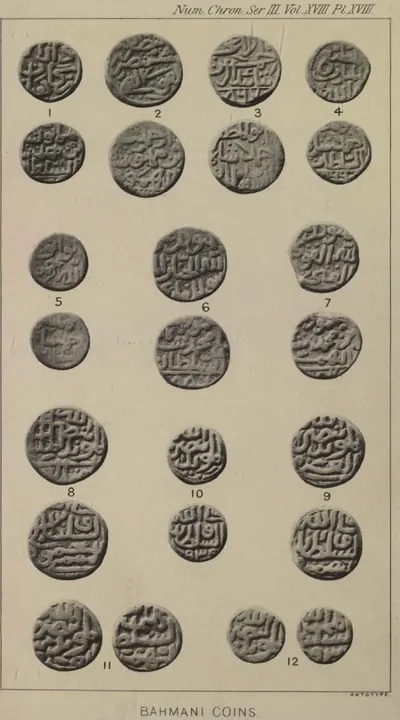 "Bahmani Coins": copper of the later Bahmani kings (O. Codrington, Numismatic Chronicle, 3rd series, Vol. XVIII (1898), Plate XVIII)Coin · 1898
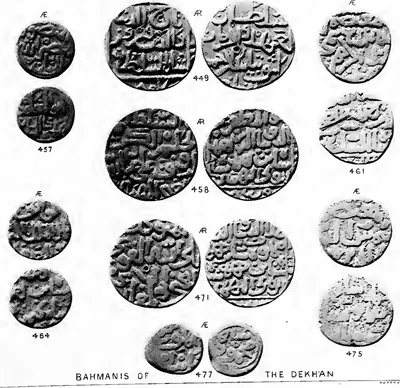 "Bahmanis of the Dekhan": coins of the Bahmani kings in the British Museum (Stanley Lane-Poole, The Coins of the Muhammadan States of India (1885), Plate XI, lower part)Coin · 1885
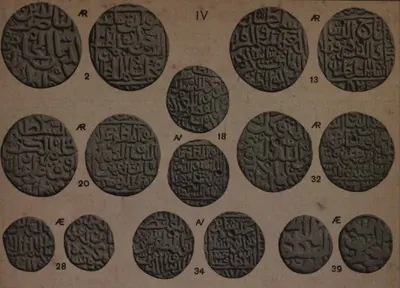 "IV. Bahmanis of Kulbarga": coins of the Bahmani kings in the Indian Museum, Calcutta (H. Nelson Wright, Catalogue of the Coins in the Indian Museum, Vol. II (1907), Plate VIII, upper part)Coin · 1907
References
Notes (0)
Sources (9)
Spotted an error on this page? Tell us
Last updated: