Vemulavada inscription of Arikesari II
Long Sanskrit inscription, with Kannada titles, on the four faces of a stone pillar beside the sanctum of the Bhimesvara (old Baddegesvara) temple at Vemulavada. It sets out the family line of the Chalukyas of Vemulavada from Vinayaditya-Yuddhamalla to Arikesari II. It describes the northern victories of Narasimha II and Arikesari II's defeat of an army sent against him by Govindaraja. Its editor, N. Venkataramanayya, took Govindaraja to be the Rashtrakuta Govinda IV and thought that this defeat sealed his fate. It records Arikesari's gift of land for a feeding house at a Sun temple in his capital, Lembulavataka. It is undated, and Arikesari reigned about 930–955.
The Vemulavada inscription is the main record of the Chalukyas of Vemulavada.1 N. Venkataramanayya edited it in 1953.1 He described it as well known and as the most important of the family’s inscriptions.1 It traces their history from Vinayaditya-Yuddhamalla to Arikesari II.1
The pillar
The inscription has 108 lines on the four faces of a rectangular stone pillar, 4 feet by 1 foot 3 inches.2 The pillar stands to the left of the sanctum of the Bhimesvara temple, formerly the Baddegesvara, at Vemulavada, which the record calls Lembulavataka.2 The letters are deeply cut and well preserved.2
The language is Sanskrit in verse and prose.23 Only lines 17–28, which list the titles of the king and his minister, are in Kannada.23 The script is the Telugu-Kannada of the 10th century.23 Venkataramanayya thought that the writer of the eulogy and the engraver were Kannada speakers, because the cerebral la is used so often for the ordinary la.23 See the temples of Vemulavada.
Contents
The record opens with an invocation of the Sun, fittingly, since the gift was for a Sun temple, and then gives the family line.3 Vinayaditya, called Yuddhamalla, ruled the Sapadalaksha country, bathed his elephants in a tank of oil at Podana and took the fort of Chitrakuta.3 His son Arikesari I conquered all of Vengi.3 After him came Narasimha, also called Rajaditya, Yuddhamalla II, Baddega and Yuddhamalla III.3
Narasimha II defeated the rulers of the Seven Malavas and made them pay tribute.3 At Kalapriya he defeated the army of the Gurjara king and set up a pillar of victory.3 Venkataramanayya noted that the inscription seldom states how one king was related to the next, so he took the relationships from the poet Pampa.4
Arikesari II
Arikesari II is given a long list of titles, from Pambarankusa to Samanta-chudamani.35 He married Revakanirmadi, daughter of Indraraja, protected Bijja and destroyed an army under Pandyarya, sent against him by the angry Govindaraja.35 Venkataramanayya took Govindaraja to be the Rashtrakuta king Govinda IV.6 In his view, this defeat “practically sealed the fate of Govinda IV”.6
His sandhivigrahi was Gunankusa.5 The sandhivigrahi is usually explained as the minister of peace and war.7 Venkataramanayya took him to have been, in practice, the composer of such records.7
The gift
The king made the grant at the request of Peddana, his tantrapala (an officer).5 Peddana, son of Nagamarya, who had been tantrapala of King Baddega, had built a temple of the Sun.5
On the festival of the winter solstice the king gave a hundred nivartanas (a land measure) of land in the north-east of the capital, Lembulavataka.5 The land was for the feeding house attached to the temple, where guests and visitors were fed.5 He gave another eight nivartanas for a shed where drinking water was given out.5
The witnesses were the heads of the four temples of Rajesvara, Adityagriha, Baddegesvara and Nagaresvara, nine merchants headed by Chandrasreshthin, and a sage of the Thataviya lineage.5
In place of the usual curses on those who break the grant, two verses ask future kings to protect it and remind them that life is short.5 The last line fixes the tax (siddhaya) on the land at twelve drammas (coins).5
Editions and date
Venkataramanayya published the text, with an introduction and four photographs, as Appendix C of his book.28 The 1961 Kannada Inscriptions of Andhra Pradesh summarised it as a gift for a feeding house for pilgrims to the Sun temple.9 It said the gift was made at the request of Peddaya, and placed Arikesari II in the ninth century.9 The record bears no date. Venkataramanayya dated Arikesari’s reign to about 930–955.10
Footnotes
-
N. Venkataramanayya, The Chalukyas of L(V)emulavada (1953), p. 1 (archive.org (opens in a new tab)). Paraphrased. ↩ ↩2 ↩3 ↩4
-
Venkataramanayya, Chalukyas of L(V)emulavada (1953), p. 82, introduction to the Lemulavada inscription (archive.org (opens in a new tab)). Paraphrased. ↩ ↩2 ↩3 ↩4 ↩5 ↩6 ↩7 ↩8
-
Venkataramanayya, Chalukyas of L(V)emulavada (1953), p. 83 (archive.org (opens in a new tab)). Paraphrased. ↩ ↩2 ↩3 ↩4 ↩5 ↩6 ↩7 ↩8 ↩9 ↩10 ↩11 ↩12
-
Venkataramanayya, Chalukyas of L(V)emulavada (1953), p. 5 (archive.org (opens in a new tab)). Paraphrased. ↩
-
Venkataramanayya, Chalukyas of L(V)emulavada (1953), p. 84 (archive.org (opens in a new tab)). Paraphrased. ↩ ↩2 ↩3 ↩4 ↩5 ↩6 ↩7 ↩8 ↩9 ↩10 ↩11
-
Venkataramanayya, Chalukyas of L(V)emulavada (1953), p. 37 (archive.org (opens in a new tab)). Paraphrased. ↩ ↩2
-
Venkataramanayya, Chalukyas of L(V)emulavada (1953), p. 40 and note 66 (archive.org (opens in a new tab)). Paraphrased. ↩ ↩2
-
Venkataramanayya, Chalukyas of L(V)emulavada (1953), pp. 85–92, text, and plates 2–5 (archive.org (opens in a new tab)). Paraphrased. ↩
-
Kannada Inscriptions of Andhra Pradesh (Andhra Pradesh Government Archaeological Series 3, 1961), p. 6, No. 13 (archive.org (opens in a new tab)). Paraphrased. ↩ ↩2
-
Venkataramanayya, Chalukyas of L(V)emulavada (1953), p. 12 (archive.org (opens in a new tab)). Paraphrased. ↩
Photos
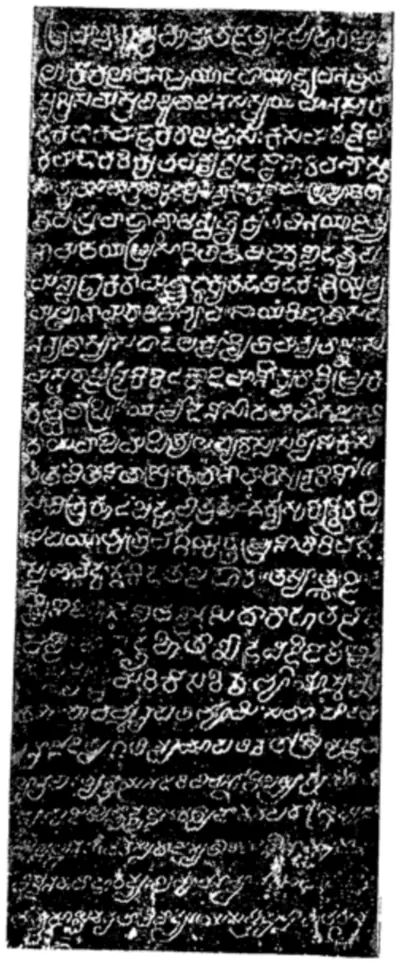 "L(V)ēmulavāḍa Inscription. First Side" (N. Venkataramanayya, The Chalukyas of L(V)emulavada, 1953, plate 2)Inscription rubbing · 1953
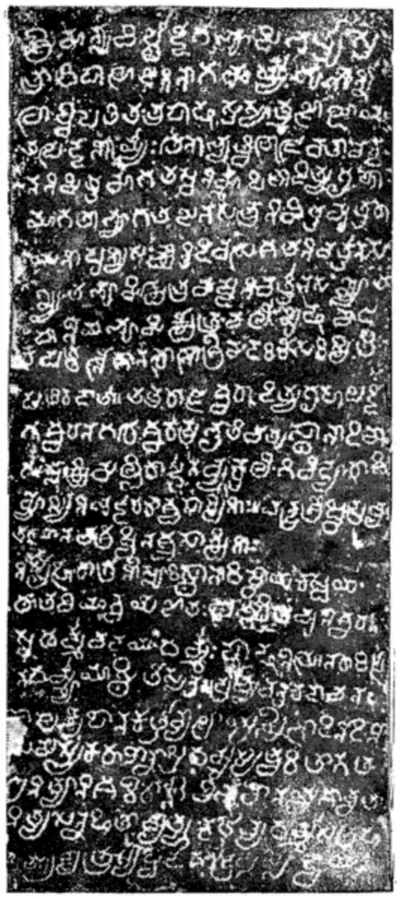 "L(V)ēmulavāḍa Inscription. Fourth Side" (N. Venkataramanayya, The Chalukyas of L(V)emulavada, 1953, plate 5)Inscription rubbing · 1953
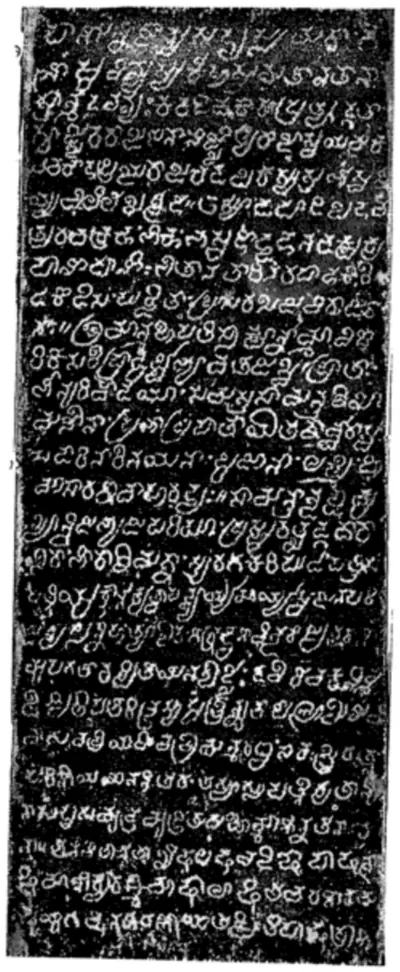 "L(V)ēmulavāḍa Inscription. Second Side" (N. Venkataramanayya, The Chalukyas of L(V)emulavada, 1953, plate 3)Inscription rubbing · 1953
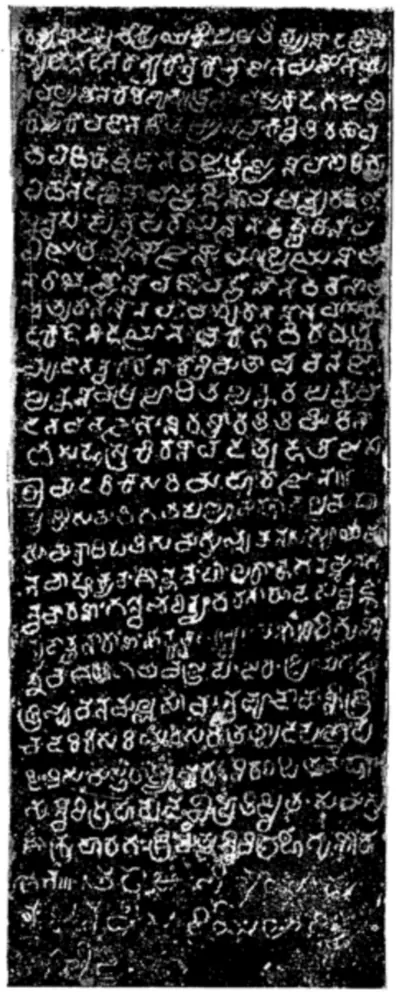 "L(V)ēmulavāḍa Inscription. Third Side" (N. Venkataramanayya, The Chalukyas of L(V)emulavada, 1953, plate 4)Inscription rubbing · 1953
References
Notes (0)
Sources (2)
Spotted an error on this page? Tell us
Last updated: