Arikesari II (Chalukya of Vemulavada)
Chalukya king of Vemulavada in today's Karimnagar district, a feudatory of the Rashtrakutas, who ruled from about 930 to about 955. He was the patron of the Kannada poet Pampa, who made him the hero of his Vikramarjunavijaya (941). His pillar inscription at Vemulavada gives the family line and records a gift to a Sun temple in his capital, Lembulavataka. He sheltered a Chalukya prince named Bijja from the Rashtrakuta king Govinda IV, and helped bring Govinda's uncle Baddega (Amoghavarsha III) to the throne.
Arikesari II was the best-known king of the Chalukyas of Vemulavada.123 This family ruled the country round Vemulavada, in today’s Karimnagar district, as feudatories of the Rashtrakutas.123 He is remembered above all as the patron of the Kannada poet Pampa.123 His long pillar inscription at Vemulavada is the main record of his family.123
Family
Arikesari II was the son of Narasimha II and his queen Jakavve.45 Pampa gives the queen’s name as Jatavve in the manuscripts B. Lewis Rice used for his edition of 1898.6 Narasimha II was the son of Yuddhamalla III, whom Pampa calls Dugdhamalla.78 Venkataramanayya took Dugdhamalla to be a form of the name Yuddhamalla.9
N. Venkataramanayya accepted the suggestion of M. Govinda Pai that Jakavve was a sister of the Rashtrakuta king Indra III.1011 He noted that this rests on Pampa’s line that the infant Arikesari had Indra’s shoulder for his cradle, and that direct proof is lacking.1011
Arikesari II married Revakanirmadi, the daughter of the Rashtrakuta king Indra III.124 He also married Lokambika, a princess of the Rashtrakuta family named in the Parbhani plates of his grandson.713 Venkataramanayya took these to be two different queens, while the editors of The Early History of the Deccan (1960) left open whether Lokambika was a second queen or a title of Revakanirmadi.14 Arikesari II had two sons, Vagaraja and Bhadradeva, also called Baddega. Vagaraja, the elder, succeeded him.15
Pampa’s patron
Pampa wrote his Vikramarjunavijaya, the “Pampa Bharata”, under Arikesari’s patronage, and finished it in or soon after 941.1617 In the poem Pampa says that he has identified the king with Arjuna, so that the king is the real hero of the epic.618 He also describes how Arikesari sent for him and gave him great gifts.618 The king “directed him to compose such a story … as should establish his (the king’s) fame in the earth”.618
As a reward the king gave the poet an agrahara (village grant) named Dharmmavuram in the Bachche Thousand.19 Edward Rice called the flattery of the patron a flaw that “mars the beauty of the work”.20
Pampa’s younger brother Jinavallabha set up a rock inscription on the Bommala Gutta at Kurikyal, which repeats the story.21 It says that King Arikesari of the Chalukya family, also called Hariga and Ariga, gave Pampa the village of Dharmavura as an agrahara in thanks for the poem.21 Doubters, it says, should go to the hill called Vrishabhadri and read the grant there.21 See the Kurkyal inscription.
Bijja, Govinda IV and Baddega
The Vemulavada inscription says that Arikesari protected Bijja, who had come to him for refuge, when Govindaraja was angry.1213 It says that he destroyed an army under Pandyarya sent against him.1213
Pampa adds more.2223 In 1903 K. B. Pathak translated the passage for D. R. Bhandarkar.2223 It says that “Arikesari conquered the great feudatories sent by the emperor named Gojjiga”.2223 It goes on: “destroying the emperor who offered opposition, gave universal sovereignty to Baddegadeva, who came placing confidence in him”.2223
Bhandarkar identified Gojjiga as the Rashtrakuta king Govinda IV, and Baddegadeva as his uncle Amoghavarsha III.23 He concluded that the rebel feudatories killed Govinda IV in battle.23 Venkataramanayya read the same evidence differently.2425 In his view Arikesari invited Baddega to Vemulavada.2425 With him and the rebels, Arikesari defeated Govinda and drove him out of the kingdom.2425 He took Pampa’s words to mean that the emperor was ruined, not necessarily killed.2425
Who Bijja was is disputed. R. G. Bhandarkar and J. F. Fleet took the Vijayaditya whom Arikesari protected to be a king of the Eastern Chalukya dynasty, and Fleet named Vijayaditya IV.2627 Venkataramanayya rejected this.2824 Vijayaditya IV reigned for only six months in 922, and Bijja’s rising came just before Govinda IV fell.2824 He identified Bijja with Bijayita, a chief of the neighbouring Chalukyas of Mudigonda.2824
Pampa also says that Arikesari, single-handed, drove off an ankakara (champion) of Bappuva.1329 Bappuva was the younger brother of Kakkala, and attacked him with many elephants.1329 Venkataramanayya thought Bappuva an enemy of Amoghavarsha III, and could not identify him with certainty.1329
The Vemulavada inscription
His inscription is on a pillar in the Bhimesvara temple at Vemulavada.312 It records a gift made at the request of his tantrapala (army officer) Peddana, son of Nagamarya, who had held the same office under King Baddega.312 Peddana had built a temple of the Sun.312
On the festival of the winter solstice, Arikesari gave a hundred nivartanas (a land measure) of land to the north-east of his capital, Lembulavataka.312 The land was to keep up a feeding house attached to that temple, and he gave eight more for a shed where drinking water was given out.312 The keepers of the four temples of the town and nine merchants were the witnesses.312 See the Vemulavada inscription of Arikesari II.
The inscription lists his titles, among them Pambarankusa, Ammanagandhavarana, Arudhasarvajna, Gunarnava, Tribhuvanamalla and Samanta-chudamani.30 Most of them also occur in Pampa’s poem.30
A second stone grant of Arikesari, now in the Karimnagar museum, gives fifty mattars of wet land to a Brahmana.31 Epigraphia Telanganica (2023) dates it to 946.31 It notes that its five opening verses are found in Pampa’s poem (chapter I, verses 15, 31, 41, 42 and 50).31
A Kannada inscription at Chennur, on the Godavari, is dated 12 July 940.32 It records a gift by a Chalukya chief named Baddega, a subordinate of Arikesari-arasa, who is himself described as a feudatory of the Rashtrakuta king.32
Dates and capital
Venkataramanayya placed Arikesari’s reign at about 930 to 955.334 In the same book he also suggested that Arikesari probably succeeded his father in 935.334 Elsewhere Venkataramanayya gave 930 to 958.5
Older writers placed his kingdom in the Kannada country. Rice wrote in 1898 that Arikesari’s capital was Puligere, the modern Lakshmeshwar in the Dharwar district.162723 His reason was that Pampa says he wrote in the Kannada of Puligere.162723 Fleet placed Arikesari’s power there for the same reason.162723 D. R. Bhandarkar called him the ruler of the Jola country, “which in the main coincides with the Dharwar district”.162723
Rice himself added in a footnote that the word on which the “Jola” reading rested “apparently bears a different meaning”.34 The Vemulavada inscription calls Lembulavataka (Vemulavada) his capital.12
Footnotes
-
N. Venkataramanayya, The Chalukyas of L(V)emulavada (1953), p. 1 (archive.org (opens in a new tab)). Paraphrased. ↩ ↩2 ↩3 ↩4
-
Venkataramanayya, Chalukyas of L(V)emulavada (1953), p. 2 (archive.org (opens in a new tab)). Paraphrased. ↩ ↩2 ↩3 ↩4
-
Venkataramanayya, Chalukyas of L(V)emulavada (1953), p. 83, introduction to the Lemulavada inscription (archive.org (opens in a new tab)). Paraphrased. ↩ ↩2 ↩3 ↩4 ↩5 ↩6 ↩7 ↩8 ↩9 ↩10
-
Venkataramanayya, Chalukyas of L(V)emulavada (1953), p. 30 (archive.org (opens in a new tab)). Paraphrased. ↩ ↩2 ↩3 ↩4
-
Epigraphia Telanganica I (2023), p. 400, reprinting Venkataramanayya, “The Kurkiyala Inscription” (1974). Cite-only; paraphrased. ↩ ↩2
-
Rice, Pampa Bharata (1898), introduction, p. 4 (archive.org (opens in a new tab)). ↩ ↩2 ↩3 ↩4
-
Venkataramanayya, Chalukyas of L(V)emulavada (1953), p. 93, introduction to the Parabhani plates (archive.org (opens in a new tab)). Paraphrased. ↩ ↩2
-
B. Lewis Rice (ed.), The Pampa Bharata (1898), “Analysis of the Poem”, p. 1, stanzas 30–31 (archive.org (opens in a new tab)). ↩
-
Venkataramanayya, Chalukyas of L(V)emulavada (1953), p. 9 and note (archive.org (opens in a new tab)). Paraphrased. ↩
-
Venkataramanayya, Chalukyas of L(V)emulavada (1953), p. 11 (archive.org (opens in a new tab)). Paraphrased. ↩ ↩2
-
Venkataramanayya, Chalukyas of L(V)emulavada (1953), p. 25 (archive.org (opens in a new tab)). Paraphrased. ↩ ↩2
-
Venkataramanayya, Chalukyas of L(V)emulavada (1953), p. 84 (archive.org (opens in a new tab)). Paraphrased. ↩ ↩2 ↩3 ↩4 ↩5 ↩6 ↩7 ↩8 ↩9 ↩10
-
Venkataramanayya, Chalukyas of L(V)emulavada (1953), p. 31 (archive.org (opens in a new tab)). Paraphrased. ↩ ↩2 ↩3 ↩4 ↩5 ↩6
-
K. A. Nilakanta Sastri and N. Venkataramanayya, “The Chalukyas of Vemulavada”, appendix C to “The Eastern Chalukyas”, in G. Yazdani (ed.), The Early History of the Deccan, Parts VII–XI (1960), p. 510. Cite-only; paraphrased. ↩
-
Venkataramanayya, Chalukyas of L(V)emulavada (1953), p. 41 (archive.org (opens in a new tab)). Paraphrased. ↩
-
B. Lewis Rice (ed.), The Pampa Bharata or Vikramarjuna Vijaya of Pampa (1898), introduction, p. 1 (archive.org (opens in a new tab)). ↩ ↩2 ↩3 ↩4 ↩5
-
Epigraphia Telanganica I (2023), p. 401, reprinting Venkataramanayya, “The Kurkiyala Inscription” (1974). Cite-only; paraphrased. ↩
-
Rice, Pampa Bharata (1898), introduction, p. 11 (archive.org (opens in a new tab)). ↩ ↩2 ↩3
-
Rice, Pampa Bharata (1898), introduction, p. 12 (archive.org (opens in a new tab)). ↩
-
Edward P. Rice, A History of Kanarese Literature (2nd ed., 1921), p. 31 (archive.org (opens in a new tab)). ↩
-
Epigraphia Telanganica I (2023), p. 395, reprinting N. Venkataramanayya, “The Kurkiyala Inscription of Jinavallabha”, Epigraphia Andhrica II (1974), pp. 21–28. Cite-only; paraphrased. ↩ ↩2 ↩3
-
D. R. Bhandarkar, “Cambay Plates of Govinda IV; Saka-Samvat 852”, Epigraphia Indica VII (1903), p. 33 (archive.org (opens in a new tab)). ↩ ↩2 ↩3 ↩4
-
Bhandarkar, “Cambay Plates of Govinda IV” (1903), p. 34 (archive.org (opens in a new tab)). ↩ ↩2 ↩3 ↩4 ↩5 ↩6 ↩7 ↩8 ↩9 ↩10
-
Venkataramanayya, Chalukyas of L(V)emulavada (1953), p. 37 and note 55 (archive.org (opens in a new tab)). Paraphrased. ↩ ↩2 ↩3 ↩4 ↩5 ↩6 ↩7
-
Venkataramanayya, Chalukyas of L(V)emulavada (1953), p. 38 and note 57 (archive.org (opens in a new tab)). Paraphrased. ↩ ↩2 ↩3 ↩4
-
Rice, Pampa Bharata (1898), introduction, p. 6, quoting R. G. Bhandarkar (archive.org (opens in a new tab)). ↩
-
J. F. Fleet, “Dynasties of the Kanarese Districts”, Gazetteer of the Bombay Presidency I, pt. II (1896), p. 381 (archive.org (opens in a new tab)). ↩ ↩2 ↩3 ↩4 ↩5
-
Venkataramanayya, Chalukyas of L(V)emulavada (1953), p. 35, note 55 (archive.org (opens in a new tab)). Paraphrased. ↩ ↩2 ↩3
-
Venkataramanayya, Chalukyas of L(V)emulavada (1953), p. 39 (archive.org (opens in a new tab)). Paraphrased. ↩ ↩2 ↩3
-
Venkataramanayya, Chalukyas of L(V)emulavada (1953), p. 40 (archive.org (opens in a new tab)). Paraphrased. ↩ ↩2
-
Epigraphia Telanganica I (2023), p. 87, summarising Inscriptions of Karimnagar District, pp. 1–5. Cite-only; paraphrased. ↩ ↩2 ↩3
-
Gajjala Vasanta Lakshmi (ed.), Epigraphia Telanganica I: Pre-Kakatiya Telangana (2023), p. 81, summarising the Annual Report on Indian Epigraphy for 1959-60, p. 46. Cite-only; paraphrased. ↩ ↩2
-
Venkataramanayya, Chalukyas of L(V)emulavada (1953), p. 12 (archive.org (opens in a new tab)). Paraphrased. ↩ ↩2
-
Rice, Pampa Bharata (1898), introduction, p. 2 and note 1 (archive.org (opens in a new tab)). ↩
Photos
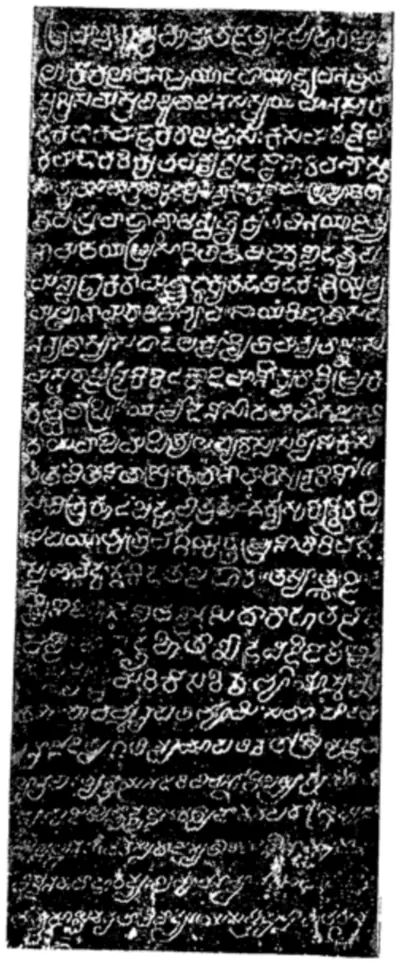 "L(V)ēmulavāḍa Inscription. First Side" (N. Venkataramanayya, The Chalukyas of L(V)emulavada, 1953, plate 2)Inscription rubbing · 1953
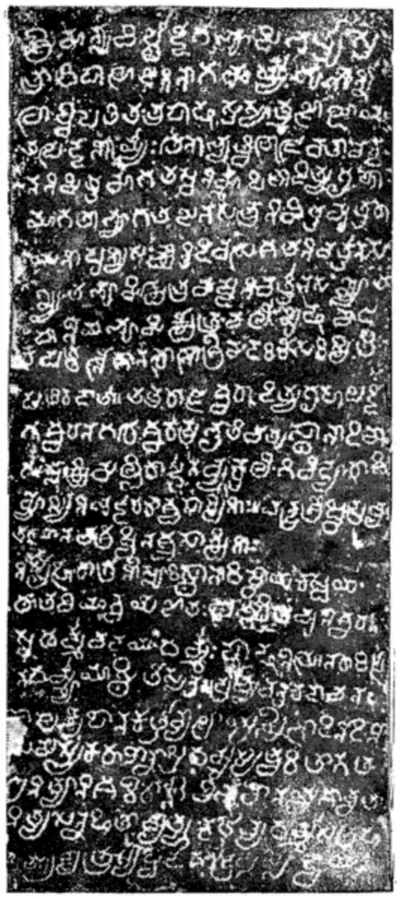 "L(V)ēmulavāḍa Inscription. Fourth Side" (N. Venkataramanayya, The Chalukyas of L(V)emulavada, 1953, plate 5)Inscription rubbing · 1953
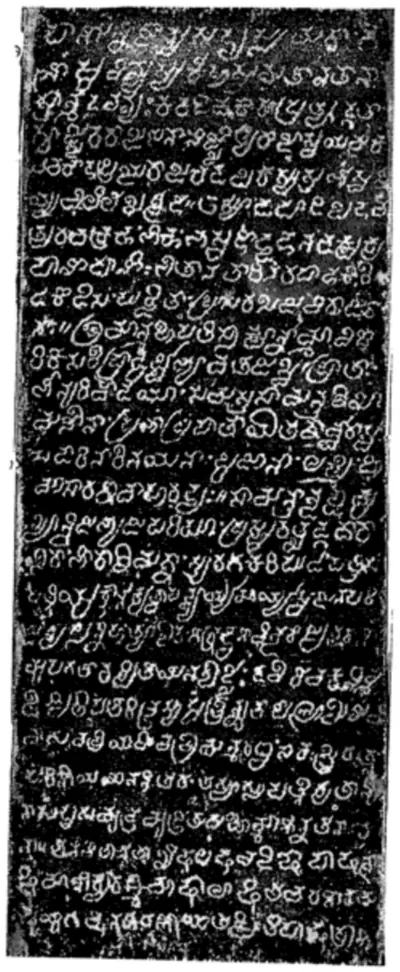 "L(V)ēmulavāḍa Inscription. Second Side" (N. Venkataramanayya, The Chalukyas of L(V)emulavada, 1953, plate 3)Inscription rubbing · 1953
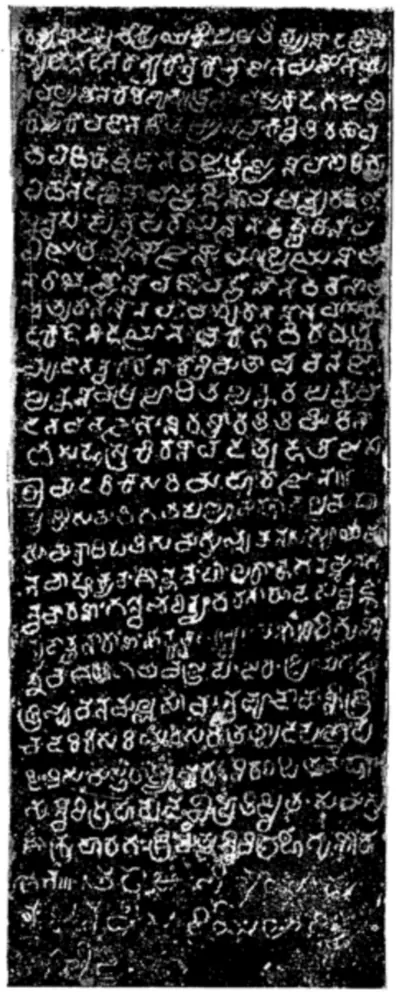 "L(V)ēmulavāḍa Inscription. Third Side" (N. Venkataramanayya, The Chalukyas of L(V)emulavada, 1953, plate 4)Inscription rubbing · 1953
Related
Dynasties
References
Notes (0)
Sources (8)
Spotted an error on this page? Tell us
Last updated: