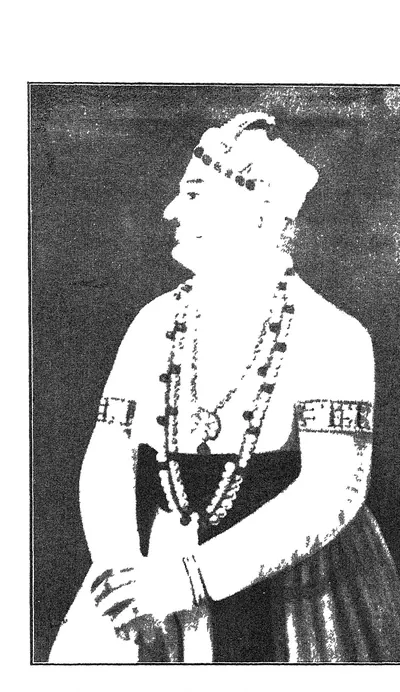
Nizam Ali Khan (Asaf Jah II)
Fourth son of Nizam-ul-Mulk Asaf Jah I. He pushed aside his brother Salabat Jang in 1761–62 and ruled the Deccan until his death at Hyderabad in 1803. In his reign the Northern Circars passed to the East India Company (1766, Guntur in 1788). The Nizam joined the British against Tipu Sultan, was defeated by the Marathas at Kharda (1795) and accepted a permanent subsidiary force (1798). To pay for it he gave up his Mysore gains, the later Ceded Districts of Rayalaseema (1800). He is the first Nizam buried at the Mecca Masjid.
Nizam Ali Khan, the fourth son of Nizam-ul-Mulk Asaf Jah I, ruled the Deccan for about forty years, from 1761 to 1803.12 His reign fixed the relationship with the East India Company that lasted to the end of the Asaf Jahi state. The treaties he signed handed the whole of the coastal and southern Telugu country to the Company, while Telangana stayed with the Nizams.34
Rise to power
In 1759 his brother Salabat Jang was away at Machilipatnam (then Masulipatam).56 Gribble says that Nizam Ali then tried to raise a rising at Hyderabad, encouraged by letters from Clive and Colonel Forde.56 On his return Salabat Jang “had to accept him as his Minister or Dewan”, and real power passed to Nizam Ali.56
A war with the Marathas ended by treaty in 1762.7 Briggs says that after it Nizam Ali imprisoned his brother at Bidar, and about fifteen months later had him killed.7 He records that some English writers date the imprisonment to 18 July 1761.7
The Imperial Gazetteer and the treaty collection of 1909 date Nizam Ali’s accession to 1761.18 Mudiraj’s Pictorial Hyderabad (1929) dates it to 1763.9 Mudiraj also points out that Nasir Jang, Muzaffar Jang and Salabat Jang were not counted as reigning Nizams.10 So Nizam Ali is reckoned the second Nizam, not the fifth.10
Briggs adds that one of his first acts was to destroy the Hindu temples at Toka on the Godavari.117 This drove Ramchandra Jadhav and most of the Marathas in Mughal service over to the Peshwa.117
The Northern Circars
In 1765 Nizam Ali invaded the Carnatic and was driven back.8 The Company had obtained an imperial grant (farman) for the Circars from the emperor at Delhi.812 General Calliaud was sent to Hyderabad to negotiate.812 By the treaty of 12 November 1766 the Company received the Circars of Eluru (then Ellore), Srikakulam (then Chicacole), Rajahmundry, Mustafanagar and Murtazanagar (Guntur).812
In return the Company agreed to give the Nizam a subsidiary force (troops to serve him, at his cost) when required.812 When its troops were not needed it would pay nine lakhs a year.812 The Imperial Gazetteer of Hyderabad gives six lakhs instead of nine.1 Guntur was left with his brother Basalat Jang for life.8
The Nizam then joined Haidar Ali of Mysore against the Company.83 After that alliance failed, a second treaty in 1768 made the Company pay a smaller sum for the Circars.83 It also limited the Company’s military help to two battalions, paid for by the Nizam.83
Mudiraj dates Basalat Jang’s death to 1782.313 Guntur should then have passed to the Company.313 It was handed over only in 1788, when a British Resident was sent to Hyderabad to demand it.313 The Imperial Gazetteer for Madras also dates the transfer of Guntur to 1788.14 See Guntur, Rajahmundry, Eluru and Srikakulam.
Tipu Sultan, the Marathas and the subsidiary alliance
By the treaty of 4 July 1790 the Nizam joined Lord Cornwallis and the Peshwa against Tipu Sultan.15 At the peace of 1792 he received territory yielding 13,16,000 pagodas a year.15 Then the Marathas revived their claim to chauth (a quarter of the revenue), and the British would not help him.15
The war of 1795 ended in the convention of Kharda (Kurdla).154 By it the Nizam ceded territory worth thirty-five lakhs a year and agreed to pay three crores of rupees.154 He also gave his minister Azim-ul-Umara as a hostage.154
Mudiraj dates the battle to 12 March 1795.16 He notes that two battalions of women soldiers fought for the Nizam there.16 He adds that the Nizam had already taken into his service battalions led by French officers under Monsieur Raymond.16 Bilgrami gives Raymond’s dates as 1755 to 25 March 1798, and says he built the gun foundry near Fateh Maidan.1718
Angry at the British refusal to help him, the Nizam dismissed the British subsidiary force.4 He called it back when his son Ali Jah rebelled.4 By the treaty of 1 September 1798 the subsidiary force was made permanent at six battalions, costing Rs 24,17,100 a year.4 The French corps was disbanded.4
After Tipu’s fall the Nizam received, by the partition treaty of 1799, districts yielding 6,07,332 pagodas.4 By the treaty of 12 October 1800 the subsidiary force was enlarged by two battalions of infantry and a regiment of cavalry.4 To pay for it the Nizam ceded most of the territory he had gained in 1792 and 1799.4 This land was worth about 18,13,188 pagodas a year.4
Briggs says that the Nizam wanted a clear frontier.19 So he kept “Roopal Goojundarghur, &c.” and gave up Adoni and other places south of the Tungabhadra, which became the boundary.19 These are the “Ceded Districts” of the Madras Presidency, later the Anantapur, Bellary, Kadapa (then Cuddapah) and Kurnool districts.120 See Adoni, Gooty and Gandikota. A trade treaty of 1802 limited customs duties between the two states to five per cent.21
Court and buildings
Mudiraj reproduces in colour a painting of “a court scene in the time of H. H. Mir Nizam Ali Khan Bahadur”.22 In it the minister Mir Alam sits opposite the Nizam, and Raymond is seen wearing a hat.22
Bilgrami credits several works in Hyderabad to his reign, among them the outer halls on wooden pillars that the Nizam added to the Badshahi Ashurkhana.232425 A chronogram (a phrase whose letters give a date) dates its repair to AH 1178 (1764; AH is the Islamic way of counting years).232425 He gave it a jagir (land grant) of Rs 12,000 a year.232425
He also gave the shrine at Maula Ali its outer door and the jagir of Charlapalli.2627 He gave Chanda Bibi the title Mah Laqa Bai.2627 In his reign the governor Bahadur Dil Khan carried out large repairs to the city wall.28
Death and family
Briggs says Nizam Ali died at Hyderabad on 7 August 1803, aged seventy.29 Campbell gives 6 August 1803, and Mudiraj puts his death in 1805.3031 The Imperial Gazetteer says that “Nizam Ali Khan and all his successors are interred in the grounds” of the Mecca Masjid.32 Bilgrami lists his grave there.33
Briggs says his wife Zeb-un-Nissa Begum, called the Burhanpur Begum, bore him no children, but that he had eight sons and thirteen daughters by other women of his household.12 Bilgrami, listing the family graves at the Mecca Masjid, calls the Burhanpuri Begum the mother of Jahandar Jah.33 He names Nizam Ali’s mother as Umda Begum and the mother of Sikandar Jah as Tahniat-un-Nissa Begum.3433 His eldest son, Sikandar Jah, succeeded him.302
Footnotes
-
Imperial Gazetteer of India: Hyderabad State (1909), p. 16 (archive.org (opens in a new tab)). ↩ ↩2 ↩3 ↩4
-
Imperial Gazetteer: Hyderabad (1909), p. 17 (archive.org (opens in a new tab)). ↩ ↩2
-
Aitchison, Treaties, Vol. IX (1909), p. 3 (archive.org (opens in a new tab)). ↩ ↩2 ↩3 ↩4 ↩5 ↩6 ↩7
-
Aitchison, Treaties, Vol. IX (1909), p. 5 (archive.org (opens in a new tab)). ↩ ↩2 ↩3 ↩4 ↩5 ↩6 ↩7 ↩8 ↩9 ↩10 ↩11 ↩12
-
J. D. B. Gribble (ed. M. Pendlebury), A History of the Deccan, Vol. II (1924), p. 58 (archive.org (opens in a new tab)). ↩ ↩2 ↩3
-
Gribble, History of the Deccan, Vol. II (1924), p. 59 (archive.org (opens in a new tab)). ↩ ↩2 ↩3
-
Briggs, The Nizam (1861), p. 64 (archive.org (opens in a new tab)). ↩ ↩2 ↩3 ↩4 ↩5
-
C. U. Aitchison, A Collection of Treaties, Engagements and Sanads, Vol. IX (1909), p. 2 (archive.org (opens in a new tab)). ↩ ↩2 ↩3 ↩4 ↩5 ↩6 ↩7 ↩8 ↩9 ↩10 ↩11
-
Mudiraj, Pictorial Hyderabad (1929), p. 58 (archive.org (opens in a new tab)). ↩
-
K. Krishnaswamy Mudiraj, Pictorial Hyderabad, Vol. I (1929), p. 57 (printed “37”) (archive.org (opens in a new tab)). ↩ ↩2
-
Henry George Briggs, The Nizam, Vol. I (1861), p. 63 (archive.org (opens in a new tab)). ↩ ↩2
-
Briggs, The Nizam (1861), p. 83 (archive.org (opens in a new tab)). ↩ ↩2 ↩3 ↩4 ↩5 ↩6
-
Mudiraj, Pictorial Hyderabad (1929), p. 59 (archive.org (opens in a new tab)). ↩ ↩2 ↩3
-
Imperial Gazetteer of India: Madras, Vol. I (1908), p. 186 (archive.org (opens in a new tab)). ↩
-
Aitchison, Treaties, Vol. IX (1909), p. 4 (archive.org (opens in a new tab)). ↩ ↩2 ↩3 ↩4 ↩5 ↩6
-
Mudiraj, Pictorial Hyderabad (1929), p. 60 (archive.org (opens in a new tab)). ↩ ↩2 ↩3
-
Bilgrami, Landmarks of the Deccan (1927), p. 104 (archive.org (opens in a new tab)). ↩
-
Bilgrami, Landmarks of the Deccan (1927), p. 105 (archive.org (opens in a new tab)). ↩
-
Briggs, The Nizam (1861), p. 81 (archive.org (opens in a new tab)). ↩ ↩2
-
W. Francis, Madras District Gazetteers: Anantapur (1905), p. 23 (archive.org (opens in a new tab)). ↩
-
Aitchison, Treaties, Vol. IX (1909), p. 6 (archive.org (opens in a new tab)). ↩
-
Mudiraj, Pictorial Hyderabad (1929), colour plate after p. 60 (archive.org (opens in a new tab)). ↩ ↩2
-
Bilgrami, Landmarks of the Deccan (1927), p. 23 (archive.org (opens in a new tab)). ↩ ↩2 ↩3
-
Bilgrami, Landmarks of the Deccan (1927), p. 24 (archive.org (opens in a new tab)). ↩ ↩2 ↩3
-
Bilgrami, Landmarks of the Deccan (1927), p. 25 (archive.org (opens in a new tab)). ↩ ↩2 ↩3
-
Syed Ali Asgar Bilgrami, Landmarks of the Deccan (1927), p. 5 (archive.org (opens in a new tab)). ↩ ↩2
-
Bilgrami, Landmarks of the Deccan (1927), p. 15 (archive.org (opens in a new tab)). ↩ ↩2
-
Bilgrami, Landmarks of the Deccan (1927), p. 95 (archive.org (opens in a new tab)). ↩
-
Briggs, The Nizam (1861), p. 82 (archive.org (opens in a new tab)). ↩
-
A. Claude Campbell, Glimpses of the Nizam’s Dominions (1898), p. 125 (archive.org (opens in a new tab)). ↩ ↩2
-
Mudiraj, Pictorial Hyderabad (1929), p. 61 (archive.org (opens in a new tab)). ↩
-
Imperial Gazetteer: Hyderabad (1909), p. 116 (archive.org (opens in a new tab)). ↩
-
Bilgrami, Landmarks of the Deccan (1927), p. 37 (archive.org (opens in a new tab)). ↩ ↩2 ↩3
-
Bilgrami, Landmarks of the Deccan (1927), p. 36 (archive.org (opens in a new tab)). ↩
Photos
Related
Dynasties
References
Notes (0)
Sources (9)
Spotted an error on this page? Tell us
Last updated: