Kondapalli fort
Hill fortress north-west of Vijayawada, said to have been built by the Reddi kings of Kondavidu about 1360. It has lines of fortifications with bastions, a lower fort guarding the main approach, and a palace on the hill. Muslim governors rebuilt the palace and called the place Mustafanagar.
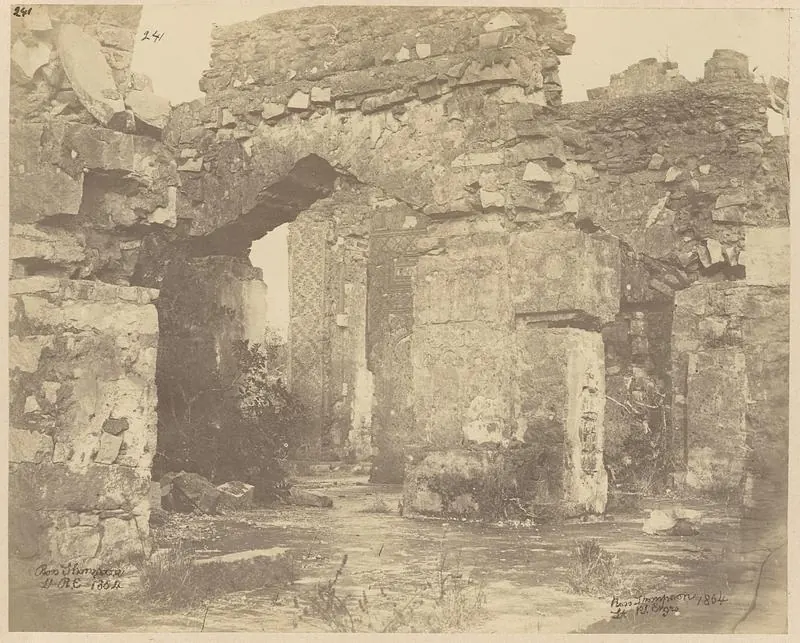
Robert Sewell described the fort in 1882: “There is a fort and handsome palace on the top of the hill.”1 The palace “was redecorated by the Mussulman governors, who called the place Mustafanagar after Mustafa, the first governor”.1 “There are lines of strong fortifications and a number of bastions on points commanding the plains. The remains are extensive.”1 Below the hill, he added, “is a second fort guarding the main approach”.1 See Kondapalli.
Date
The Imperial Gazetteer says that Kondapalli was “built about A.D. 1360 by the Reddi kings of Kondavid”.2 The Kistna manual says that the hill fort “is said to have been built” in the reign of Anuvema Reddi.3 Sewell thought the fort did not exist in the tenth century.1 He thought it “probably dates from about the fourteenth century when the Reddis were in power”.1 A correspondent of his gave the dates of its completion as 1334 (the first figure is unclear in the print) to 1362.1
M. Somasekhara Sarma says that Peda Komati Vema’s brother Macha fortified Kondapalli.4 Macha did this when he received the country north of the Krishna, in the early fifteenth century.4 An inscribed slab of 1436 is set into the first gateway of the lower fort.1 It records the building of a temple on the Krishna by a private person, and Sewell thought it had been brought from elsewhere.1 See the Reddis of Kondavidu.
Later history
The Gajapati king Purushottama gave up Kondapalli to the Bahmani sultan in 1470.56 Its Hindu inhabitants revolted and killed the Muslim governor.56 The sultan retook it about 1477–78.56 The Godavari gazetteer says that Kondapalli’s temple (it does not name it) was then destroyed, its Brahman priests were killed and a mosque was built on the site.6
Later the fort was taken again several times:2
- by Krishnadeva Raya about 15152
- by Sultan Quli Qutb Shah in 15312
- by the troops of Aurangzeb in 16872
- by General Caillaud in 17662
Sewell recorded an inscription of 1528 or 1530 on the boundary of Kondapalli and Malkapuram.7 It is about a grant made by a Muslim “overjoyed at the capture of Kondapalle”.7
Footnotes
-
Robert Sewell, Lists of the Antiquarian Remains in the Presidency of Madras, Vol. I (1882), p. 49 (archive.org (opens in a new tab)). ↩ ↩2 ↩3 ↩4 ↩5 ↩6 ↩7 ↩8 ↩9
-
Imperial Gazetteer of India: Madras, Vol. I (1908), p. 323 (archive.org (opens in a new tab)). ↩ ↩2 ↩3 ↩4 ↩5 ↩6
-
Gordon Mackenzie, A Manual of the Kistna District (1883), p. 10 (archive.org (opens in a new tab)). ↩
-
M. Somasekhara Sarma, History of the Reddi Kingdoms (1948), p. 158 (archive.org (opens in a new tab)). ↩ ↩2
-
F. R. Hemingway, Madras District Gazetteers: Godavari, Vol. I (1907), p. 26 (archive.org (opens in a new tab)). ↩ ↩2 ↩3
-
Hemingway, Godavari (1907), p. 27 (archive.org (opens in a new tab)). ↩ ↩2 ↩3 ↩4
-
Sewell, Lists of the Antiquarian Remains, Vol. I (1882), p. 50 (archive.org (opens in a new tab)). ↩ ↩2
Photos
References
Notes (0)
Sources (5)
Spotted an error on this page? Tell us
Last updated: