Shitab Khan's hall, Warangal
Tall roofless stone hall in Warangal fort, near the western gateway of the old central temple. It is named after the chief Shitab Khan, who held Warangal from 1504. The Hyderabad Archaeological Department conserved it in 1925–26. It compared the hall with the Hindola Mahal at Mandu and thought it built about the turn of the fifteenth and sixteenth centuries. The hall is 86 feet by 24, with cross arches 28 feet high that once carried a flat vault, sloping walls, a cistern in the floor and a tall arched entrance on the north.
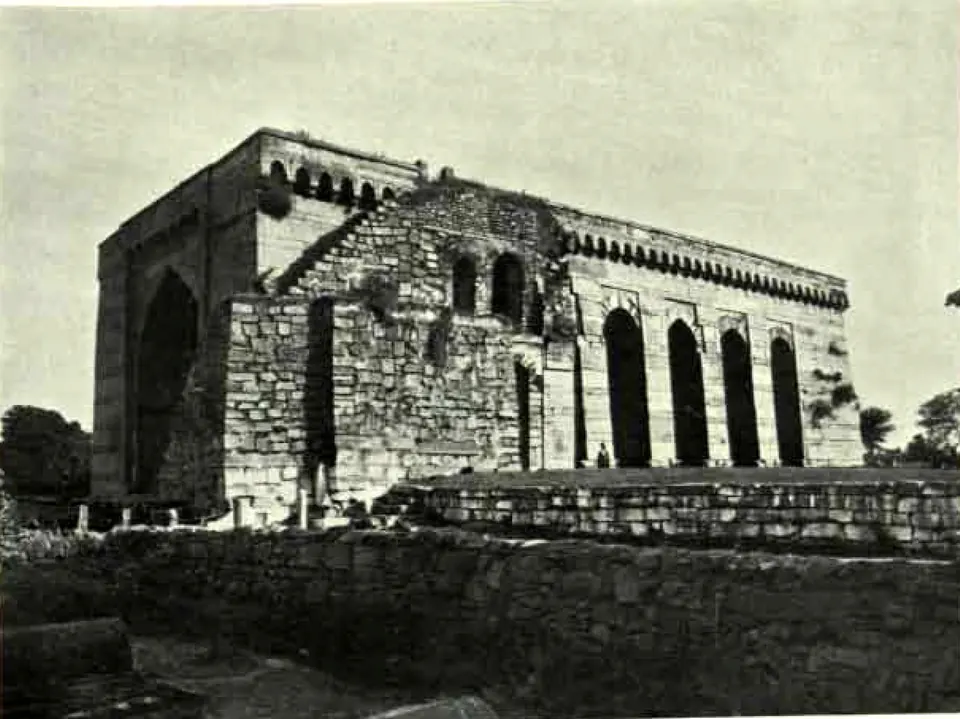
The hall stands inside Warangal Fort. Hirananda Sastri (1932), following G. Yazdani, describes “a Darbar Hall of Shitab Khan still standing in the fort of Warangal” (a hall for holding court).1 He calls it “a spacious building of the true Pathan style which stands near the Western Gateway of the Central Shrine in the Fort”.1 He took its survival as a sign “that this man of fortune must have won the chieftainship or kingship attributed to him” in his inscription.1 See Shitab Khan (Sitapati) and Shitab Khan of Warangal.
The building
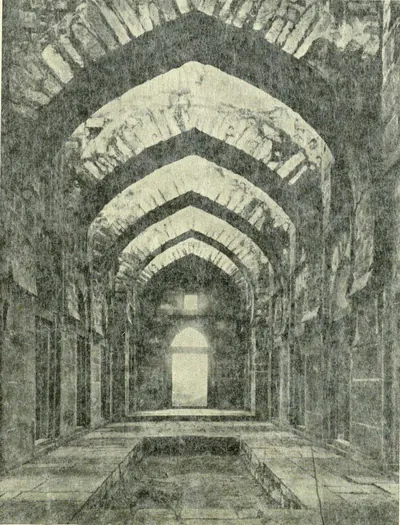
The Archaeological Department’s report for 1925–26 says that “this hall in its architectural style is an exact replica of the well-known Hindola Mahal of Mandu”.2 It adds that the hall “is a little smaller in dimensions than the latter”.2 The hall measures 86 feet by 24 feet.2 Arches built along its length rise to a height of 28 feet.2 They “once supported the ceiling which has fallen down now”.2
Like the Mandu building, the roof “appears” to have been a flat vault.2 The vault, “not having been built on sound principles”, fell soon after it was built.2
The walls are 36 feet 10 inches high.2 They slope outwards towards the base, where they are 20 feet thick.2 There are arched openings in the sides, with windows above them.2 The report found “the bold arched cornice, supported on stone brackets and built on the exterior of the building” “very striking”.2
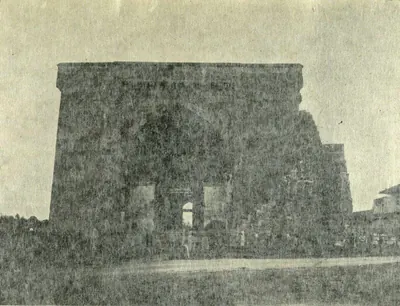
The hall stands on a platform 7½ feet high.2 The report says that “the main access to the building was from the north where a lofty arch has been built”.2 The facing stones are laid in alternate courses of different widths, “a device” also used at Mandu.2 A cistern, 31 feet 6 inches by 10, lies in the middle of the floor.2
Date and builder
The report thought it “not unlikely that it was built by an architect who was familiar with” the Hindola Mahal.2 It explained that “at the end of the fifteenth century and the beginning of the sixteenth century there was considerable intercourse between Malwa and the Deccan” (much contact).2 It concluded that “Shitab Khan’s hall seems to have been constructed about that time”.2 Shitab Khan’s own inscription dates his capture of Warangal to 21 January 1504.3
A Telugu local history, the Ekasilanagara kaifiyat (village record), tells of the palace.45 It says that Shitab Khan “built a very high palace for himself to the west of the temple of Pattasavedi-Sambhu-lingadu and to the south of the tank”.45 It calls the palace the khas-mahal.45 It also says he finished the Kakatiya stone fort with stones from ruined temples.45 Sastri treated this kaifiyat with caution.45 See the inscription of 1504.
Conservation
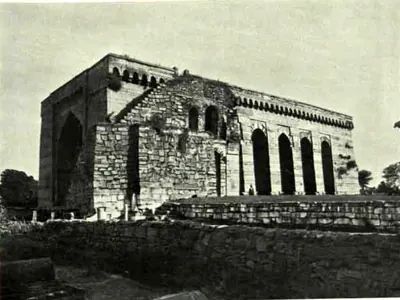
In 1925–26 “the audience-hall of Shitab Khan” was “thoroughly conserved”.2 The cistern was cleared, and the rubble that filled the openings was removed.2 The floor was repaired.2 A barbed-wire fence was put up “for protection against cattle and other undesirable intruders”.2 The report and Sastri’s monograph illustrate the hall from the front, the inside and the north-west.67 See Warangal.
Footnotes
-
Hirananda Sastri, Shitab Khan of Warangal (Hyderabad Archaeological Series No. 9, 1932), p. 2 (archive.org (opens in a new tab)). ↩ ↩2 ↩3
-
Annual Report of the Archaeological Department of H.E.H. the Nizam’s Dominions, 1925–26 (1928), p. 11 (archive.org (opens in a new tab)). ↩ ↩2 ↩3 ↩4 ↩5 ↩6 ↩7 ↩8 ↩9 ↩10 ↩11 ↩12 ↩13 ↩14 ↩15 ↩16 ↩17 ↩18 ↩19 ↩20 ↩21 ↩22
-
Sastri, Shitab Khan of Warangal (1932), p. 13 (archive.org (opens in a new tab)). ↩
-
Sastri, Shitab Khan of Warangal (1932), p. 9 (archive.org (opens in a new tab)). ↩ ↩2 ↩3 ↩4 ↩5
-
Sastri, Shitab Khan of Warangal (1932), p. 10 (archive.org (opens in a new tab)). ↩ ↩2 ↩3 ↩4 ↩5
-
Hyderabad Archaeological Report, 1925–26 (1928), Plates XIV (b) and XV (archive.org (opens in a new tab)). ↩
-
Sastri, Shitab Khan of Warangal (1932), Plate II (archive.org (opens in a new tab)). ↩
Photos
References
Notes (0)
Sources (2)
Spotted an error on this page? Tell us
Last updated: