Padmakshi Temple, Hanamkonda
A small, plain temple on the hill south of Hanamkonda, now worshipped as the goddess Padmakshi. The inscribed pillar in front of it records that in December 1117, in the reign of the Kakatiya Prola II, Mailama, wife of the minister Beta, built a Jaina temple, the Kadalalaya-basadi, on the hill. H. Krishna Sastri took the temple to be that basadi and called it the earliest known building of the Kakatiya period.
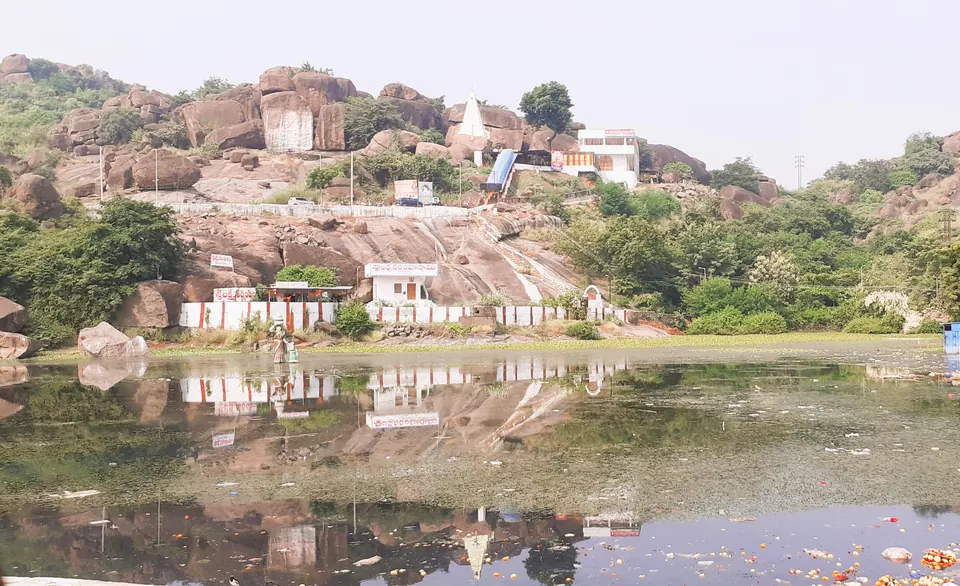
The Padmakshi temple stands on a hillock south of Hanamkonda, the old Kakatiya capital Anumakonda.1 H. Krishna Sastri published its inscription in Epigraphia Indica in 1908.12 He described it as a small temple “devoid of any architectural pretensions” (without any show of architecture), unlike the other buildings of the Kakatiya period.12 The rock beside it is carved with a row of seated Jaina figures.12
The pillar and the basadi
In front of the temple stands a four-sided pillar of black granite.2 At the top of each face, in a sunk square, sits a Jaina ascetic with crossed arms.2 On the east face he has a cow and calf on one side and a dagger and shield on the other.2 On the north face he has the sun and moon.2 Its Kannada inscription opens with an invocation to the Jina. It names the Western Chalukya emperor Vikramaditya VI as overlord and Kakati Beta as his feudatory, “the lord of Anmakunda”.3
The inscription goes on to say that Mailama built the Kadalalaya-basadi on top of the hill.34 She was the wife of Beta, a minister of Kakati Prola and son of the minister Vaija.34 The day of the gift was the winter solstice in the Chalukya-Vikrama year 42.4 F. Kielhorn calculated this as Monday, 24 December 1117, while Prola II ruled at Anmakonda.4 On that day she gave land below a tank that her husband had named after her, and set up the pillar.4 The record is described further on the page for the inscription.
From the sculptures and the inscription, Krishna Sastri concluded that the temple was first dedicated to a Jaina goddess called Kadalalaya.2 He thought the lady who built the basadi (Jain temple) had set up the pillar.2 He suggested that the goddess was a Jaina sasanadevi (guardian goddess) such as Ambika or Padmavati.2
In his time the Brahmans of Anmakonda held the temple.2 They worshipped the goddess as Padmakshi, whom they took to be Durga.2 He could not tell how or when the temple had passed from the Jainas to them.2
P. V. Parabrahma Sastry, writing in 1978, likewise took the Hindu goddess Padmakshi to have been a Jaina goddess in Prola II’s time, perhaps Padmavati.5 He cited this inscription and the Jaina images in the shrine as evidence that the early Kakatiyas followed Jainism.5
The earliest Kakatiya building
Krishna Sastri called the Padmakshi temple “the earliest known structural monument of the Kakatiya period”.2 He thought its age might explain why it lacks the rich carving of the dynasty’s later buildings.2 Henry Cousens, in 1900, had listed the same inscription as standing “on a pillar in front of the temple of Padmakshi in the town”.6 He took it for an incomplete record of the Western Chalukya king Tribhuvanamalla.6
Parabrahma Sastry names the Padmakshi temple on the hill among the chief shrines of Anumakonda.7 He also states that Gangadhara, a minister of Rudradeva later in the twelfth century, built a Jaina basadi on the Padmakshi hill.8 He does not say whether this was the same building as Mailama’s.8
S. Gopalakrishna Murthy, writing in 1964, thought part of the shrine was older than Mailama.9 The sanctum is a recess between an upright and a leaning boulder.9 Life-size figures of a Tirthankara, probably Parsvanatha, and his attendant yaksha and yakshi are carved on the eastern rock.9 From their size and style, and from two small unfinished caves west of the temple, he judged that these went back to Rashtrakuta times.9
Mailama, he concluded, added the tower, the hall north of the sanctum and the reliefs on the western rock.9 He noted that some scholars identify a nobleman and a lady carved beside one Parsvanatha as Beta and Mailama.9
Footnotes
-
H. Krishna Sastri, “Anmakonda Inscription of Prola; the Chalukya-Vikrama Year Forty-Two”, Epigraphia Indica IX (1908), p. 256 (archive.org (opens in a new tab)). ↩ ↩2 ↩3 ↩4
-
Krishna Sastri, “Anmakonda Inscription of Prola” (1908), p. 257 (archive.org (opens in a new tab)). ↩ ↩2 ↩3 ↩4 ↩5 ↩6 ↩7 ↩8 ↩9 ↩10 ↩11 ↩12 ↩13 ↩14 ↩15
-
Krishna Sastri, “Anmakonda Inscription of Prola” (1908), p. 258 (archive.org (opens in a new tab)). ↩ ↩2 ↩3
-
Krishna Sastri, “Anmakonda Inscription of Prola” (1908), p. 259 (archive.org (opens in a new tab)). ↩ ↩2 ↩3 ↩4 ↩5
-
P. V. Parabrahma Sastry, The Kakatiyas of Warangal (1978), p. 24 (archive.org (opens in a new tab)). Cite-only; paraphrased. ↩ ↩2
-
Henry Cousens, Lists of Antiquarian Remains in His Highness the Nizam’s Territories (1900), p. 48 (archive.org (opens in a new tab)). ↩ ↩2
-
Parabrahma Sastry, The Kakatiyas of Warangal (1978), p. 282 (archive.org (opens in a new tab)). Cite-only; paraphrased. ↩
-
Parabrahma Sastry, The Kakatiyas of Warangal (1978), p. 167 (archive.org (opens in a new tab)). Cite-only; paraphrased. ↩ ↩2
-
S. Gopalakrishna Murthy, The Sculpture of the Kakatiyas (Andhra Pradesh Government Archaeological Series 34, n.d.; preface dated 1964), p. 9 and fig. 7 (archive.org (opens in a new tab)). Public domain in India; paraphrased. ↩ ↩2 ↩3 ↩4 ↩5 ↩6
Photos
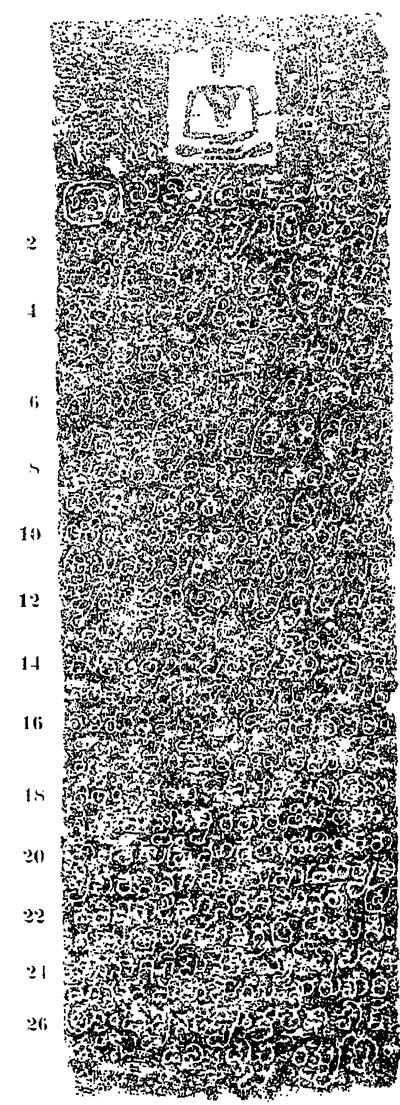 "Anmakonda Inscription of Prola; The Chalukya-Vikrama Year Forty-Two", east face (Epigraphia Indica IX, plate between pp. 262 and 263 (PDF p. 326))Inscription rubbing · 1908
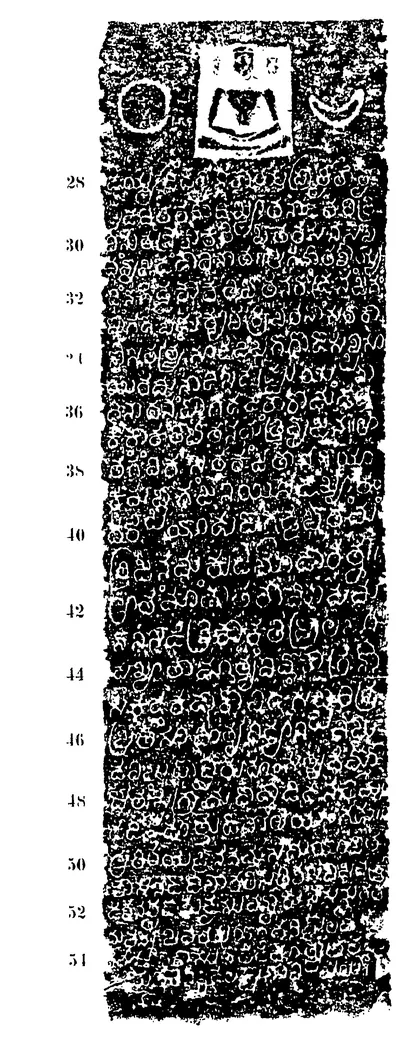 "Anmakonda Inscription of Prola; The Chalukya-Vikrama Year Forty-Two", north face (Epigraphia Indica IX, plate between pp. 262 and 263 (PDF p. 326))Inscription rubbing · 1908
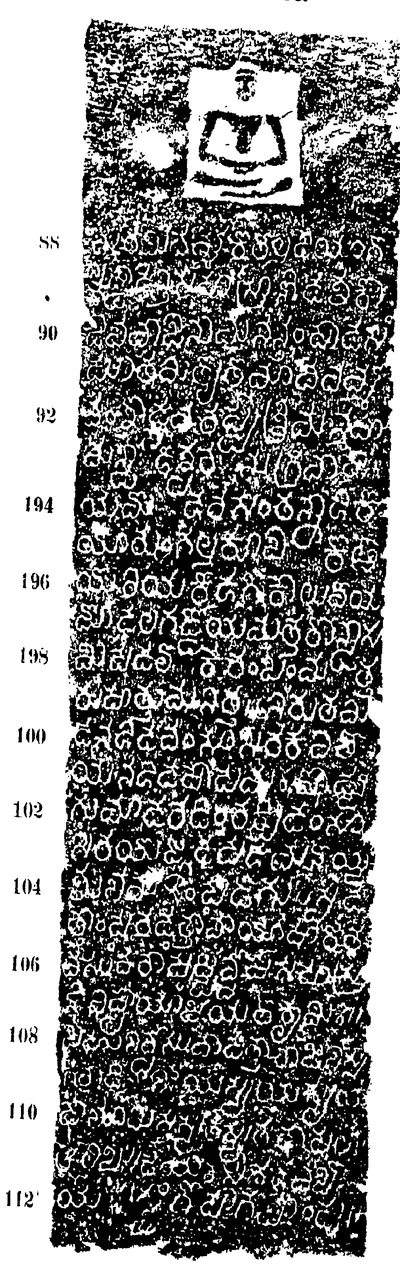 "Anmakonda Inscription of Prola; The Chalukya-Vikrama Year Forty-Two", south face (Epigraphia Indica IX, plate between pp. 262 and 263 (PDF p. 327))Inscription rubbing · 1908
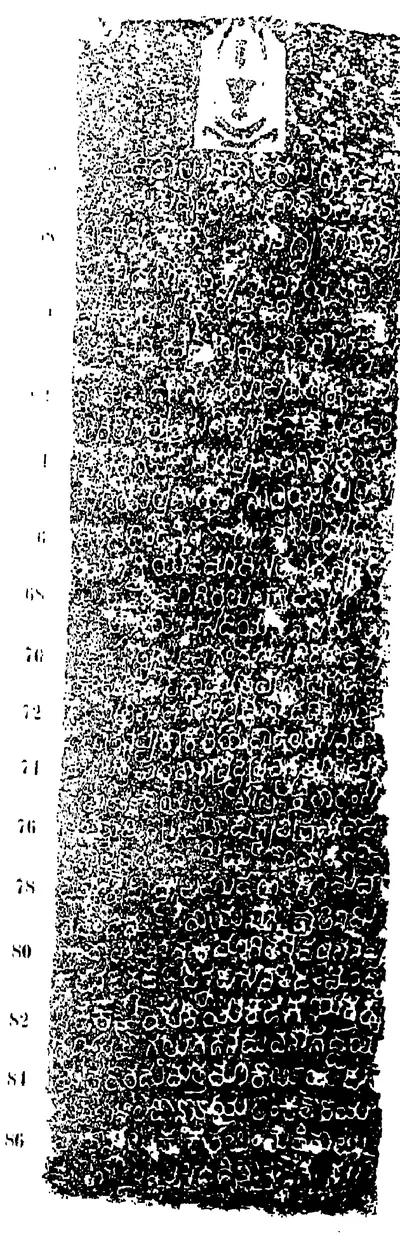 "Anmakonda Inscription of Prola; The Chalukya-Vikrama Year Forty-Two", west face (Epigraphia Indica IX, plate between pp. 262 and 263 (PDF p. 327))Inscription rubbing · 1908
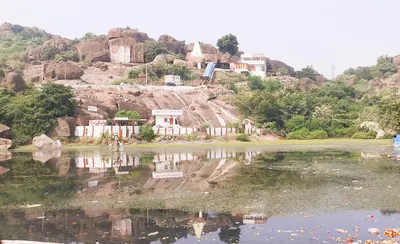 Padmakshi hill, HanamkondaPhotograph · 2023
References
Notes (0)
Sources (4)
Spotted an error on this page? Tell us
Last updated: