Ramappa Lake
The large reservoir at Palampet beside which the Ramappa (Rudreshvara) temple stands. P. V. Parabrahma Sastry, following the temple's inscription of 1213, gives it to the Kakatiya general Recherla Rudra, who probably built it together with the temple. Hyderabad's Archaeological Department counted it among the great tanks of the Kakatiya rulers.
Ramappa Lake lies near Palampet in the old Mulug taluk of Warangal district, about 65 km from Warangal.1 Henry Cousens described it in 1900 as “the large Ramappa Lake”, a couple of miles south of Palampet.2 A group of richly decorated temples stands on its further side.2 The chief of these temples, the Rudreshvara, is now known as the Ramappa temple.2
Builder and date
The inscribed pillar at the temple records a gift by the general Recherla Rudra, a dependant of the Kakatiya king Ganapatideva.3 He gave villages to the god Rudreshvara in Saka 1135 (Saka is an Indian way of counting years).3 L. D. Barnett calculated this date as 31 March 1213 (see the Palampet inscription).3 The same inscription describes a city that Rudra founded, with a temple of Rudreshvara and a pond beside it.4
Parabrahma Sastry’s view
P. V. Parabrahma Sastry wrote in 1978.1 On the authority of this inscription, he states that Recherla Rudra dug the lake in Saka 1135 (1213 CE).1 He thinks this was probably at the same time as the temple was built.1 He describes the temple as standing beside the great lake called Ramappa-cheruvu.5 He gives the lake as about 8 square miles in extent.5
Gopalakrishna Murthy’s view
S. Gopalakrishna Murthy, writing in 1964, saw the order of work differently.67 He thought the tank came first.67 In his account Ganapatideva gave Recherla Rudra a large fief (land held from the king) north-east of Warangal.67 Rudra built the tank by contour bunding (banks built along the slope of the land) and founded a town, Atkur, near it.67 The Shiva temples on and near the bund followed.67
Murthy reasoned that so large a tank must have taken a long time.67 For this reason, he thought, the temple was not dedicated until 1213.67 He also gives the two temples at either end of the bund to Rudra.8
A Kakatiya work
In its report for 1932–33 the Hyderabad Archaeological Department named the large tanks “at Pakhal, Palampet and other places” as monuments of the Kakatiya dynasty.9 It named them together with the forts and temples as signs of the dynasty’s “remarkable constructive skill”.9 The Imperial Gazetteer of 1909 lists the Ramappa tank among the chief tanks of Warangal district.10 It adds that some of them were then in disrepair.10
The bund and its channels
According to Parabrahma Sastry, the bund is 2,000 feet long and 56 feet high, with 35 feet of water above the silt.1 Four channels, between about 2½ and 5½ miles long, carry its water.1 The tank irrigates some 4,350 acres.1
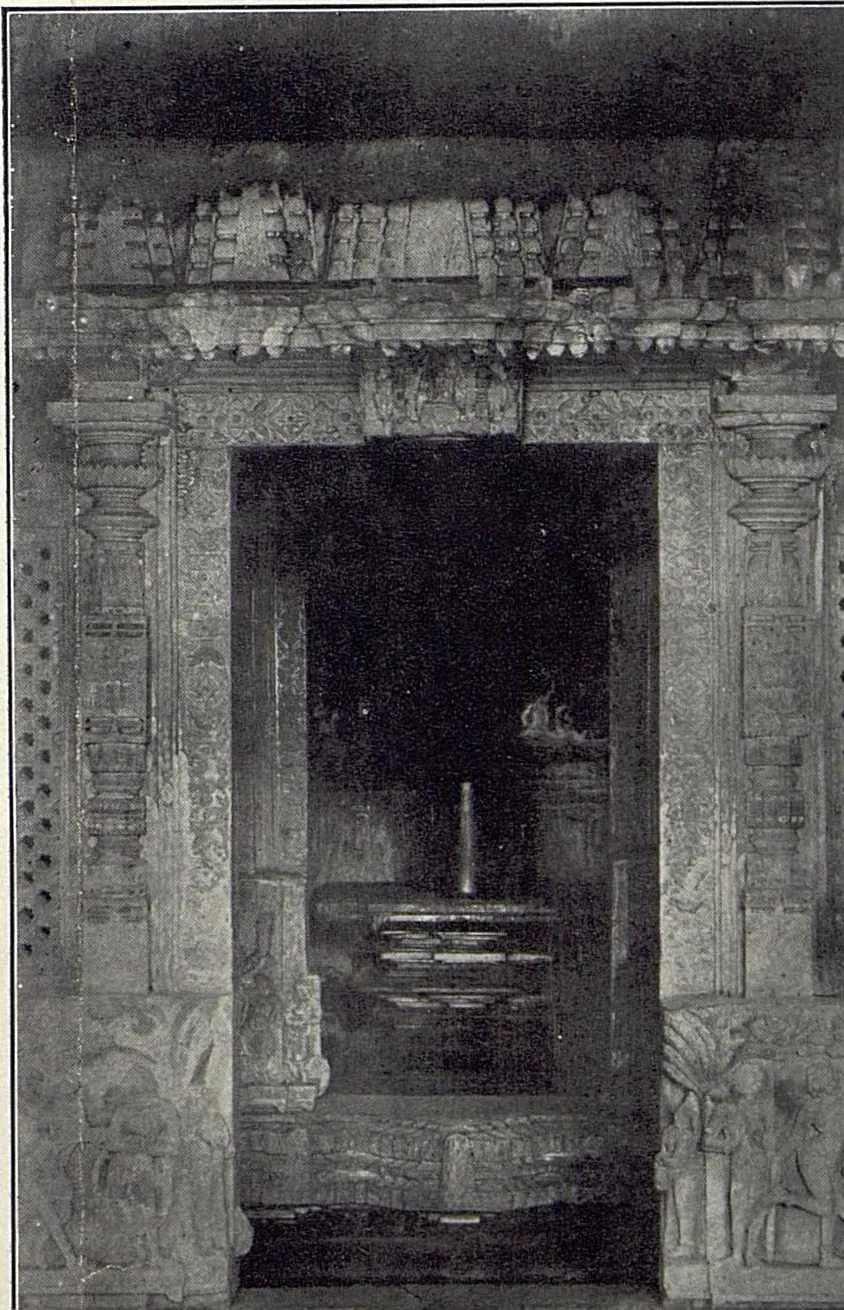
Small temples stand at either end of the bund.8 G. Yazdani photographed them for his 1922 memoir on the Palampet temples.11 His plates show the inside of one at the eastern end and the doorway of one at the western end.11
Footnotes
-
P. V. Parabrahma Sastry, The Kakatiyas of Warangal (1978), p. 205 (archive.org (opens in a new tab)). Cite-only; paraphrased. ↩ ↩2 ↩3 ↩4 ↩5 ↩6 ↩7
-
Henry Cousens, Lists of Antiquarian Remains in His Highness the Nizam’s Territories (1900), p. 49 (archive.org (opens in a new tab)). ↩ ↩2 ↩3
-
L. D. Barnett (ed.), Inscriptions at Palampet and Uparpalli (1919), pp. v, 2 (archive.org (opens in a new tab)). ↩ ↩2 ↩3
-
Barnett, Inscriptions at Palampet and Uparpalli (1919), pp. 10–11 (archive.org (opens in a new tab)). ↩
-
Parabrahma Sastry, The Kakatiyas of Warangal (1978), p. 301 (archive.org (opens in a new tab)). Cite-only; paraphrased. ↩ ↩2
-
S. Gopalakrishna Murthy, The Sculpture of the Kakatiyas (Andhra Pradesh Government Archaeological Series 34, n.d.; preface dated 1964), p. 20 (archive.org (opens in a new tab)). Public domain in India; paraphrased. ↩ ↩2 ↩3 ↩4 ↩5 ↩6 ↩7
-
S. Gopalakrishna Murthy, The Sculpture of the Kakatiyas (Andhra Pradesh Government Archaeological Series 34, n.d.; preface dated 1964), p. 21 (archive.org (opens in a new tab)). Public domain in India; paraphrased. ↩ ↩2 ↩3 ↩4 ↩5 ↩6 ↩7
-
S. Gopalakrishna Murthy, The Sculpture of the Kakatiyas (Andhra Pradesh Government Archaeological Series 34, n.d.; preface dated 1964), p. 27 (archive.org (opens in a new tab)). Public domain in India; paraphrased. ↩ ↩2
-
Annual Report of the Archaeological Department of H.E.H. the Nizam’s Dominions for the year 1342 Fasli (1932–33), bound with the report for 1931–32 (1935), p. 66 (archive.org (opens in a new tab)). ↩ ↩2
-
Imperial Gazetteer of India, Provincial Series: Hyderabad State (1909), p. 166 (archive.org (opens in a new tab)). ↩ ↩2
-
G. Yazdani, The Temples at Palampet, Memoirs of the Archaeological Survey of India 6 (1922), Plates XXVII (b) and XXVIII (c) (archive.org (opens in a new tab)). ↩ ↩2
Photos
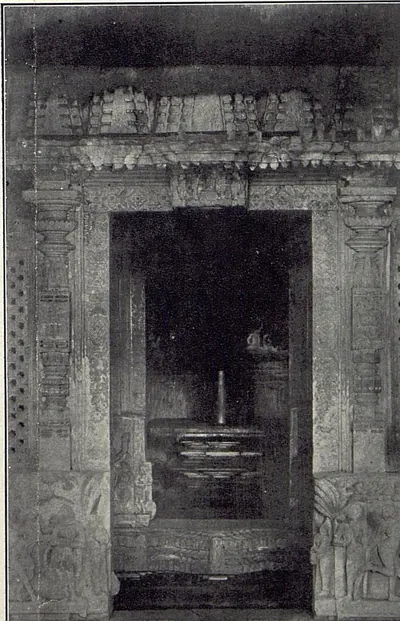 Doorway of Temple at the western end of the Ramappa Lake Band, Palampet (Yazdani 1922, Pl. XXVIII (c))Historic photograph · 1922
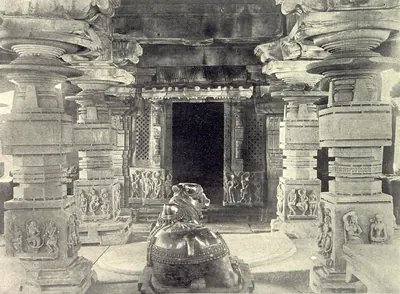 Interior of Temple at the eastern end of the Ramappa Lake Band, Palampet (Warangal) (Yazdani 1922, Pl. XXVII (b))Historic photograph · 1922
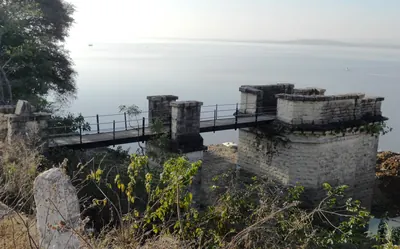 Masonry tower on Ramappa LakePhotograph · 2015
References
Notes (0)
Sources (7)
Spotted an error on this page? Tell us
Last updated: