Somesvara temple, Somarama (Bhimavaram)
Two-storeyed Shiva temple at Gunupudi, now Somaram in the town of Bhimavaram in the western Godavari delta. M. Rama Rao (1964) counted it among the five Pancharama shrines and gave it to the Eastern Chalukya king Chalukya-Bhima I. Robert Sewell recorded it in 1882 as a very old temple of Somesvara, said to be one of the five aramas. The Godavari gazetteer of 1907 left it out of its list of the five.
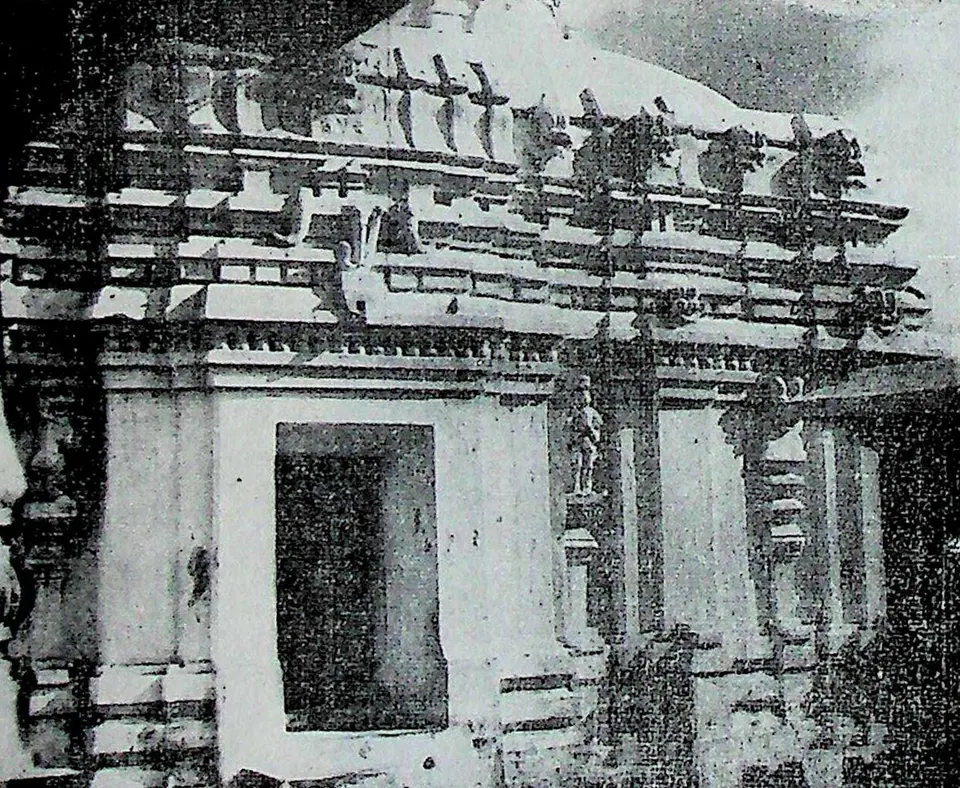
The Somesvara temple stands just behind the railway station of Bhimavaram, in the western Godavari delta. M. Rama Rao described it in 1964.1 He wrote that Somarama, one of the five famous aramas (Pancharama shrines) of the Telugu country, was then called Somaram.1 It formed part of the village of Bhimavaram in West Godavari district.1 This Bhimavaram is not the Chalukya-Bhimavaram near Samalkot, where the temple of the fourth arama stands.2
Name and legend
Rama Rao took a version of the Pancharama legend from the Skanda Purana.2 In it Shiva cut the linga (stone emblem of Shiva) of the Tripura demons into five pieces.2 Soma, the moon, set up one of them on the bank of the Godavari at the village of Gunupidi.2 It became Somesvara of Somarama.2
Robert Sewell’s list of 1882 recorded “a very old temple of Somesvarasvami” of considerable size at Gunupudi, half a mile east of Bhimavaram.3 He added that the place was said to be the “Pancha Rama Kshetra” described in the Bhima-khanda of the Skanda Purana.3 Rama Rao’s own preface gives the modern name of Somarama as Somavaram, not Somaram.4
Where the sources disagree
Not every source counts this temple among the five. The Godavari district gazetteer of 1907 named the five places as Bhimavaram (Chalukya-Bhimavaram) near Kakinada (then Cocanada), Draksharama, Amaravati, Palakollu and a “Kumara-rama” that it could not identify.56 It did not mention Somarama or Gunupudi.56 Rama Rao identified Kumararama with Chalukya-Bhimavaram and made Somarama the fifth.42 See Bhimesvara temple, Chalukya-Bhimavaram.
Who built it?
Rama Rao credited the Eastern Chalukya king Chalukya-Bhima I with the Shiva shrines at all five Pancharamas, Somarama among them.4 He gave that king the dates 892–922.78 This site follows J. F. Fleet and Robert Sewell, who put his reign at 888–918.78
Rama Rao’s chapter on the temple gives no inscriptions and does not discuss its date or builder.1 Sewell’s list of 1882 records no inscriptions there.3 So the attribution to the Eastern Chalukyas rests on Rama Rao’s general statement and on the likeness he saw to the other two-storeyed temples.41
The building
The temple faces east inside a walled compound.1 In front of it is a tall stone pillar topped by a Nandi, and behind it is a large tank with another Nandi pillar in the middle.1 The single entrance to the compound has a short modern gopura (gate tower).1
Rama Rao described the temple as a two-storeyed building like those at Draksharama, Chalukya-Bhimavaram and Amaravati.1 Its base is unusual, in two sections tied together by broad upright bands.1 Each wall of the ground floor has a doorway with pilasters on either side.1 Above it is a cornice with lion-face gables, and a row of miniature roof forms runs along the edge of the roof.1
A large modern hall stands in front of the porch, which has four Chalukyan pillars.1 The ground-floor sanctum holds a granite linga, and the upper floor has an open hall, a narrow corridor and a sanctum with an image of the goddess Annapurna.1 The small shrines of Kumara, Hanuman and Surya in the courtyard seemed to him modern.1
Footnotes
-
Rama Rao, Eastern Calukyan Temples (1964), p. 41 (archive.org (opens in a new tab)). ↩ ↩2 ↩3 ↩4 ↩5 ↩6 ↩7 ↩8 ↩9 ↩10 ↩11 ↩12 ↩13 ↩14 ↩15
-
Rama Rao, Eastern Calukyan Temples (1964), p. 16 (archive.org (opens in a new tab)). ↩ ↩2 ↩3 ↩4 ↩5 ↩6
-
Robert Sewell, Lists of the Antiquarian Remains in the Presidency of Madras, Vol. I (1882), p. 39, Bhimavaram taluk, s.v. Gunupudi (archive.org (opens in a new tab)). ↩ ↩2 ↩3
-
M. Rama Rao, Eastern Calukyan Temples of Andhra Desa (1964), preface (unnumbered) (archive.org (opens in a new tab)). ↩ ↩2 ↩3 ↩4
-
F. R. Hemingway, Madras District Gazetteers: Godavari (1907), p. 207 (archive.org (opens in a new tab)). ↩ ↩2
-
Hemingway, Godavari (1907), p. 250 (archive.org (opens in a new tab)). ↩ ↩2
-
Rama Rao, Eastern Calukyan Temples (1964), p. 1 (archive.org (opens in a new tab)). ↩ ↩2
-
Robert Sewell and S. Krishnaswami Aiyangar, The Historical Inscriptions of Southern India (1932), p. 337, pedigree and notes (archive.org (opens in a new tab)). ↩ ↩2
Photos
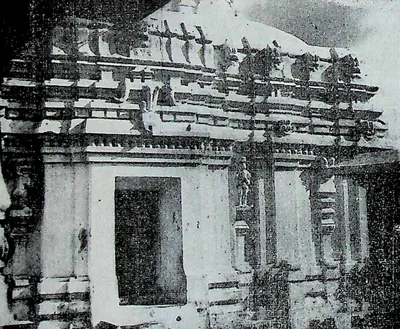 "38. South Wall - Sōmēśvara Temple - Sōmārāma" (M. Rama Rao, Eastern Calukyan Temples of Andhra Desa, 1964, Fig. 38 (PDF p. 107))Historic photograph · 1964
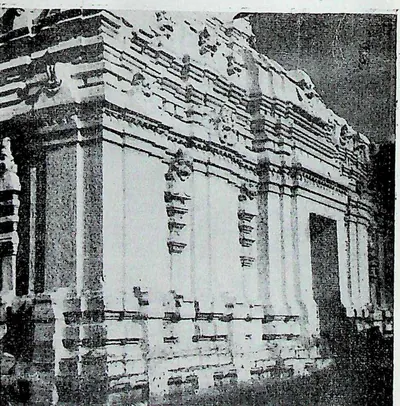 "39. East & North Wall - Sōmēśvara Temple - Sōmārāma" (M. Rama Rao, Eastern Calukyan Temples of Andhra Desa, 1964, Fig. 39 (PDF p. 109))Historic photograph · 1964
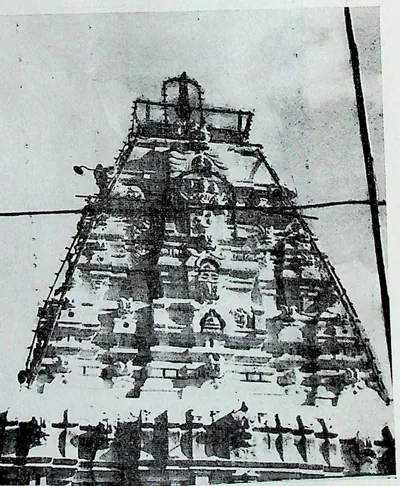 "40. Vimāna - Sōmēśwara Temple - Sōmārāma, Bhimavaram, W. G. Dt." (M. Rama Rao, Eastern Calukyan Temples of Andhra Desa, 1964, Fig. 40 (PDF p. 111))Historic photograph · 1964
References
Notes (0)
Sources (4)
Spotted an error on this page? Tell us
Last updated: